Vorbesteller
Neu
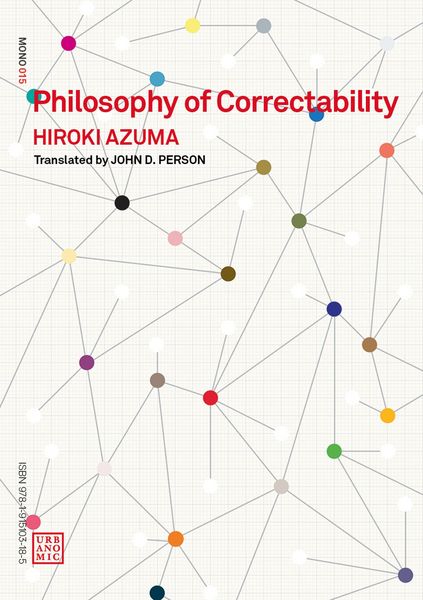
Philosophy of Correctability
-
- Taschenbuch
- eBook ausgewählt
-
Form:Einzelkauf Download
-
Sprache:Englisch
Fr. 32.90
inkl. gesetzl. MwSt.Artikel erhalten
Beschreibung
Produktdetails
Format
ePUB
Kopierschutz
Ja
Family Sharing
Ja
Text-to-Speech
Ja
Erscheinungsdatum
16.09.2026
Verlag
MIT PressSeitenzahl
400 (Printausgabe)
Übersetzt von
John D. Person
Sprache
Englisch
EAN
9781915103239
A profound rethinking of the political categories of openness and closedness.
In a new work building upon his Philosophy of the Tourist, Hiroki Azuma reconsiders the connection between the figure of the tourist and that of the family. Setting out from the reevaluation of the family as a figure of containment following the COVID-19 pandemic, in this exploration of the inside and outside of community, Azuma questions the shifting values of openness and security, challenging the distinction between the openness of civil society and the closedness of the family, which he deciphers as an artefact of a Western philosophical standpoint in which polis is opposed to oikos.
Via Wittgenstein's notion of family resemblance and Kripke's interpretation of language games, Azuma develops a new concept of the family as a closed unit that is paradoxically open to drastic transformations of its own rules of inclusion. The tourist, an anomaloous agent that escapes Carl Schmitt's opposition between friend and enemy, can then be reinterpreted as a familial figure.
In this subtle rethinking of some of the most fundamental categories of modern political economy, the topology of the open society is reconfigured beyond the opposition between conservatism and liberalism: through close readings of Rorty and Arendt, Azuma sketches out a new vision of an open polis supported by the transformative sustainability of the oikos.
In a new work building upon his Philosophy of the Tourist, Hiroki Azuma reconsiders the connection between the figure of the tourist and that of the family. Setting out from the reevaluation of the family as a figure of containment following the COVID-19 pandemic, in this exploration of the inside and outside of community, Azuma questions the shifting values of openness and security, challenging the distinction between the openness of civil society and the closedness of the family, which he deciphers as an artefact of a Western philosophical standpoint in which polis is opposed to oikos.
Via Wittgenstein's notion of family resemblance and Kripke's interpretation of language games, Azuma develops a new concept of the family as a closed unit that is paradoxically open to drastic transformations of its own rules of inclusion. The tourist, an anomaloous agent that escapes Carl Schmitt's opposition between friend and enemy, can then be reinterpreted as a familial figure.
In this subtle rethinking of some of the most fundamental categories of modern political economy, the topology of the open society is reconfigured beyond the opposition between conservatism and liberalism: through close readings of Rorty and Arendt, Azuma sketches out a new vision of an open polis supported by the transformative sustainability of the oikos.
Kundinnen und Kunden meinen
Verfassen Sie die erste Bewertung zu diesem Artikel
Helfen Sie anderen Kund*innen durch Ihre Meinung