Produktbild: Handbook of Learning Disabilities

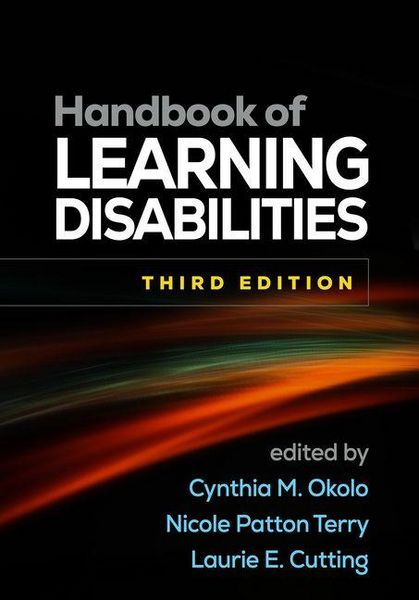
Handbook of Learning Disabilities

Fr. 133.00

inkl. gesetzl. MwSt., Versandkostenfrei


Beschreibung

Produktdetails

Einband

Gebundene Ausgabe

Erscheinungsdatum

30.03.2026

Herausgeber

Cynthia M. Okolo + weitere

Verlag

Taylor and Francis

Seitenzahl

588

Maße (L/B/H)

25.4/17.8/3.3 cm

Gewicht

1266 g

Auflage

3rd edition

Sprache

Englisch

ISBN

978-1-4625-5907-7

Beschreibung

Portrait

Cynthia M. Okolo, PhD, is Professor Emeritus of Counseling, Educational Psychology, and Special Education at Michigan State University. Her research focuses on technology and literacy for students with mild disabilities, universal design for learning, and history instruction for students with learning challenges. Dr. Okolo is a former special education teacher, and her scholarship is rooted in applied issues related to instruction in inclusive classrooms. She has played a leadership role in numerous state, regional, and national boards and organizations, has directed undergraduate, master's, and doctoral programs, and has been a frequent contributor to the scholarly literature as an author and editor. Dr. Okolo is a recipient of the Lifetime Achievement Award from the Council for Exceptional Children.

Laurie E. Cutting, PhD, is the Patricia and Rodes Hart Professor of Neuroscience in the Departments of Special Education, Psychology and Human Development, Radiology, Pediatrics, and Electrical and Computer Engineering at Vanderbilt University. She is also Associate Director of the Vanderbilt Kennedy Center, a member of the Vanderbilt Brain Institute, and training faculty for Vanderbilt's Neuroscience PhD program, and was the recipient of the 2017-2018 Joe B. Wyatt Distinguished University Professorship. Dr. Cutting is currently serving a two-year term as Associate Provost in the Office of the Vice Provost for Research and Innovation. Her work focuses on brain-behavior relations in children and adolescents, with a particular emphasis on academic and cognitive development.

Nicole Patton Terry, PhD, is the Olive and Manuel Bordas Professor of Education in the School of Teacher Education and Director of the Florida Center for Reading Research (FCRR) at Florida State University. She is the founding director of The Urban Child Study Center at Georgia State University and The Village at FCRR, two research entities where researchers collaborate with school and community partners to promote student success. Dr. Patton Terry's work focuses on young learners who are vulnerable to experiencing difficulty with language and literacy achievement in school, in particular, African American children, children growing up in poverty, and children with disabilities. A former special education teacher, she currently serves as president of the Society for the Scientific Study of Reading and is a Fellow of the American Speech-Language-Hearing Association and the American Educational Research Association.

Produktdetails

Einband

Gebundene Ausgabe

Erscheinungsdatum

30.03.2026

Herausgeber

Verlag

Taylor and Francis

Seitenzahl

588

Maße (L/B/H)

25.4/17.8/3.3 cm

Gewicht

1266 g

Auflage

3rd edition

Sprache

Englisch

ISBN

978-1-4625-5907-7

Herstelleradresse

Libri GmbH
Europaallee 1
36244 Bad Hersfeld
DE

Email: gpsr@libri.de

Noch keine Bewertungen vorhanden

Verfassen Sie die erste Bewertung zu diesem Artikel

Helfen Sie anderen Kundinnen und Kunden durch Ihre Meinung.

Kundinnen und Kunden meinen

Bewertungen (0)

Weitere Artikel finden Sie in

Die Leseprobe wird geladen.
  • Produktbild: Handbook of Learning Disabilities
  • I. Causes, Correlates, and Manifestations of Learning Disabilities
    1. Classification and Definition of Learning Disabilities: A Hybrid Approach to Identification, Jeremy Miciak & Jack M. Fletcher
    2. Representational Quality in Children with Dyslexia: Issues of Precision and Redundancy That Affect Long-Term Word Reading and Decoding Development, Donald L. Compton, Laura M. Steacy, Valeria M. Rigobon, Ashley A. Edwards, Nuria Gutiérrez, Nancy C. Marencin, & Rebecca M. Vasile
    3. Mathematics Learning Difficulties, Nancy C. Jordan, Dana Miller-Cotto, & Kelly-Ann Gesuelli
    4. Social and Emotional Learning and Learning Disabilities, Laura Larissa Feuerborn, Barbara A. Gueldner, & Ashli D. Tyre
    5. Cognitive Processes, Neuroscience, and Learning Disabilities, Emily M. Harriott & Laurie E. Cutting
    6. Genetics, Learning Abilities, and Disabilities, Stephen A. Petrill & Alexa Levison
    7. Executive Functions and Learning Disabilities, Marcia A. Barnes & Peng Peng
    8. Memory Difficulties in Children with Specific Learning Disabilities (An Update), H. Lee Swanson & Jennifer E. Kong
    9. Language Development, Developmental Language Disorder, and Reading Disabilities, Suzanne M. Adlof & Lesly Wade-Woolley
    10. Learning Disabilities and Comorbidity: Prevalence, Etiology, and Implications, Erik G. Willcutt
    II. Instructional Interventions
    11. Effective Instruction and Intervention for Word-Level Reading for Students with and At Risk for Learning Disabilities, Stephanie Al Otaiba, Dayna Russell-Freudenthal, & Mai W. Zaru
    12. Reading Comprehension Instruction and Students with Learning Disabilities in the Twenty-First Century, Jeanne Wanzek, Katherine Sargent, & Sally K. Fluhler
    13. Direct and Extended Vocabulary Instruction and Intervention for Students with Learning Disabilities, Michael D. Coyne & Susan M. Loftus-Rattan
    14. Intervention to Address the Needs of Students with Mathematics Learning Disabilities, Lynn S. Fuchs, Pamela M. Seethaler, Douglas Fuchs, & Daniel Espinas
    15. Writing and Students with Learning Disabilities, Steve Graham & Karen R. Harris
    16. Social Studies and History Instruction for Students with Learning Disabilities, Susan De La Paz, Daniel R. Wissinger, & Josue Otarola
    17. Science Education for Students with Learning Disabilities, Delinda van Garderen, William Romine, Heba Abdelnaby, Cassandra Smith, & Rachel Juergensen
    18. Key Practices for Preventing and Ameliorating Reading Disabilities among English Learners, Philip Capin, Tim T. Andress, & Sharon Vaughn
    III. Future Directions in Learning Disabilities
    19. Recent Trends in Dyslexia Legislation, Timothy N. Odegard, Emily A. Farris, Anna E. Middleton, Sheryl Rimrodt-Frierson, & Julie A. Washington
    20. Advances in Assessment to Monitor Progress and Performance, Matthew K. Burns, Monica E. Romero, McKinzie D. Duesenberg-Marshall, Hoi Ting Wan, & Heba Abdelnaby
    21. Child X Instruction Interactions: Using Technology to Support Differentiated Instruction, Ashley Adams Sanabria & Sarah Siegal
    22. Trends in Research Methods in the Learning Disabilities Field, Bryan G. Cook, Jesse I. Fleming, William J. Therrien, & Vivian C. Wong
    23. Beyond Demography: Integrating Mind, Culture, and Equity in LD Research, Amy L. Ferrell & Alfredo J. Artiles
    24. Integrated Multi-Tiered Systems of Support (I-MTSS): New Directions for Supporting Students with or At Risk for Learning Disabilities, Allison Gruner Gandhi, Nathan Clemens, Michael Coyne, Steve Goodman, Kathleen Lynne Lane, Erica Lembke, & Brandi Simonsen
    25. Understanding and Developing Expert Teachers for Students with Learning Disabilities, Mary T. Brownell, Melinda M. Leko, & Amber E. Benedict