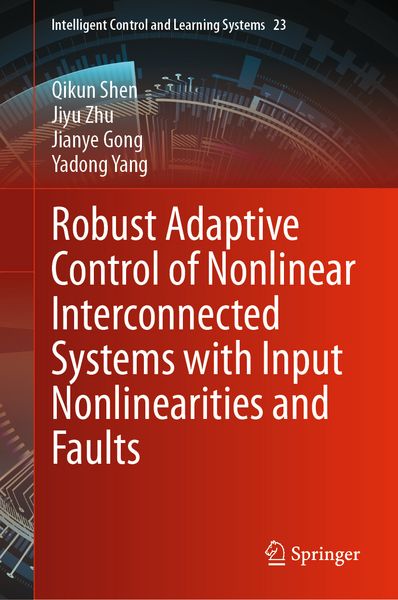
Robust Adaptive Control of Nonlinear Interconnected Systems with Input Nonlinearities and Faults
Fr. 182.00
inkl. gesetzl. MwSt.,
Beschreibung
Produktdetails
Einband
Gebundene Ausgabe
Erscheinungsdatum
14.02.2026
Abbildungen
XVII, 196 p. 1 illus.
Verlag
Springer SingaporeSeitenzahl
196
Maße (L/B/H)
24.1/16/1.8 cm
Gewicht
492 g
Auflage
1. Auflage
Sprache
Englisch
ISBN
978-981-9521-80-7
This book provides recent theoretical results and applications of the fault-tolerant control for the nonlinear interconnected systems with input nonlinearities. Combining adaptive control technique and fuzzy logic systems with other control approaches or techniques, it investigates the fault-tolerant control problem of the nonlinear interconnected systems, and constructs fault-tolerant control schemes. It intends to provide the readers a good understanding on adaptive fault-tolerant control of the nonlinear interconnected systems with input nonlinearities. This book can serve as a reference for the main research issues and results on nonlinear interconnected systems with input nonlinearities for researchers devoting to various areas of fault-tolerant control theory, as well as a material for graduate and undergraduate students interested in nonlinear system control, especially fault-tolerant control, and their applications. Some prerequisites for reading this book include nonlinear system theory, knowledge and theory related to algebraic geometry, and so on.
Noch keine Bewertungen vorhanden
Verfassen Sie die erste Bewertung zu diesem Artikel
Helfen Sie anderen Kundinnen und Kunden durch Ihre Meinung.