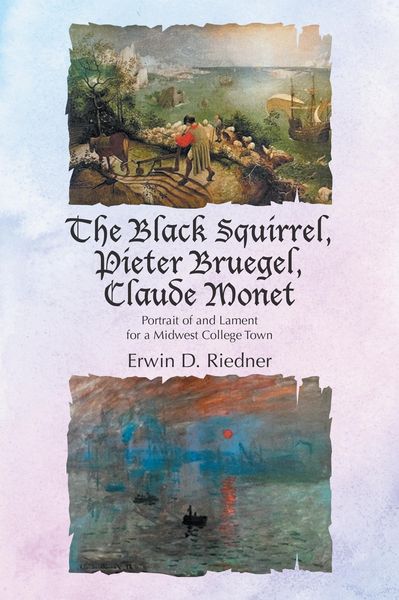
The Black Squirrel, Pieter Bruegel, Claude Monet Portrait of and Lament for a Midwest College Town
-
- Taschenbuch
- eBook ausgewählt
-
Form:Einzelkauf Download
-
Sprache:Englisch
Fr. 3.90
inkl. gesetzl. MwSt.Beschreibung
Produktdetails
Format
ePUB
Kopierschutz
Nein
Family Sharing
Nein
Text-to-Speech
Ja
Erscheinungsdatum
28.10.2025
Verlag
AuthorhouseSeitenzahl
516 (Printausgabe)
Dateigröße
2390 KB
Sprache
Englisch
EAN
9798823058766
Bruegel, Monet, and Us
"...once, on this earth, once, on this familiar spot of ground, walked other men and woman, as actual
as we are today, thinking their own thoughts, swayed by their own passions, but now are gone,
one generation vanishing after another, gone as utterly as we ourselves shall shorty by gone...."
-George Trevelyan
The genesis of this story grew out from my long-term attraction to and consideration
of two paintings: Pieter Brueghel's sixteenth century Fall of Icarus, and Claude Monet's
nineteenth century Impression, sunrise. For a long while I thought of the two as separate
and nearly unrelated works of art - diff erent paintings, diff erent eras, diff erent traditions,
diff erent references and messages. Yet in spite of my being fully aware of their disparate
synchronicities, it got so that each time I looked at one, the other inevitably crept into
the back of my mind. I seem to have begun to believe the two works were linked, paired
almost, possessing some sort of weird artistic consanguinity. Like a pair of long-lost
twins who share commonality but are yet strangers to each other, a yin and a yang but
where I didn't know which was the yang and which was the yin.
In this frustrating attempt to clear up of why I considered the Brueghel and the Monet
as a strange twosome, I attempted to write about their relationship. I eventually found
myself creating a story with the paintings as a backdrop, a fi ction set in a beguilingly
attractive Midwest college town like the one where I now live and where, beneath our
pleasant veneer exist, demonstrable cases of those who bully others, who turn their
backs to the beliefs and misfortunes of others.
As I worked through my story, it began to dawn on me that while the Brueghel and
the Monet paintings are indeed diff erent from each other, they can be said to exist as a
conjoined, contrasting duality, and I began to worry that my seeing Monet's depiction
of monumental change, his declaration of Western culture throwing off the past and
entering into a glowing new world of social brotherhood might well lean toward the
Pollyanna. That even as Monet celebrated human progress and awakening, the Brueghel
lurks in our psyche, that we need to remind ourselves that the past-like selfi shness of
turning away from misfortune remains with us; that the awakening in Western culture
the great Impressionist movement identifi ed has yet to fully penetrate.
-Wooster, Ohio
October, 2025
"...once, on this earth, once, on this familiar spot of ground, walked other men and woman, as actual
as we are today, thinking their own thoughts, swayed by their own passions, but now are gone,
one generation vanishing after another, gone as utterly as we ourselves shall shorty by gone...."
-George Trevelyan
The genesis of this story grew out from my long-term attraction to and consideration
of two paintings: Pieter Brueghel's sixteenth century Fall of Icarus, and Claude Monet's
nineteenth century Impression, sunrise. For a long while I thought of the two as separate
and nearly unrelated works of art - diff erent paintings, diff erent eras, diff erent traditions,
diff erent references and messages. Yet in spite of my being fully aware of their disparate
synchronicities, it got so that each time I looked at one, the other inevitably crept into
the back of my mind. I seem to have begun to believe the two works were linked, paired
almost, possessing some sort of weird artistic consanguinity. Like a pair of long-lost
twins who share commonality but are yet strangers to each other, a yin and a yang but
where I didn't know which was the yang and which was the yin.
In this frustrating attempt to clear up of why I considered the Brueghel and the Monet
as a strange twosome, I attempted to write about their relationship. I eventually found
myself creating a story with the paintings as a backdrop, a fi ction set in a beguilingly
attractive Midwest college town like the one where I now live and where, beneath our
pleasant veneer exist, demonstrable cases of those who bully others, who turn their
backs to the beliefs and misfortunes of others.
As I worked through my story, it began to dawn on me that while the Brueghel and
the Monet paintings are indeed diff erent from each other, they can be said to exist as a
conjoined, contrasting duality, and I began to worry that my seeing Monet's depiction
of monumental change, his declaration of Western culture throwing off the past and
entering into a glowing new world of social brotherhood might well lean toward the
Pollyanna. That even as Monet celebrated human progress and awakening, the Brueghel
lurks in our psyche, that we need to remind ourselves that the past-like selfi shness of
turning away from misfortune remains with us; that the awakening in Western culture
the great Impressionist movement identifi ed has yet to fully penetrate.
-Wooster, Ohio
October, 2025
Noch keine Bewertungen vorhanden
Verfassen Sie die erste Bewertung zu diesem Artikel
Helfen Sie anderen Kundinnen und Kunden durch Ihre Meinung.