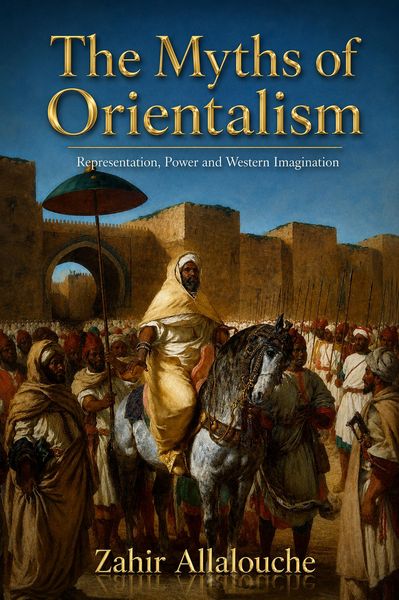
The Myths of Orientalism Myths of History, #2
-
- Einzelkauf Download ausgewählt
-
Sprache:Englisch
Fr. 4.00
Fr. 5.00
*
*befristete Preissenkung des Verlages.
Beschreibung
Produktdetails
Format
ePUB
Kopierschutz
Ja
Family Sharing
Ja
Text-to-Speech
Ja
Erscheinungsdatum
09.11.2025
Verlag
Zahir AllaloucheSeitenzahl
(Printausgabe)
Dateigröße
282 KB
Sprache
Englisch
EAN
9798232404833
DESCRIPTION
"The Myths of Orientalism" is an essay that sets out to dismantle, with lucid rigor and a sensitive touch, the illusions accumulated by centuries of Western representations of the Orient. The author pursues a twofold approach: the deconstruction of clichés and the rehabilitation of dialogue between civilizations.
The book begins with a fundamental observation: the Orient as described by Europe never truly existed. What was called "the Orient" was less a geographical reality than a cultural projectiona mirror in which the West contemplated its own fantasies, fears, and ideals. From this projection emerged a vast system of thought and domination: Orientalism. It fueled the arts, literature, scholarly research, and imperial policies, while forging a European identity in opposition to an "other" imagined as mystical, archaic, or sensual.
The book does not simply reiterate Edward Said's thesis. It expands upon it by exploring the **myths** themselves: those collective narratives that have shaped the Western imagination and continue, in more subtle forms, to influence contemporary discourse. Through ten mythsthe frozen Orient, the veiled and submissive woman, the harem, Ottoman barbarity, the clash of civilizations, among othersthe book examines the origins, functions, and persistence of these biased visions.
But the approach is not accusatory: it is intended to be **critical and dialogical**. The author reminds us that Orientalism was also the product of a sincere curiosity, a desire for the unknown, sometimes naive but fruitful. By tracing the intellectual, artistic, and scientific exchanges that linked East and Westfrom Baghdad to Cordoba, from Istanbul to Parishe shows that these two worlds were never separate, but constantly intertwined.
The conclusion brings the reader back to a powerful idea: **the Orient was not a mirage, but a mirror.** Understanding Orientalism means learning to see ourselves differently, to discern in our own representations the traces of our power dynamics and our desires for identity. Deconstructing these myths is not about denying the fascination they have inspired, but about rediscovering the complexity of reality and the richness of human connections.
This work follows in the tradition of major postcolonial thought, while offering a more nuanced, almost poetic approach: it invites us less to condemn than to understand, less to oppose than to connect.
Kundinnen und Kunden meinen
Verfassen Sie die erste Bewertung zu diesem Artikel
Helfen Sie anderen Kund*innen durch Ihre Meinung