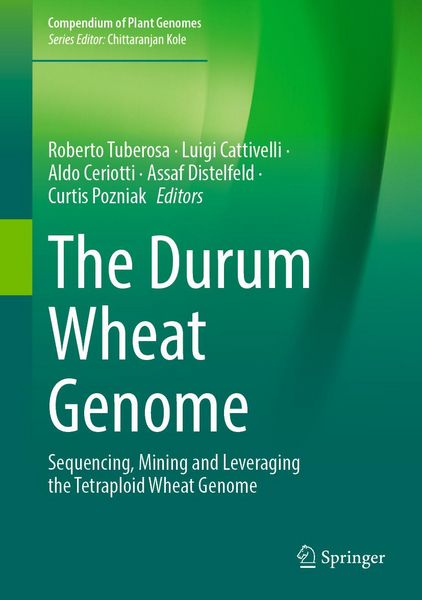
The Durum Wheat Genome Sequencing, Mining and Leveraging the Tetraploid Wheat Genome
Fr. 275.90
inkl. gesetzl. MwSt.Beschreibung
Produktdetails
Format
Kopierschutz
Nein
Family Sharing
Nein
Text-to-Speech
Nein
Erscheinungsdatum
17.11.2025
Herausgeber
Roberto Tuberosa + weitereVerlag
Springer Nature SwitzerlandSeitenzahl
312 (Printausgabe)
Dateigröße
21975 KB
Sprache
Englisch
EAN
9783031846892
This book caters to those interested in deploying forward- and reverse-genetics toward a more complete characterization of tetraploid wheat biodiversity for a more effective circular genomics for tailoring climate-resilient cultivars able to sustainably feed mankind while limiting the environmental footprint. Durum wheat (Triticum turgidum ssp. durum) is the main source of semolina for producing pasta, the staple of the Mediterranean diet, and other local foods in the Middle East and North Africa. Durum is the donor of the A and B genomes of bread wheat, hence a model species and a treasure trove of biodiversity for hexaploid wheat breeding.
The book highlights the pivotal role of the assembly of the durum wheat genome and its progenitor, wild emmer, to enhance our understanding of gene/QTL functions in polyploid wheat while contributing toward a more effective genomics-assisted breeding of wheat cultivars with a lower environmental footprint while ensuring high yield and grain quality.
The book describes the sequencing of wild emmer and durum wheat, the tuning of sequence coverage, gene expression, small RNAi and molecular fingerprinting for an informative profiling of genetic resources of tetraploid wheat. The remaining chapters illustrate how genomics and sequencing facilitate (i) the application of TILLING, (ii) mapping and meta-QTL analysis of drought and heat tolerance, head blight resistance, nitrogen-use efficiency and prolamins, (iii) genome editing, and (iv) organelle genomics.
Overall, readers will acquire knowledge on how best leverage the durum wheat genome based on, gene/QTL mapping and cloning, harnessing beneficial haplotypes and, ultimately, KASPTM-based marker-assisted breeding.
Noch keine Bewertungen vorhanden
Verfassen Sie die erste Bewertung zu diesem Artikel
Helfen Sie anderen Kundinnen und Kunden durch Ihre Meinung.