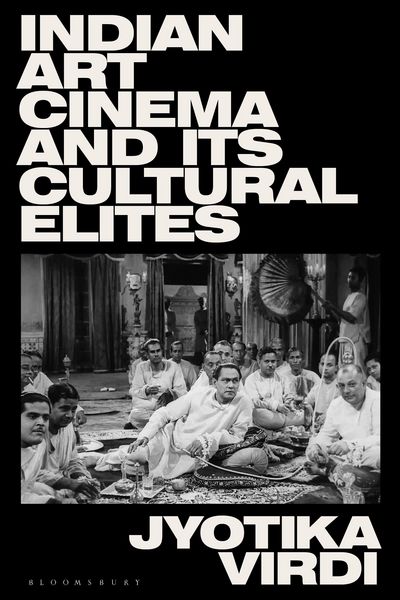
Indian Art Cinema and its Cultural Elites
-
Form:Einzelkauf Download
-
Sprache:Englisch
-
eBook Format:PDF
- ePUB 3 Fr. 103.90
- PDF Fr. 103.90 ausgewählt
Fr. 103.90
inkl. gesetzl. MwSt.Beschreibung
Produktdetails
Format
Kopierschutz
Ja
Family Sharing
Nein
Text-to-Speech
Nein
Erscheinungsdatum
22.01.2026
Verlag
Bloomsbury eBooks UKSeitenzahl
280 (Printausgabe)
Auflage
1. Auflage
Sprache
Englisch
EAN
9781350452985
Repositioning Indian art cinema as a genre that articulated an elite, middle-class social imaginary, Indian Art Cinema and its Cultural Elites examines the form's contentious position within Indian society, at once exclusionary in its outlook and yet instrumental in bringing Indian film into global prominence in the latter half of the twentieth century.
Drawing on Bourdieu's theory of cultural production, Jyotika Virdi looks at how a closed producer-critic-consumer circuit reinforced class distinction through a presumption of superior taste. She traces the trajectory of art cinema in India from the 1950s, when new institutions under Nehru's socialist ideals catalysed its emergence, through the New Wave movement of the 1970s and 1980s, and finally to its gradual decline in the 1990s as economic liberalization once again transformed the social landscape. By examining films like The Apu Trilogy (1955-1959) and Ardh Satya (Half Truth, 1983), she showcases the complex contradictions of the middle class, who were both the creative producers and consumers of alternative cinema, especially during the political turbulence of the late 1960s and 1970s.
Combining a meticulous examination of key auteurs such as Satyajit Ray, Mrinal Sen, and Shyam Benegal, among others, with a broader study of cultural shifts and institutional frameworks, this book reevaluates the intricate relationship between art films, the state that sustains them, and the ruling cultural elite whose influence far exceeds its size.
Drawing on Bourdieu's theory of cultural production, Jyotika Virdi looks at how a closed producer-critic-consumer circuit reinforced class distinction through a presumption of superior taste. She traces the trajectory of art cinema in India from the 1950s, when new institutions under Nehru's socialist ideals catalysed its emergence, through the New Wave movement of the 1970s and 1980s, and finally to its gradual decline in the 1990s as economic liberalization once again transformed the social landscape. By examining films like The Apu Trilogy (1955-1959) and Ardh Satya (Half Truth, 1983), she showcases the complex contradictions of the middle class, who were both the creative producers and consumers of alternative cinema, especially during the political turbulence of the late 1960s and 1970s.
Combining a meticulous examination of key auteurs such as Satyajit Ray, Mrinal Sen, and Shyam Benegal, among others, with a broader study of cultural shifts and institutional frameworks, this book reevaluates the intricate relationship between art films, the state that sustains them, and the ruling cultural elite whose influence far exceeds its size.
Kundinnen und Kunden meinen
Verfassen Sie die erste Bewertung zu diesem Artikel
Helfen Sie anderen Kund*innen durch Ihre Meinung