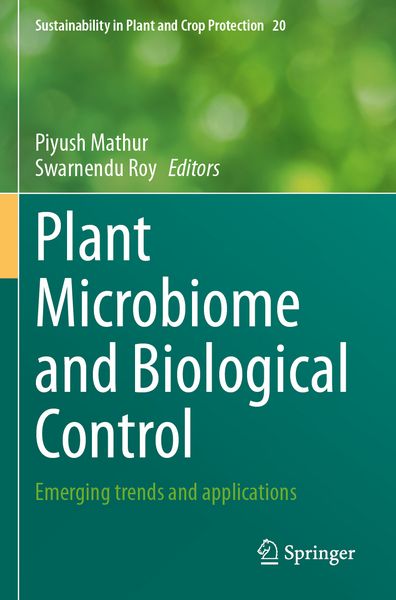
Produktbild: Plant Microbiome and Biological Control
Band 20

Plant Microbiome and Biological Control Emerging trends and applications

Fr. 264.00

inkl. gesetzl. MwSt., Versandkostenfrei


Beschreibung

Produktdetails

Einband

Taschenbuch

Erscheinungsdatum

08.01.2026

Abbildungen

XXVI, 624 p. 54 illus., 47 illus. in color.

Herausgeber

Piyush Mathur + weitere

Verlag

Springer

Seitenzahl

624

Maße (L/B/H)

23.5/15.5/3.5 cm

Gewicht

972 g

Sprache

Englisch

ISBN

978-3-031-75847-8

Beschreibung

Portrait


Dr. Piyush Mathur 
is presently working as an Assistant Professor in the Department of Botany, Institute of Science, Banaras Hindu University, Varanasi, Uttar Pradesh, India. He has been teaching for the past 6 years and has taught both at the undergraduate and postgraduate level. He has done his Ph.D. in Botany with a specialization in Mycology and Plant Pathology from Delhi University. Presently, he is supervising four Ph. D. research scholars who are working on microbial diversity, bioprospecting, and plant disease management. He has published quite a number of articles and papers in well-known international journals of good repute. He has also contributed articles as book chapters in International and National books. He is serving as a member of editorial board of BMC Plant Biology (Taylor and Francis).  He has previously edited three books with Springer and is working on other books too. Dr. Mathur is an active member of the Society of Rapeseed Mustard Research (SRMR), Bharatpur, and Delhi University Botanical Society (DUBS) Delhi, India and Indian Phytopathological Society, New Delhi, India.


Dr. Swarnendu Roy
 is presently working as an Assistant Professor at the University of North Bengal, Siliguri, India. He has more than 12 years of teaching experience. His doctoral thesis involved understanding the mechanism of salinity stress tolerance in grasses. He has published more than 35 articles in reputed journals with high impact factors like Water Research, Scientific Reports, Plant Physiology and Biochemistry, and Physiologia Plantarum. He has recently edited a book entitled 
Plant Stress: Challenges and Management in the New Decade
, published by Springer and also published several book chapters in edited volumes. He is presently supervising 4 Ph. D. research scholars who are working on stress management in plants by engineered nanoparticles, synthesis of starch-based biofilms and edible coatings. He received International Travel Support (ITS) from DST, Government of India to present his research paper at International Conference on Integrative Plant Physiology at Sitges, Spain. He is a life member of prestigious societies like The Indian Science Congress Association, Association of Food Scientists and Technologists (India).

Produktdetails

Einband

Taschenbuch

Erscheinungsdatum

08.01.2026

Abbildungen

XXVI, 624 p. 54 illus., 47 illus. in color.

Herausgeber

Verlag

Springer

Seitenzahl

624

Maße (L/B/H)

23.5/15.5/3.5 cm

Gewicht

972 g

Sprache

Englisch

ISBN

978-3-031-75847-8

Herstelleradresse

Springer-Verlag KG
Sachsenplatz 4-6
1201 Wien
AT

Email: ProductSafety@springernature.com

Noch keine Bewertungen vorhanden

Verfassen Sie die erste Bewertung zu diesem Artikel

Helfen Sie anderen Kundinnen und Kunden durch Ihre Meinung.

Kundinnen und Kunden meinen

Bewertungen (0)

  • Produktbild: Plant Microbiome and Biological Control

  • Chapter 1. Beneficial Microbes in Plant Health, Immunity and Resistance.- Chapter 2. Understanding Plant Immunity Through Plant-Microbe Interaction.- Chapter 3. Plant-Microbe Interactions, Signalling Events, And Cellular Networks Against Harmful Pathogens.- Chapter 4. Building Resilience: Engineering the Plant Microbiome for Biotic Stress Management.- Chapter 5. Rhizosphere microbiome and plant tolerance against biotic agents.- Chapter 6. Rhizospheric Microbiome: Biodiversity, Significance, and Prospects for Biotechnological Advancements.- Chapter 7. Rhizobiome Microbials in the Protection of Plants From Biotic Stress.- Chapter 8. Harnessing Rhizosphere Mycobiome for Sustainable Agriculture: Perspectives and Prospects.- Chapter 9. Boosting Plant Immunity: The Functional Role and Mechanism of Arbuscular Mycorrhizal Fungi in Resistance.- Chapter 10. Phytostimulation and Systemic Resistance Induction by Plant Growth Promoting Fungi (PGPF).- Chapter 11. Functional Role and Mechanism of PGPRs, AMFs and Endophytes in Improving Host Resistance Against Plant Pathogens.- Chapter 12. Bacterial Secondary Metabolites (B-SMs): Empowering Agriculture Against Fungal Disease Challenges.- Chapter 13. Fungal Plant Bio-stimulants: Cutting-edge Bioinoculants for Sustainable Agriculture.- Chapter 14. Fungi as Biocontrol Agents Against Insect and Mite Pests.- Chapter 15. Pathogenic algae in host microbiota: invasion mechanism and management strategies.- Chapter 16. Disease Resistance in Mycorrhiza-Colonised Vegetable Crop: Understanding and Opportunity.- Chapter 17. Optimizing Post-Harvest Disease Management through Plant Microbiome Intervention Strategies.- Chapter 18. Exploring the Role of Plant Microbiome in Post-Harvest Disease Management of Tomato (Lycopersicon esculentum Mill.).- Chapter 19. Counteracting Post-Harvest Diseases through Horticultural Plants Microbiome.-Chapter 20. Management of Mycotoxin Problems: Prospects and Limitations.- Chapter 21. Genetic Basis Providing Crop Plants Resistance to Phytopathogens.- Chapter 22. Small RNAs – Game Changers of Plant Defense System Against Bacteria.- Chapter 23. Deciphering the rhizosphere microbiome through metagenomics.- Chapter 24. Harnessing the Power of Phytomicrobiome Interaction Involving Multi-Omics Techniques to Control Biotic Stresses.