KI-Beratung Beta

Produktbild: Cross-Cultural Perspectives on Gangs

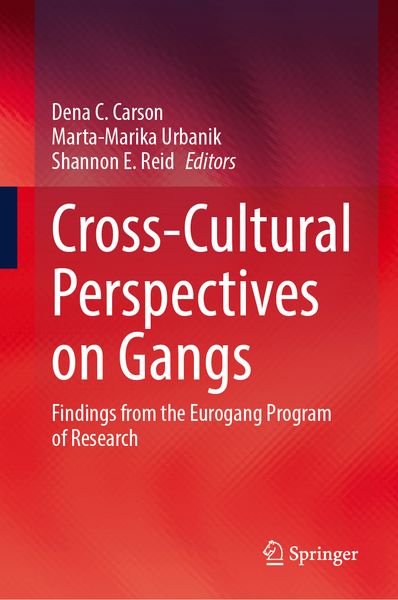
Cross-Cultural Perspectives on Gangs Findings from the Eurogang Program of Research

Fr. 181.00

inkl. gesetzl. MwSt., Versandkostenfrei


Beschreibung

This book offers a comprehensive exploration of gangs as a global phenomenon, moving beyond the traditional American-centric perspective. It delves into the study of gangs worldwide as well as factors that aid in prevention and intervention. Compiled by members of the Eurogang Program of Research, this...

Beschreibung

This book offers a comprehensive exploration of gangs as a global phenomenon, moving beyond the traditional American-centric perspective. It delves into the study of gangs worldwide as well as factors that aid in prevention and intervention. Compiled by members of the Eurogang Program of Research, this volume presents cutting-edge findings from recent academic studies.


The book is structured into four key areas:


  • Innovative methodologies for studying gangs.

  • Factors and behaviors leading to gang membership.

  • Group dynamics influencing gang behavior.

  • Community responses to gang violence. 


Each section provides a detailed analysis, utilizing diverse research methods and theoretical frameworks. The insights offered in this volume are invaluable for academics, students, and practitioners aiming to understand gangs in varied cultural and social contexts. This volume is an essential resource for those engaged in criminology, sociology, and urban studies, providing a thorough understanding of the complexities of gang behavior and community interactions.

Portrait


Dena C. Carson is an associate professor in the Paul H. O’Neill School of Public and Environmental Affairs at Indiana University Indianapolis. Her appointment followed her Ph.D. and post-doctoral work at the University of Missouri-St. Louis. Dr. Carson’s broad research interests includes youth violence and gangs, but, more specifically, her work focuses on the role of group processes in gangs and delinquent peer groups, gang disengagement, as well as the impact of gangs in the school setting. Her recent publications have appeared in
Youth Violence and Juvenile Justice
,
Justice Quarterly
, and the
Journal of Developmental and Life-Course Criminology
. She also serves on the editorial boards of
Criminal Justice and Behavior
,
Journal of Crime & Justice
, and
Youth Violence and Juvenile Justice
.


Dr. Marta-Marika Urbanik is an Associate Professor at the Centre for Criminological Research in the Department of Sociology at the University of Alberta. An urban ethnographer, Dr. Urbanik’s expertise lies in examining the intersections between marginalized neighbourhoods, poverty, drugs, violence, homelessness, and social media, with a particular focus on gangs. Her work appears in
Social Problems
, the
British Journal of Criminology
, the
International Journal of Drug Policy
, and
Qualitative Sociology
. Dr. Urbanik routinely serves as an expert witness for gang involved and/or gang adjacent homicides, and shares her work with the mass media.


Dr. Shannon Reid is an Associate Professor in the Department of Criminal Justice and Criminology and the School of Data Science at the University of North Carolina at Charlotte. Dr. Reid received her Ph.D. in Criminology, Law, and Society from the University of California, Irvine in 2013. Her research interests are focused on street gangs, white power youth, youth and adults in the correctional system, and the integration of AI technology into public safety. This includes the development and patenting of team-developed visual AI focused on anomaly and action detection, path prediction, object identification, and boundary creation for public safety and security. Her work has been published in
Criminology
, the
Journal of Interpersonal Violence
,
Homicide Studies, Journal of Youth Studies, Legal and Criminal Psychology,
and
Deviant Behavior
. Her research has been funded by the National Science Foundation, the Office of Juvenile Justice and Delinquency Prevention, and the Army Research Office.
Produktdetails

Einband

Gebundene Ausgabe

Erscheinungsdatum

22.05.2026

Abbildungen

VIII, 295 p. 11 illus., 9 illus. in color.

Herausgeber Dena C. Carson + weitere

Produktdetails

Einband

Gebundene Ausgabe

Erscheinungsdatum

22.05.2026

Abbildungen

VIII, 295 p. 11 illus., 9 illus. in color.

Herausgeber
Verlag Springer
Seitenzahl

295

Maße (L/B/H)

24.1/16/2.2 cm

Gewicht

571 g

Sprache

Englisch

ISBN

978-3-032-19824-2

Herstelleradresse

Springer-Verlag GmbH
Europaplatz 3
69115 Heidelberg
DE

Email: ProductSafety@springernature.com

Noch keine Bewertungen vorhanden

Verfassen Sie die erste Bewertung zu diesem Artikel

Helfen Sie anderen Kundinnen und Kunden durch Ihre Meinung.

Kundinnen und Kunden meinen

Bewertungen (0)

  • Produktbild: Cross-Cultural Perspectives on Gangs

  • Chapter 1. The Eurogang Program of Research: A Look to the Past and Future Directions.- Chapter 2. Non-Gang Eurogang Members? Revisiting Eurogang Measurement in a National Sample.- Chapter 3. There and Back Again: How the History, and Evolution of Gangs Impact the Future of the Eurogang Definition.- Chapter 4. Reflexive Metadata in Gangland.- Chapter 5. Hoped-for, Expected, and Feared Selves: Exploring Possible Selves of Youth from Gang- Involved Families.- Chapter 6. Youth Gangs in Southern Italy: An Ecological Perspective.- Chapter 7. Gender differences in gang participation: Results from a multinational sample of youth in the English-speaking Caribbean.- Chapter 8. They are just UK fans who started living what they are rapping instead of rapping what they are living”: The multimedial performance of authenticity in (online) Dutch drill culture.- Chapter 9. (Trans)gangs have the Power: Rethinking gangs as agents of mediation.- Chapter 10. Gangs and organized crime in Colombia and Honduras: Boundaries, intersections, and policy.- Chapter 11. The Paradigmatic Change: How the Gang Issue Radically Transformed the Swedish Exception in Criminal Policy.- Chapter 12. Examining the Effectiveness of a Violence Prevention Program on Gang Youth.- Chapter 13. Utilizing the Good Lives Model as a Framework to Guide and Improve Gang Interventions.- Chapter 14. The Alberta Model: Gang Exit Programming and Violence Interruption amid a rapidly changing gang context.