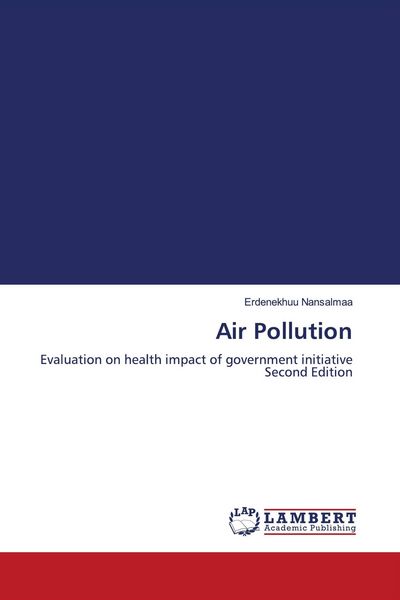
Air Pollution Evaluation on health impact of government initiative Second Edition
-
- Englisch ausgewählt
Fr. 61.90
inkl. gesetzl. MwSt.,
Beschreibung
Produktdetails
Einband
Taschenbuch
Erscheinungsdatum
02.03.2026
Verlag
LAP LAMBERT Academic PublishingSeitenzahl
64
Maße (L/B/H)
22/15/0.4 cm
Gewicht
113 g
Sprache
Englisch
ISBN
978-620-9-60108-8
During the last 10 years, air pollution has become one of the major public health problems in Ulaanbaatar city of Mongolia, and concentrations of pollutants were measured 3 to 50 times higher than WHO recommendation. This devastating air pollution is produced mostly by thousands of families who migrated from countryside and live in gers (traditional dwellings) in the suburban area which is not connected to the central heating system, and nearly all of them burn coal to keep them warm. Due to air pollution, residents living in Ulaanbaatar city suffer health problems that equal to the smoking of 4-5 packs of cigarettes. During the winter time, PM10 hourly average concentrations increased to 2,300 ¿g/m3, and daily average became over than 1,000 ¿g/m3 in the most polluted parts of the city. At present, Mongolian government has accepted that the health of Mongolian residents has deteriorated at an alarming level.The study result showed when this new regulation is fully implemented in the ger districts, the annual consumption of coal and wood would be decreased by about 550,000 tons and 415,000 tons, accompanied by massive reduction of the emission.
Noch keine Bewertungen vorhanden
Verfassen Sie die erste Bewertung zu diesem Artikel
Helfen Sie anderen Kundinnen und Kunden durch Ihre Meinung.