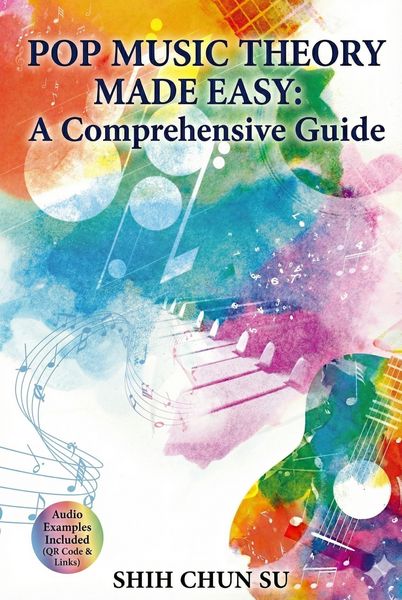
Pop Music Theory Made Easy : A Comprehensive Guide
-
- Einzelkauf Download ausgewählt
-
Sprache:Englisch
Fr. 3.00
inkl. gesetzl. MwSt.Beschreibung
Produktdetails
Format
ePUB
Kopierschutz
Ja
Family Sharing
Ja
Text-to-Speech
Ja
Erscheinungsdatum
26.03.2026
Verlag
STC MusicSeitenzahl
(Printausgabe)
Dateigröße
2392 KB
Sprache
Englisch
EAN
9798233707520
A tailored textbook designed for pop music learners, helping you effortlessly master the essential and commonly used music theory basics in pop music.
Introduction
This book is an introductory guide to music theory that primarily uses numbered musical notation (Jianpu), supplemented by the standard staff. Designed with ease of learning and application in mind, it incorporates visual aids and diagrams to help readers grasp music theory concepts more intuitively.
Whether you have a formal background in music or not, this book will gently guide you into the engaging world of pop music styles.
Four Key Features
- Super Practical: Effectively builds a solid foundation in music theory, making advanced learning much easier in the future.
- Super Clear: Visual aids and graphics make understanding complex music theory highly intuitive.
- Super Fun: Features practical pop music style examples, allowing you to learn effortlessly while listening.
- Super Unique: Focuses primarily on numbered musical notation and uses the standard staff as a supplement, significantly accelerating the learning process for beginners.
Perfect for Non-Majors and Beginners
Traditional music theory books mostly rely on the standard staff and classical music scores for their examples, which can create a high barrier to entry for self-taught musicians or non-majors. To solve this, this book adopts the widely familiar numbered musical notation as its core framework. By combining it with the staff, graphical illustrations, and practical pop music examples, we hope to empower more learners to unlock the mysteries of music theory without the frustration.
Content
Chapter 1 - The Core of Music - Keys and Scales
- Unit 1: Diatonic Scales and Major Keys
- Unit 2: Musical Melody
- Unit 3: Representation of Numbered Musical Notation
Chapter 2 - The Distance Between Notes - Intervals
- Unit 1: Features of Intervals
- Unit 2: The Value of Intervals
- Unit 3: The Quality of Intervals
- Unit 4: Intervals and Musical Feeling
Chapter 3 - Grasping the Characteristics and Relationships of Keys - Circle of Fifths
- Unit 1: Keys and Key Signature Changes
- Unit 2: Keys and Key Signature Notes
Chapter 4 - Basic Triads Formed by Three Notes
- Unit 1: Composition of Triads
- Unit 2: Types of Triads
- Unit 3: Chords and Musical Feeling
Chapter 5 - Basic Chords in a Key
- Unit 1: Diatonic Chords
- Unit 2: Chord Degrees (Roman Numerals)
- Unit 3: Functional Chord Names
Chapter 6 - Seventh Chords Formed by Four Notes
- Unit 1: Composition of Seventh Chords
- Unit 2: Types of Seventh Chords
- Unit 3: Diatonic Seventh Chords
- Unit 4: Using Seventh Chords or Triads
Chapter 7 - Minor Key
- Unit 1: Minor Scale
- Unit 2: Relationship Between Minor and Major Keys
- Unit 3: Minor Key Chords
- Unit 4: Cadence and Minor Key
- Unit 5: Harmonic and Melodic Minor Scales
Chapter 8 - Other Common Chord Types
- Unit 1: Suspended Chords (sus)
- Unit 2: Slash Chords (/)
- Unit 3: Sixth Chords (6)
- Unit 4: Added Tone Chords (add)
- Unit 5: Scale Notes and Chords
Kundinnen und Kunden meinen
Verfassen Sie die erste Bewertung zu diesem Artikel
Helfen Sie anderen Kund*innen durch Ihre Meinung