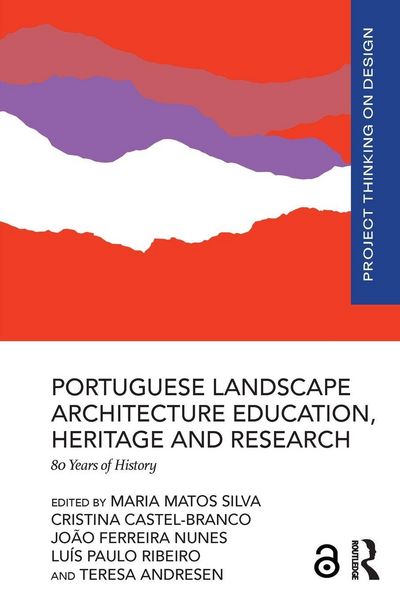
Portuguese Landscape Architecture Education, Heritage and Research 80 Years of History
-
- Englisch ausgewählt
Fr. 83.90
inkl. gesetzl. MwSt.,
Portrait
Maria Matos Silva, Assistant Professor of Landscape Architecture (LA) at Instituto Superior de Agronomia (ISA-UL), is currently coordinating the master's Programme in LA (2022-). She has a degree in LA from ISA-UL (2007), a master's degree (2010) and PhD (2016) from the University of Barcelona, where she focused on urban and public space design. She has been a research associate of Centro de Investigação em Arquitectura, Urbanismo e Design (CIAUD) at the Faculty of Architecture, UL since 2016. She was awarded an Honourable Mention in the Scientific Prize of the UL/CGD (2019) and is co-PI of the "MetroPublicNet" FCT research project.
Cristina Castel-Branco is a landscape architect and professor at the University of Lisbon. As a Fulbright student, she received an MLA from UMass and obtained her PhD in the history of garden art. She has published on subjects in Landscape Architecture history, restoration, and ecological design. She is founder and the first president of the Historic Gardens Association; director of the Botanical Garden of Ajuda (1997-2002) and is a member of the UNESCO-ICOMOS cultural landscapes. She maintains a professional practice in Lisbon, the ACB studio, which has been prize-winning since 1990. She was granted the award of Officier des Arts et des Lettres in 2015 and the Japanese Government Praise of Merit in 2020.
João Ferreira Nunes is a landscape architect with a great passion for drawing and understanding the processes of the world. The founder of PROAP, his professional and teaching activities intertwine and contribute to the development of new lines of research and experimentation. He is full professor at the Accademia di Architettura in Mendrisio, Switzerland and visiting professor at international universities.
Luís Paulo Ribeiro, Assistant Professor of Landscape Architecture (LA) at Instituto Superior de Agronomia (ISA-UL), has been lecturing since 1999. He obtained his degree in LA at ISA-UL, and his PhD from the University of Massachusetts, USA (1997). He is a founding partner of TOPIARIS (1988), an expert in the restoration of historical gardens and a coordinator of related projects, such as the Tropical Botanical Garden of Lisbon. He is head of the master's and PhD programs in the LA department and a regular invited lecturer at the University of Massachusetts, where he was awarded the 6th Fábos Medal for the excellence of his work on Greenway planning and design.
Teresa Andresen is a landscape architect and agricultural engineer (CLAP, 1982; EA, 1982). She has been a professor in higher education for 30 years and was a member of the Scientific Council of the European Environment Agency from 2002 to 2008; president of the European Foundation for Landscape Architecture from 2004 to 2007; vice president of the International Federation of Landscape Architects (2007); and Portuguese Expert at the Permanent Commission for World Heritage (UNESCO) from 2014 to 2017. He has been a member of the National Council for Environment and Sustainable Development since 2013 and president of the Board of AJH-Portuguese Association of Historic Gardens since 2017.
Produktdetails
Einband
Taschenbuch
Erscheinungsdatum
22.05.2026
Abbildungen
schwarz-weiss Illustrationen, Raster, schwarz-weiss, Zeichnungen, schwarz-weiss, Tabellen, schwarz-weiss
Herausgeber
Maria Matos Silva + weitereVerlag
Taylor and FrancisSeitenzahl
308
Maße (L/B/H)
23.4/15.6/1.8 cm
Gewicht
630 g
Sprache
Englisch
ISBN
978-1-03-259286-2
Maria Matos Silva, Assistant Professor of Landscape Architecture (LA) at Instituto Superior de Agronomia (ISA-UL), is currently coordinating the master's Programme in LA (2022-). She has a degree in LA from ISA-UL (2007), a master's degree (2010) and PhD (2016) from the University of Barcelona, where she focused on urban and public space design. She has been a research associate of Centro de Investigação em Arquitectura, Urbanismo e Design (CIAUD) at the Faculty of Architecture, UL since 2016. She was awarded an Honourable Mention in the Scientific Prize of the UL/CGD (2019) and is co-PI of the "MetroPublicNet" FCT research project.
Cristina Castel-Branco is a landscape architect and professor at the University of Lisbon. As a Fulbright student, she received an MLA from UMass and obtained her PhD in the history of garden art. She has published on subjects in Landscape Architecture history, restoration, and ecological design. She is founder and the first president of the Historic Gardens Association; director of the Botanical Garden of Ajuda (1997-2002) and is a member of the UNESCO-ICOMOS cultural landscapes. She maintains a professional practice in Lisbon, the ACB studio, which has been prize-winning since 1990. She was granted the award of Officier des Arts et des Lettres in 2015 and the Japanese Government Praise of Merit in 2020.
João Ferreira Nunes is a landscape architect with a great passion for drawing and understanding the processes of the world. The founder of PROAP, his professional and teaching activities intertwine and contribute to the development of new lines of research and experimentation. He is full professor at the Accademia di Architettura in Mendrisio, Switzerland and visiting professor at international universities.
Luís Paulo Ribeiro, Assistant Professor of Landscape Architecture (LA) at Instituto Superior de Agronomia (ISA-UL), has been lecturing since 1999. He obtained his degree in LA at ISA-UL, and his PhD from the University of Massachusetts, USA (1997). He is a founding partner of TOPIARIS (1988), an expert in the restoration of historical gardens and a coordinator of related projects, such as the Tropical Botanical Garden of Lisbon. He is head of the master's and PhD programs in the LA department and a regular invited lecturer at the University of Massachusetts, where he was awarded the 6th Fábos Medal for the excellence of his work on Greenway planning and design.
Teresa Andresen is a landscape architect and agricultural engineer (CLAP, 1982; EA, 1982). She has been a professor in higher education for 30 years and was a member of the Scientific Council of the European Environment Agency from 2002 to 2008; president of the European Foundation for Landscape Architecture from 2004 to 2007; vice president of the International Federation of Landscape Architects (2007); and Portuguese Expert at the Permanent Commission for World Heritage (UNESCO) from 2014 to 2017. He has been a member of the National Council for Environment and Sustainable Development since 2013 and president of the Board of AJH-Portuguese Association of Historic Gardens since 2017.
Noch keine Bewertungen vorhanden
Verfassen Sie die erste Bewertung zu diesem Artikel
Helfen Sie anderen Kundinnen und Kunden durch Ihre Meinung.