KI-Beratung Beta

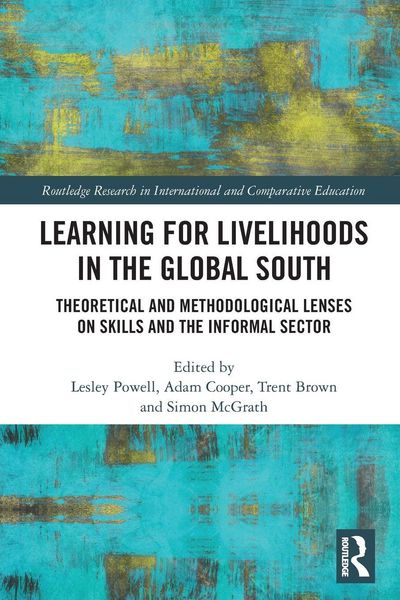
Produktbild: Learning for Livelihoods in the Global South

Learning for Livelihoods in the Global South Theoretical and Methodological Lenses on Skills and the Informal Sector

Fr. 79.90

inkl. gesetzl. MwSt., Versandkostenfrei


Beschreibung

This edited volume explores how youth and informal sector workers in the Global South are pioneering learning and livelihoods that exist at the intersections of, and beyond, the boundaries of the state, market, and other formal institutions.

Underpinned by research undertaken in the Global South, this...

Beschreibung

This edited volume explores how youth and informal sector workers in the Global South are pioneering learning and livelihoods that exist at the intersections of, and beyond, the boundaries of the state, market, and other formal institutions.

Underpinned by research undertaken in the Global South, this book discusses how we might better theorise, conceptualise, and critique what skills and vocational education and training mean for young people with diverse livelihoods - people who rely substantially on the informal and social economy. Rather than envisioning education and skills as oriented towards profit-making or increased productivity, chapters offer fresh perspectives that move beyond the dominant neoliberal and human capital orthodoxies. This book features chapters that are global in approach, uses case studies from contexts as diverse as India, South Africa, West Africa, and Colombia, and focuses on how education can be used to empower people, strengthen livelihoods, and expand human agency, skills, personal growth, and the capability for voice.

Issuing a clarion call, it appeals for recognition of the ways in which learning, working, and living take place in the informal sector in the Global South, arguing that this matters for the vast majority of the world's population. This book will be of relevance to scholars, academics, and postgraduate students in vocational education and training, skills development, the informal sector, international and comparative education, international development, and adult education.

Produktdetails

Einband

Taschenbuch

Erscheinungsdatum

22.05.2026

Abbildungen

schwarz-weiss Illustrationen, Raster,schwarz-weiss, Zeichnungen, schwarz-weiss, Tabellen, schwarz-weiss

Herausgeber Lesley Powell + weitere

Produktdetails

Einband

Taschenbuch

Erscheinungsdatum

22.05.2026

Abbildungen

schwarz-weiss Illustrationen, Raster,schwarz-weiss, Zeichnungen, schwarz-weiss, Tabellen, schwarz-weiss

Herausgeber
Verlag Taylor and Francis
Seitenzahl

280

Maße (L/B/H)

23.4/15.6/1.6 cm

Gewicht

426 g

Sprache

Englisch

ISBN

978-1-03-265093-7

Herstelleradresse

Libri GmbH
Europaallee 1
36244 Bad Hersfeld
DE

Email: gpsr@libri.de

Noch keine Bewertungen vorhanden

Verfassen Sie die erste Bewertung zu diesem Artikel

Helfen Sie anderen Kundinnen und Kunden durch Ihre Meinung.

Kundinnen und Kunden meinen

Bewertungen (0)

Weitere Artikel finden Sie in

Die Leseprobe wird geladen.
  • Produktbild: Learning for Livelihoods in the Global South
  • Foreword

    1. Skills, the informal sector and global south youth: theory and methods to break the silence

    PART 1. THEORISING: RETHINKING THE PURPOSE OF EDUCATION AND TRAINING

    2. A relational capabilitarian approach for wellbeing livelihoods: Reframing and making alternative education, skills and work for young people

    3. Subsumption, Alienation, and Questions of Meaning in Informal Sector Skills Training

    4. Supporting youth livelihoods in an informal "sub-field" in the global south

    PART 2. CONCEPTUALISING: CONCEPTUAL TOOLS FOR UNDERSTANDING INFORMAL SECTOR SKILL ACQUISITION IN PRACTICE

    5. Shifting informal geographies and the hustle for a better future

    6. A typology of informal sector workers - heterogeneity and the complexity of skills development responses

    7. The potential role of ICT in facilitating learning for livelihoods among informal apprentices in the automotive trade in Ghana

    8. Highly educated migrants in platform-mediated food delivery work in the Netherlands: The absent presence of skills and its social effects

    PART 3. CRITIQUING: UNDERSTANDING CONSTRAINTS AND WEAKNESSES IN DOMINANT APPROACHES

    9. Exploring 'valuable' knowledge, skills and attitudes: Perceptions of young people in an informal settlement in Pietermaritzburg

    10. Critiquing the concept of 'self-reliance' in informal sector training: A case study of Afghan refugee women in India

    11. Gendering decent work: Rethinking the connections between informality, TVET and gender through the 'Decent Work' agenda in Sierra Leone and Cameroon

    PART 4. ADVOCATING: TOWARDS REFORM OF POLICY AND PRACTICE

    12. Financing Skills and Lifelong Learning in the Informal Sector

    13. Exploring the intersectionality of green skills, innovation and livelihoods in the informal economy in Harare, Zimbabwe

    14. Recognising Colombian waste pickers as public service providers and producers of knowledge

    PART 5. CONCLUDING: MOVING FORWARD

    15. Skill and livelihoods: some concluding ideas