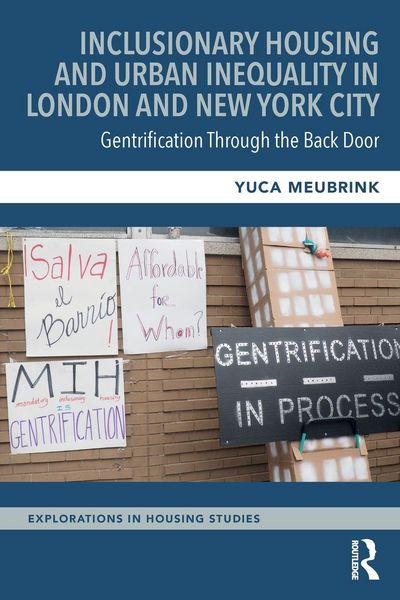
Inclusionary Housing and Urban Inequality in London and New York City Gentrification Through the Back Door
-
- Englisch ausgewählt
Fr. 79.90
inkl. gesetzl. MwSt.,
Beschreibung
Produktdetails
Einband
Taschenbuch
Erscheinungsdatum
22.05.2026
Abbildungen
schwarz-weiss Illustrationen, Raster, schwarz-weiss, Zeichnungen, schwarz-weiss, Tabellen, schwarz-weiss
Verlag
Taylor and FrancisSeitenzahl
208
Maße (L/B/H)
23.4/15.6/1.2 cm
Gewicht
420 g
Sprache
Englisch
ISBN
978-1-03-274274-8
Municipalities around the world have increasingly used inclusionary housing programs to address their housing shortages. This book problematizes those programs in London and New York City by offering an empirical, research-based perspective on the socio-spatial dimensions of inclusionary housing approaches in both cities. The aim of those programs is to produce affordable housing and foster greater socio-economic inclusion by mandating or incentivizing private developers to include affordable housing units within their market-rate residential developments.
The starting point of this book is the so-called "poor door" practice in London and New York City, which results in mixed-income developments with separate entrances for "affordable housing" and wealthier market-rate residents. Focusing on this "poor door" practice allowed for a critical look at the housing program behind it. By exploring the relationship between inclusionary housing, new-build gentrification, and austerity urbanism, this book highlights the complexity of the planning process and the ambivalences and interdependencies of the actors involved. Thereby, it provides evidence that the provision of affordable housing or social mixing through this program has only limited success and, above all, that it promotes - in a sense through the "back door" - the very gentrification and displacement mechanisms it is supposed to counteract.
This book will be of interest to researchers and students of housing studies, planning, and urban sociology, as well as planners and policymakers who are interested in the consequences of their own housing programs.
Noch keine Bewertungen vorhanden
Verfassen Sie die erste Bewertung zu diesem Artikel
Helfen Sie anderen Kundinnen und Kunden durch Ihre Meinung.