KI-Beratung Beta

  • Produktbild: Affordable Science and Innovation for Impact
  • Produktbild: Affordable Science and Innovation for Impact

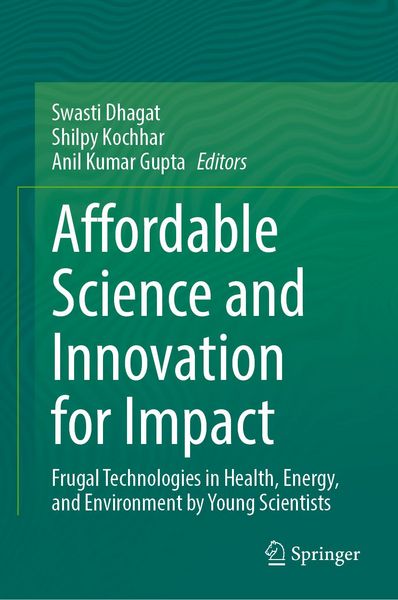
Affordable Science and Innovation for Impact Frugal Technologies in Health, Energy, and Environment by Young Scientists

Fr. 218.00

inkl. gesetzl. MwSt., Versandkostenfrei


Beschreibung

Produktdetails

Einband

Gebundene Ausgabe

Erscheinungsdatum

19.08.2026

Abbildungen

XXIX, 205 p. 137 illus., 55 illus. in color.

Herausgeber

Swasti Dhagat + weitere

Verlag

Springer Singapore

Seitenzahl

205

Maße (L/B/H)

24.1/16/1.9 cm

Gewicht

472 g

Sprache

Englisch

ISBN

978-981-9209-89-7

Beschreibung

Portrait

Dr. Swasti Dhagat is an accomplished biotechnologist and academic writer with a strong portfolio in scientific publishing and editorial management. She has co-authored and edited pivotal academic texts, including Recent Advances in Bioprocess Engineering and Bioreactor Design, Thermophiles for Biotech Industry: A Bioprocess Technology Perspective, and Computer-Aided Design of Antimicrobial Lipopeptides as Prospective Drug Candidates. Her editorial expertise extends to contributing chapters on drug design and microbial pathogenesis for reputed publishers. Currently, Dr. Dhagat serves as a Scientist and Laboratory Coordinator at the Sadbhav SRISTI Sansodhan Natural Product Laboratory under the Society for Research and Initiatives for Sustainable Technologies and Institutions (SRISTI). In this capacity, she leads the coordination of the prestigious Gandhian Young Technological Innovation (GYTI) Awards, overseeing the evaluation and recognition of student innovations across India. Additionally, she acts as the Principal Investigator for GSBTM-sponsored projects focused on sustainable agriculture and natural farming practices.

Shilpy has over 18 years of experience in research, innovation management and strategic partnerships with a strong focus on the India’s life sciences sector. She is currently working as Director-Research & Development office at the Ashoka University, one of the leading teaching and research University in India. Previously, she has worked with the Biotechnology Industry Research Assistance Council (BIRAC), a Public Sector Enterprise under the Ministry of Science & Technology, Government of India, for over a decade. In her most recent role at BIRAC, she led partnerships with government, industry, philanthropies and global agencies, and drove strategic outreach and communication initiatives. She has designed, managed, and scaled large entrepreneurship and funding programmes of DBT and BIRAC. She regularly represented BIRAC at national and international fora. She loves to volunteer as an educator for underprivileged students. Shilpy holds a Master’s degree in Biotechnology from IIT Roorkee. She has also studied Public Policy at the ISB and is currently pursuing her Executive doctoral studies in Management (Business Environment) at IIM Lucknow.

Prof. Anil K Gupta is a visiting faculty, Indian Institute of Management, Ahmedabad; after retiring in 2017, besides Academy professor at AcSIR. His mission is to expand the global as well as local space for innovations from and for grassroots, link technological ideas in informal and formal STI sector; ensure recognition, respect and reward for creative communities and youth. He facilitated Festival of Innovation (2015-2017) and Festival of Innovation & Entrepreneurship (FINE, 2018) through NIF hosted by the office of President of India (2018). SITARE-GYTI awards & GYTI awards given to bright technology students by HBN and SRISTI every year (in collaboration with BIRAC, DBT until 2022). HBNCRIIA awards are given by GIAN and HBN to outstanding innovation around the world and the country since 2021. Coordinated five international conferences on Creativity and Innovation at Grassroots-ICCIG (1997-2025) with the support of CMA, IIMA and other partners. He has pursued Shodhyatra, learning and sharing walk in every state of India covering more than 7000 km during 1998-2025 with Honey Bee Network volunteers and students of IIMA.

Produktdetails

Einband

Gebundene Ausgabe

Erscheinungsdatum

19.08.2026

Abbildungen

XXIX, 205 p. 137 illus., 55 illus. in color.

Herausgeber

Verlag

Springer Singapore

Seitenzahl

205

Maße (L/B/H)

24.1/16/1.9 cm

Gewicht

472 g

Sprache

Englisch

ISBN

978-981-9209-89-7

Herstelleradresse

Springer-Verlag GmbH
Europaplatz 3
69115 Heidelberg
DE

Email: ProductSafety@springernature.com

Noch keine Bewertungen vorhanden

Verfassen Sie die erste Bewertung zu diesem Artikel

Helfen Sie anderen Kundinnen und Kunden durch Ihre Meinung.

Kundinnen und Kunden meinen

Bewertungen (0)

  • Produktbild: Affordable Science and Innovation for Impact
  • Produktbild: Affordable Science and Innovation for Impact
  • Chapter 1. A novel optical fiber Bragg grating sensor-based tracking of eye saccades for early level diagnosis of neurological disorders.- Chapter 2. STERI-FREEZ: A non-electric sterilization device with a “cool” green biocide.- Chapter 3. Developments in the Process Technologies of Milk Tablets and Scale-up Considerations.- Chapter 4. A novel milk pail for chilling milk from the farmer’s door-steps.-Chapter 5. Novel Hybrid System for Textile Dye Wastewater Treatment.- Chapter 6. Microbial Electrosynthesis for Biogas Upgradation by CO 2 Utilisation: Evaluating the Scalability of the Process.- Chapter 7. Decellularized Corneal Extracellular Matrix-Based Injectable Hydrogel for Strengthening the Corneal Matrix in Corneal Keratoconus.- Chapter 8. Artificial Deep Learning Brain Actuated Lower Limb Exoskeleton for Paralyzed.- Chapter 9. Super Resolution Ultrasonic Imaging.- Chapter 10. Affordable detection kit for Cervical Cancer: Innovations in Colorimetric Detection and Self-Sampling for Cervical Cancer Screening.- Chapter 11. Sustainable Absorbent Nature-friendly Antimicrobial Innova-tion in Disposable sanitary pads.- Chapter 1.: CardioPump- A multipurpose digital pulsatile pump for testing of cardiac implants and disease simulation.- Chapter 13. Iron oxide-based nanomaterials and mammalian health: A spatial assessment of nano impact.