Gutscheinbedingungen

*Gültig bis 20.09.2026 auf (fast) alles. Ausgeschlossen sind Smartboxen, Zeitschriften, Tickets, Lebensmittel, Gaming-Elektroartikel, Tinte/Toner, Gutscheine, Geschenkkarten, Blumen und Abos | Einlösbar in allen Buchhandlungen von Orell Füssli, Barth Bücher, Buchladen Rapunzel, Schuler Orell Füssli, Stauffacher und ZAP unter Vorweisung des Gutscheins, auf www.orellfüssli.ch durch Eingabe des Gutscheincodes. Beim Service „eBooks verschenken“ und bei eBook-Käufen via eReader nicht einlösbar | Mindesteinkaufswert: Fr. 100.- | Nicht mit anderen Rabatten kumulierbar.

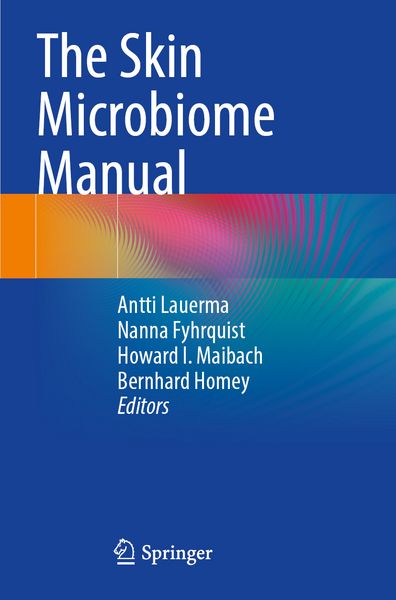
Produktbild: The Skin Microbiome Manual

The Skin Microbiome Manual

Fr. 99.90

inkl. gesetzl. MwSt., Versandkostenfrei


Beschreibung

Produktdetails

Einband

Taschenbuch

Erscheinungsdatum

03.04.2026

Abbildungen

VI, 273 p. 22 illus., 20 illus. in color.

Herausgeber

Antti Lauerma + weitere

Verlag

Springer

Seitenzahl

273

Maße (L/B/H)

23.5/15.5/1.2 cm

Gewicht

480 g

Sprache

Englisch

ISBN

978-3-031-82691-7

Beschreibung

Portrait


Antti Lauerma
is Professor of Dermatology and Allergology at University of Helsinki and Director of Inflammation Center at Helsinki University Hospital. He is an internationally recognized scientist, whose research for the last 40 years has concentrated on skin allergy, development of skin testing, prevention of allergy, as well as the role of inflammatory pathways and microbiome in chronic skin diseases. He has been in leadership positions in scientific societies such as European Society of Contact Dermatitis, European Society for Dermatological Research, European Academy of Allergology and Clinical Immunology and European Academy of Dermatology and Venereology. He is currently chair of Finnish Allergy Research Foundation and Auditor of Nordic Dermatology Association.


Nanna Fyhrquist
is a Researcher at the University of Helsinki. Her research has previously focused on T cell mediated skin inflammation, and in particular on how CD4+ and CD8+ T cells contribute to contact hypersensitivity (CHS) responses and on the role of T regulatory cells in experimental atopic dermatitis. Currently she is leading a project which aims at identifying biomarkers discriminating between human irritant and allergic contact dermatitis, and involved in multiple projects which explore host-microbe interplay in health and allergic disease and autoimmunity.


Howard I. Maibach
is one of the leading US-American dermatologists. He has written and lectured extensively on dermatotoxicology (the toxicity to man from skin exposure) and dermatopharmacology (the treatment of skin diseases). Dr. Maibach has been on the editorial boards of over 30 scientific journals and is a member of 19 professional societies. When seeing patients he mostly provides second opinions on allergic contact dermatitis.


Bernhard Homey
is the Director of the Dept. of Dermatology at the University Hospital Düsseldorf. He is an internationally recognized clinician scientist and immunologist focusing on the underlying mechanisms of chronic inflammatory and autoimmune skin diseases. His research is centered around the biology of cytokines and chemokines, neuroimmune pathways as well as microbe-host interactions. The integration of multi-OMICs datasets including metagenomics and the development of novel therapeutic strategies are current interests.

Produktdetails

Einband

Taschenbuch

Erscheinungsdatum

03.04.2026

Abbildungen

VI, 273 p. 22 illus., 20 illus. in color.

Herausgeber

Verlag

Springer

Seitenzahl

273

Maße (L/B/H)

23.5/15.5/1.2 cm

Gewicht

480 g

Sprache

Englisch

ISBN

978-3-031-82691-7

Herstelleradresse

Springer-Verlag KG
Sachsenplatz 4-6
1201 Wien
AT

Email: ProductSafety@springernature.com

Noch keine Bewertungen vorhanden

Verfassen Sie die erste Bewertung zu diesem Artikel

Helfen Sie anderen Kundinnen und Kunden durch Ihre Meinung.

Kundinnen und Kunden meinen

Bewertungen (0)

  • Produktbild: The Skin Microbiome Manual

  • 1. Effect of cream application in childhood on skin barrier and development of atopic disease.- 2. The human skin microbiome.- 3. Tools to explore human skin microbiota.- 4. Skin microbiota: host interactions in health and disease.- 5. Biodiversity hypothesis: role of the human microbiota in health and disease.- 6. Microbiome in patients this atopic dermatitis.- 7. Skin microbiome in psoriasis.- 8. Host-microbe interactions and the biology of acne vulgaris.- 9. Skin exploitation by viruses.- 10. Skin-dwelling fungus’ role in health and disease.- 11. Skin microbiome: potential for novel diagnostic and therapeutic approaches.- 12. Microbiome of skin: an overview.