Produktbild: The Handbook of Intuitions
Band 57 Vorbesteller

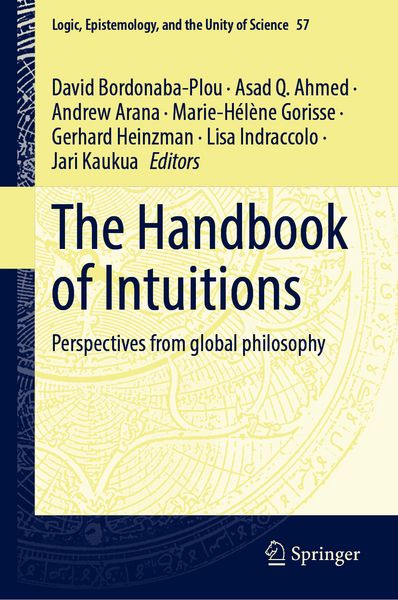
The Handbook of Intuitions Perspectives from global philosophy

Fr. 218.00

inkl. gesetzl. MwSt., Versandkostenfrei


Beschreibung

Produktdetails

Einband

Gebundene Ausgabe

Erscheinungsdatum

20.10.2026

Abbildungen

V, 644 p. 43 illus., 14 illus. in color.

Herausgeber

David Bordonaba-Plou + weitere

Verlag

Springer

Seitenzahl

644

Maße (L/B)

23.5/15.5 cm

Sprache

Englisch

ISBN

978-3-032-27945-3

Beschreibung

Portrait

David Bordonaba-Plou is an assistant professor at the Universidad Complutense de Madrid, Spain. His research focuses on experimental philosophy of language, the role of intuitions, Digital Humanities, and political philosophy of language. He is the principal investigator of the project Intuiciones y Filosofía Experimental del Lenguaje (PID2023-150396OA-I00). In addition to numerous articles, his publications include Experimental Philosophy of Language. Perspectives, Methods, and Prospects (Springer, 2023), (editor).

Asad Q. Ahmed is the Magistretti Distinguished Professor of Middle Eastern Languages and Cultures at UC Berkeley and Director of its Center for Middle Eastern Studies.  His work focuses on Islamic intellectual and social history, especially philosophy, logic, and legal theories. His books include The Religious Elite of the Early Islamic Ḥijāz and Palimpsests of Themselves.

Andrew Arana is Professor of Philosophy at the Université de Lorraine, France, and director of the Archives Henri-Poincaré. His domains of specialisation are the history and philosophy of mathematics, logic, and epistemology. He has published on models of arithmetic, purity of methods, proof theory, projective geometry, mathematical depth, and philosophy of mathematics in the Japanese tradition. He is an editor of Philosophers’ Imprint.

Marie-Hélène Gorisse is Assistant Professor in Jain Studies in the School of Philosophy, Theology and Religion at the University of Birmingham. She specialises in Jain theories of knowledge, interpretation and argumentation. She leads the Dharmanath Network, which enhances the societal impact of Jainism and non-violence through engagement between academic, religious, cultural, and political institutions. She is also co-PI of the project “Global Philosophy of Religion: Fundamental Spiritual Reality, Human Purpose, and Living Well” funded by Templeton (2024–27).

Gerhard Heinzmann is Emeritus Professor of Philosophy at the Department of Philosophy, University of Lorraine at Nancy. Founder of the Research Center Archives Henri–Poincaré, he is the editor of the Publications of the Henri-Poincaré Archives and founder of the journal Philosophia Scientiae. Author of numerous articles and books on the philosophy of mathematics, he is member of the International Academy for Philosophy of Science (Brusssels), the Academia Europaea, the European Academy of Sciences and the International Institute of Philosophy.

Lisa Indraccolo is Associate Professor of Chinese Studies at Tallinn University and affiliated member of the Zurich Center for the Study of the Ancient World. Her research interests include classical Chinese philosophy; early Chinese rhetoric; structural and rhetorical patterns of ancient Chinese texts; conceptual and intellectual history of premodern China; and early cross-cultural encounters among China, Japan, and Korea. She has published extensively on early Chinese philosophy and rhetoric and premodern Chinese intellectual and conceptual history in major journals in the field; and edited and contributed to several volumes and special journal issues.

Jari Kaukua is Academy Professor in philosophy at the University of Jyväskylä. An expert in Avicenna’s philosophy and its Islamic reception, Kaukua is the author of Suhrawardī’s Illuminationism (Brill, 2022) and the award-winning Self-Awareness in Islamic Philosophy (CUP, 2015), as well as the editor of several anthologies and journal special issues. He has published numerous articles on classical and post-classical Islamic philosophy in central fora of the historiography of philosophy.

Produktdetails

Einband

Gebundene Ausgabe

Erscheinungsdatum

20.10.2026

Abbildungen

V, 644 p. 43 illus., 14 illus. in color.

Herausgeber

Verlag

Springer

Seitenzahl

644

Maße (L/B)

23.5/15.5 cm

Sprache

Englisch

ISBN

978-3-032-27945-3

Herstelleradresse

Libri GmbH
Europaallee 1
36244 Bad Hersfeld
DE

Email: GPSR Kontakt

Noch keine Bewertungen vorhanden

Verfassen Sie die erste Bewertung zu diesem Artikel

Helfen Sie anderen Kundinnen und Kunden durch Ihre Meinung.

Kundinnen und Kunden meinen

Bewertungen (0)

  • Produktbild: The Handbook of Intuitions
  • Part 1: South Asian tradition.- Chapter 1: Maṇḍana Miśra on Intuition as a Source of Practical Knowledge (Nilanjan Das).- Chapter 2: Timeless Visions: Prajñākaragupta on Futureless Precognition and Temporal Intuitions (Jed Forman).- Chapter 3: The Importance of Intuitions in Madhva’s Religious Epistemology (Akshay Gupta).- Chapter 4: Bramanubhava and the Limits of Knowledge (Neil Sims).- Chapter 5: Self-Knowledge in Ecstatic "Intuition: Krishnachandra Bhattacharrya’s Intrinsic Relation Between Spiritual Discipline and Philosophical Enquiry (Elise Coquereau-Saouma).- Part 2: Chinese tradition.- Chapter 6: Intuition in the Daoist and Cosmological Tradition (Lisa Raphals).- Chapter 7: Intuition in Early Confucian Philosophy (Dawid Rogacz).- Chapter 8: Intuition and Argumentation in Chinese Philosophy (Yiu-ming Fung).- Chapter 9: Non-volitional Actions and Their Epistemological, Soteriological and Ethical Ramifications in Buddhist Philosophy (Bart Dessein).- Chapter 10: Intuition in Modern and Contemporary Chinese Philosophy (Jana S. Rošker).- Part 3: Japanese tradition.- Chapter 11: Nishida and active intuition (Yasuo Deguchi).- Chapter 12: Intuition in Japan from the perspective of experimental philosophy (Koji Ota).- Chapter 13: Linguistic intuitions in Japanese languages (Chris Davis).- Chapter 14: Intuition in modern Japanese Buddhism (Toshihiro Ōmi).- Chapter 15: Intuition in Japanese philosophy of mathematics (Ryota Akiyoshi).- Part 4: Arabo-Islamic tradition.- Chapter 16: Intuition in Islamic Philosophy, Theology, and Science (Asad Q. Ahmed).- Chapter 17: Intuition in Islamic Legal Theories (Rob Gleave).- Chapter 18: Intuition in Islamic Mysticisms (Muhammad Faruque).- Chapter 19: Intuition in Islamic ‘Occult’ Disciplines (Michael Noble).- Chapter 20: Intuition in Islamic Poetics and Rhetoric.- Part 5: Western tradition - Philosophy of Mathematics.- Chapter 21: Intuition and Phenomenology (Dominique Pradelle).- Chapter 22: The crisis of intuition (Michael Friedman).- Chapter 23: Intuition and the cognitive roots of concepts (Giuseppe Longo).- Chapter 24: Intuition and Constructive Type Theory (Ansten Klev).- Chapter 25: Intuition in Contemporary Mathematics (Jean-Paul Bendegem).- Part 6: Western tradition - Philosophy of Language.- Chapter 26: Linguistics intuitions: what do we know about language use? (María José Frápolli).- Chapter 27: Evidential and Rhetorical Moves in the Study of Language (Jeffrey Maynes).- Chapter 28: Referential Intuitions and Experimental Philosophy of Language (Luís Fernández Moreno).- Chapter 29: Intuitions and theory of reference (Filipo Domaneschi).- Chapter 30: Does intuition talk have an evidential role in philosophy of language? A corpus-based study (David Bordonaba-Plou).