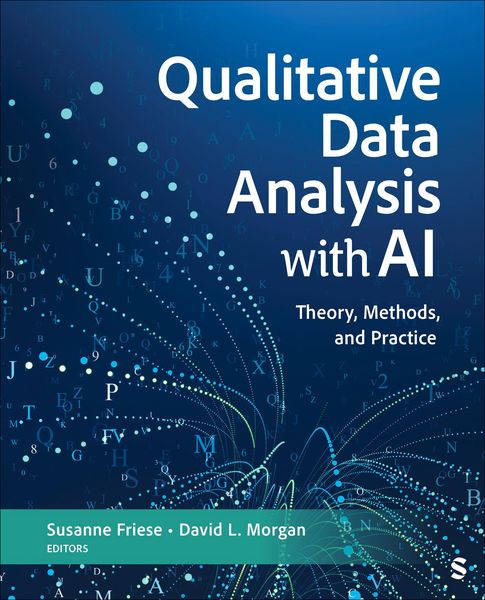
Produktbild: Qualitative Data Analysis With AI
Vorbesteller Neu

Qualitative Data Analysis With AI Theory, Methods, and Practice

Fr. 118.00

inkl. gesetzl. MwSt., Versandkostenfrei


Beschreibung

Produktdetails

Einband

Taschenbuch

Erscheinungsdatum

14.01.2027

Herausgeber

Susanne Friese + weitere

Verlag

Sage Publications

Seitenzahl

304

Maße (L/B)

23.1/18.7 cm

Sprache

Englisch

ISBN

978-1-07-186839-3

Beschreibung

Portrait

Susanne Friese is a scholar of qualitative methods with a long track record in research, teaching, and methodological development. Her work spans interpretive approaches, and the evolution of computer assisted analysis. In recent years, she has become a leading voice in rethinking how qualitative analysis is done in an era shaped by artificial intelligence. Her focus lies on dialogue-based inquiry, transparency, and the integration of AI in ways that strengthen rather than replace human interpretation.


David L. Morgan received his PhD in sociology from the University of Michigan, and is currently an emeritus professor in the Department of Sociology at Portland State University. He is an inter-disciplinary research methodologist, working in both qualitative research and mixed methods research. In addition to artificial intelligence, his research interests include focus groups and mixed methods research. He is the author of more than fifty peer-reviewed articles and author or editor of nine books on research methods; he is currently the series editor for the Qualitative Research Methods Series from Sage (the "little blue books").

Produktdetails

Einband

Taschenbuch

Erscheinungsdatum

14.01.2027

Herausgeber

Verlag

Sage Publications

Seitenzahl

304

Maße (L/B)

23.1/18.7 cm

Sprache

Englisch

ISBN

978-1-07-186839-3

Herstelleradresse

Libri GmbH
Europaallee 1
36244 Bad Hersfeld
DE

Email: gpsr@libri.de

Noch keine Bewertungen vorhanden

Verfassen Sie die erste Bewertung zu diesem Artikel

Helfen Sie anderen Kundinnen und Kunden durch Ihre Meinung.

Kundinnen und Kunden meinen

Bewertungen (0)

  • Produktbild: Qualitative Data Analysis With AI
  • Preface
    Acknowledgement
    Editors
    List of Contributors
    Introduction
    The AI-Cyborg Researcher: A Human-Centered Approach to Qualitative Data Analysis in the Era of Artificial Intelligence, - Sharlene Hesse-Biber
    Introduction
    The Coming of a New Renaissance: The Rise of Artificial Intelligence and Generative Technologies
    The Paradigm Shift from Manual Coding and Computer-Assisted Coding to Prompting
    The Rise of the AI-Cyborg Researcher
    The Cyborg Researcher Guides AI in Feminist Principles of Praxis
    Future Directions: Expanding the AI-Cyborg Researcher Model of Meaning-Making Framework.
    Conclusion
    AI Sandbox: Reflection
    References
    Chapter 2: The Five-Level QDA Method in the Gen-AI Era: Rethinking Qualitative Pedagogy and Practice - Christina Silver
    CAQDAS Pedagogy: The Five-Level QDA Method
    Experiences and Ethos
    Learners' Uncertainties and Expectations
    Pedagogic Aims and Instructional Frameworks
    The Whether-When-How Debate
    Encouraging Critical Reflection
    Contexts Framing Discussion of GenAI for QDA
    Enacting Analytic Tasks via the use of GenAI Tools
    GenAI Conversing as an Example of Tactics Informing Strategies
    Discussion
    Conclusion
    AI Sandbox: Reflection
    References
    Chapter 3: Integrating AI into QDA Software: The Example of MAXQDA - Stefan Rädiker and Udo Kuckartz
    Introduction
    Software and AI in Qualitative Data Analysis
    Overview of AI Features in MAXQDA
    AI in Practice: Support for Qualitative Content Analysis and Grounded Theory
    Integrated AI in MAXQDA vs. External AI Tools like ChatGPT
    Conclusion
    AI Sandbox: Practice
    References
    Chapter 4: An Experiment: Can Consumer Chatbots Analyze Open-Ended Survey Responses? - Jessica Parker, Veronika Richard and Susanne Friese
    Introduction
    Traditional Coding Workflows in Qualitative Survey Analysis
    The value and limits of traditional approaches
    From Human Coding to AI Assisted Coding
    Why This Is Not a Straw-Man Experiment
    The Sample Data Set
    Why Automated Coding Falls Short
    Implications: From Coding to Dialogic Analysis
    Conclusion
    AI Sandbox: Practice
    References
    Appendix: Initial prompt for code frame development
    Chapter 5: Beyond Coding: Conversational AI for Qualitative Analysis with QInsights - Susanne Friese
    Towards a New Perspective on Qualitative Analysis
    The Origins of Coding: A Historical Perspective
    The Emergence of AI and LLMs in Qualitative Analysis
    Understanding and Working with LLMs
    A New Workflow: Engaging with Data Through Questions
    Exemplary Analysis with QInsights
    Methodological Adaptation
    Discussion
    AI Sandbox: Practice
    References
    Chapter 6: Productivity and Quality of using AI for Qualitative Data Analysis in One Research Project - Jonas Wibowo & Hendrik Wiese
    Introduction
    Productivity Promises of Generative AI
    Problematic Dimensions in QDA using GenAI
    Project Description
    Categorical Qualitative Data Analysis as an Analytic Framework
    Study Design for Testing GenAI Supported Categorical QDA
    The Final Procedure
    A Framework for GenAI-Assisted Categorical QDA
    Discussion
    AI Sandbox: Reflection
    References
    Appendix
    Chapter 7: Hybrid interpretation of text-based data with dialogically integrated LLMs. On the use of generative AI in qualitative research - Uwe Krähnke, Thorsten Dresing, and Thorsten Pehl
    Introduction
    Fundamentals, Potentials and Current Developments of AI-supported Analysis of Text-based Empirical Data
    Hybrid Text Interpretation with Multiple, Dialogically Integrated LLMs
    Application Example: Functional Segmentation as a Coping Strategy
    Discussion: Opportunities and Challenges of AI-assisted Qualitative Analysis
    Epistemological Clarification
    Data Protection Compliance and Research Ethics
    Critical Reflection
    AI Sandbox: Practice
    References
    Chapter 8: AI and the Co-Creation of Meaning: Using Large Language Models in Grounded Theory Research - Kai Dröge
    Introduction
    Grounded Theory and AI - An Overview
    The Role of AI in the Research Process
    Sycophancy: Bias Towards User Confirmation
    Common Sense Orientation and Bias
    The Fluid Positionality of AI
    Putting It into Practice: Integrating AI into Grounded Theory Research
    Coding and Memo Writing in the Age of AI
    Close Reading and "Open Data Exploration" Memos
    AI Assisted "Horizontal" Coding
    Consolidating the Emerging Theory and Writing a Report
    Conclusion
    AI Sandbox: Practice
    References
    Chapter 9: Modular Prompting with the Documentary Method: Rethinking Interpretation with AI in Reconstructive Social Research - Fabio Roman Lieder
    Introduction
    Some Theoretical Considerations
    Agency of LLMs in Distributed Interpretation
    Meaning-Making through Modular Prompting
    Some Basics on the Documentary Method
    A Practical Example of Distributed Interpretation via Modular Prompting
    Resulting Hybrid Interpretation
    Evaluating the Result
    Discussion and Outlook
    AI Sandbox: Practice
    References
    Chapter 10: The MERIT Framework: Guiding responsible innovation in qualitative methods - Jessica Nina Lester and Trena M. Paulus
    Introduction
    Defining generative AI
    AI and Qualitative Data Analysis Software
    Guidelines for Responsible AI Use
    Reporting Guidelines for Qualitative Researchers
    A Heuristic for Generating Reporting Guidelines for Qualitative Data Analysis
    Future Directions
    AI Sandbox: Reflection
    References
    Chapter 11: Understanding the Adoption of an Innovation: The Case of AI in Analyzing Qualitative Data - David Morgan
    Diffusion of Innovations
    Conclusions
    References
    Glossary
    References