Vorbesteller
Neu
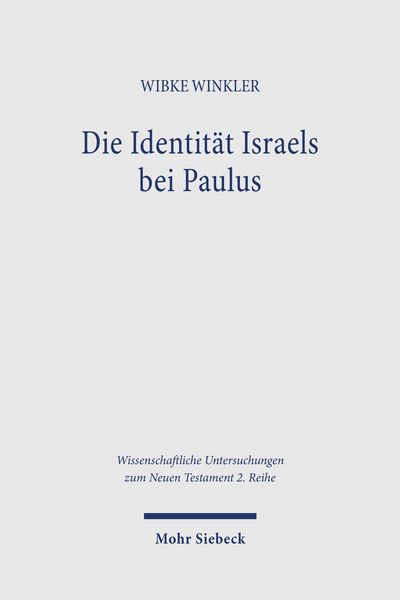
Die Identität Israels bei Paulus Eine Untersuchung des Israel-Begriffs im paulinischen Schrifttum
Aus der Reihe
Wissenschaftliche Untersuchungen zum Neuen Testament 2.
-
- Deutsch ausgewählt
Fr. 142.00
inkl. gesetzl. MwSt.,
Beschreibung
Produktdetails
Einband
Taschenbuch
Erscheinungsdatum
31.01.2027
Verlag
Mohr SiebeckSeitenzahl
430
Maße (L/B)
23.2/15.5 cm
Auflage
1
Sprache
Deutsch
ISBN
978-3-16-161781-2
Wibke Winkler examines the identity of Israel in Paul's letters and develops a coherent understanding of the concept of Israel within the tension between divine election and present distance from Christ. She focuses on the chapters on Israel in the Epistle to the Romans (Rom 9-11) in connection with relevant passages from the Apostle's other letters to the churches in Corinth, Galatia, and Philippi. Winkler shows that for Paul, Israel is dually constituted: at once a community of descent and a community of calling. Both aspects are inextricably intertwined and form the basis for the continuity of the people across generations. Bodily descent grounds a real kinship and genealogical belonging; divine calling and election give this people its theological depth. In this interlocking, Israel is the people of God, its identity rooted both in its origin and in God's enduring turning towards it. In response to views that claim a conceptual division of the term "Israel" in Paul's letters or assume a metaphorical extension to believers in Christ from the nations, the author argues that Paul consistently uses the "Israel" terminology to refer to the members of the people defined by genealogy and calling. Paul does not subsume the Christ-believing community of Gentile and Jewish persons under the category of "Israel" nor does a "remnant" chosen from within Israel denote a second concept of Israel, but rather signifies a differentiation within the same people in the context of salvation history. Paul's concept of Israel thus emerges as semantically stable.
Noch keine Bewertungen vorhanden
Verfassen Sie die erste Bewertung zu diesem Artikel
Helfen Sie anderen Kundinnen und Kunden durch Ihre Meinung.