KI-Beratung Beta

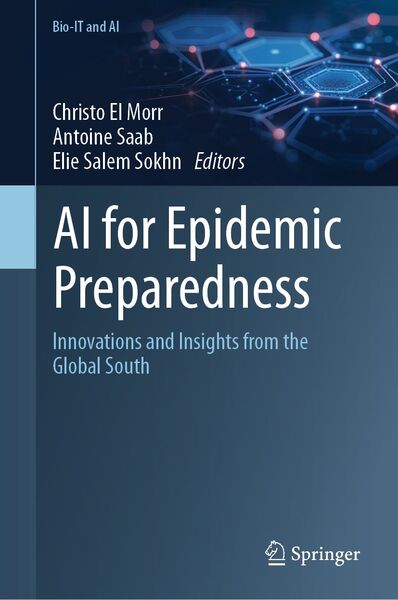
Produktbild: AI for Epidemic Preparedness

AI for Epidemic Preparedness Innovations and Insights from the Global South

Aus der Reihe Bio-IT and AI

Fr. 241.00

inkl. gesetzl. MwSt., Versandkostenfrei


Beschreibung

This book examines how artificial intelligence is being used for epidemic preparedness in the lived realities of the Global South—where infrastructure gaps, fragmented data systems, and unequal governance shape what “innovation” can actually do. Moving beyond algorithmic hype, the chapters analyze real...

Beschreibung

This book examines how artificial intelligence is being used for epidemic preparedness in the lived realities of the Global South—where infrastructure gaps, fragmented data systems, and unequal governance shape what “innovation” can actually do. Moving beyond algorithmic hype, the chapters analyze real deployments and prototypes in resource-constrained settings, spanning deep learning for peripheral blood smear analysis, AI-enabled tuberculosis screening, and predictive models for outbreak surveillance and operational planning. Across these cases, the volume shows how technical performance is inseparable from questions of implementation: data quality, interpretability, workforce capacity, interoperability, and public trust.

Preparedness, the book argues, is not merely a computational challenge but a social and political project. Contributors challenge AI-as-neutral-fix narratives by foregrounding equity, accountability, and the colonial legacies embedded in data extraction and model transfer. The volume advances practical frameworks for ethical governance, data sovereignty, and decolonizing AI—emphasizing participatory design, context adaptation, and epistemic pluralism. Bringing together empirical case studies from Africa, Asia, and the Middle East, it offers researchers, practitioners, and policymakers grounded pathways for building epidemic readiness that is effective, locally legitimate, and just.

book explores innovative applications of AI for epidemic preparedness and response in the Global South. Drawing from real-world projects, it addresses the practical, ethical, and technical challenges of deploying AI technologies for public health emergencies in diverse contexts such as Africa, Asia, Latin America, and the Middle East.

Portrait

Christo El Morr, PhD, is Professor of Health Informatics and Director of the Centre for Feminist Research at York University, Toronto. His Equity Informatics research spans equity AI, patient-centered virtual care, mental health, global health promotion, and disability rights monitoring. He is also a theologian, poet and a novelist.

Antoine Saab, MEng, PhD, is the Quality and Safety Manager at Lebanese Hospital Geitaoui-UMC, Beirut, Lebanon and an Associate Researcher in Health Informatics at LIMICS Laboratory, Sorbonne University, France. His research interests include design and evaluation of Clinical Decision Support Systems for patient safety, clinical risk management and infection control.

Elie Salem-Sokhn, PhD is an Associate Professor of Clinical Microbiology at Beirut Arab University, Lebanon, and Head of the Microbiology and Molecular Biology Departments at the Lebanese Hospital Geitaoui–University Medical Center, Beirut, Lebanon. His research interests include antibiotic resistance in Gram-negative organisms and detection of antibiotic resistance genes by PCR.

Produktdetails

Einband

Gebundene Ausgabe

Erscheinungsdatum

13.09.2026

Abbildungen

XXII, 535 p. 65 illus., 49 illus. in color.

Herausgeber Christo El Morr + weitere

Produktdetails

Einband

Gebundene Ausgabe

Erscheinungsdatum

13.09.2026

Abbildungen

XXII, 535 p. 65 illus., 49 illus. in color.

Herausgeber
Verlag Springer
Seitenzahl

535

Maße (L/B/H)

24.1/16/3.6 cm

Gewicht

947 g

Sprache

Englisch

ISBN

978-3-032-30646-3

Herstelleradresse

Springer-Verlag GmbH
Europaplatz 3
69115 Heidelberg
DE

Email: ProductSafety@springernature.com

Noch keine Bewertungen vorhanden

Verfassen Sie die erste Bewertung zu diesem Artikel

Helfen Sie anderen Kundinnen und Kunden durch Ihre Meinung.

Kundinnen und Kunden meinen

Bewertungen (0)

  • Produktbild: AI for Epidemic Preparedness
  • .- Foundations and Cross-Cutting Themes.

    .- Introduction: Rethinking Epidemic Response in a Digital Age.

    .- Artificial Intelligence: An Introduction.

    .- Contextualizing AI for Epidemic Preparedness in the Global South: Challenges, Opportunities, and Foundational Principles .

    .- AI-based epidemic and pandemic early warning systems: A systematic scoping review.

    .- AI for Early Detection, Surveillance, and Prediction.

    .- AI-Powered Surveillance of Waterborne Pathogens: The INTERACT Project.

    .- Community-Based Early Detection of Zoonotic Diseases: The AI4DECLIC-Senegal Initiative.

    .- Leveraging AI for Enhanced Epidemiological Surveillance in the Global South.

    .- Machine Learning Approaches to Epidemic Forecasting in Resource-Limited Settings.

    .- Strengthening Lebanon’s Pandemic Surveillance through AI-Driven Automation.

    .- Intelligent Early Warning and Response System in Indonesia.

    .- Polio Antenna: Enhancing Surveillance Sensitivity in Ethiopia.

    .- Applications of AI for Early Diagnosis of Tuberculosis in Morocco.

    .- AI and Eco-Epidemiology-Based Early Warning Systems for Aedes-Borne Viruses in the Dominican Republic.

    .- CNRS Early Warning Systems Platforms for Disaster Risk Management.

    .- AI Applications for Public Health Innovation.

    .- Harnessing AI for Cleaner Air: South Africa's Partnership with Evotel.

    .- Blockchain-Enabled AI Architecture for Trustworthy Digital Health in Malaysia.

    .- AI and the One Health Approach in Cameroon: Tackling Re-emerging Diseases.

    .- Use of Artificial Intelligence to Improve Health Outcomes among Vulnerable Populations: Case Studies and Key Considerations.

    .- Telehealth Data for Vulnerable Indigenous Communities: Ethical Considerations.

    .- AI-Driven Biomedical Innovations for Early Disease Detection.

    .- Designing Mechatronic Systems for AI-Enhanced Health Monitoring.

    .- AI Governance, Ethics, and Equity.

    .- Democratizing AI for Pandemic Preparedness: Insights from Latin America and the Caribbean.

    .- AI and Disability Resilience in Pandemic Preparedness: The Ghana Experience.

    .- Towards Responsible AI Governance in the Global South.

    .- Global South Collaboration: Building a Community of Practice.

    .- Lessons Learned and Future Outlook: AI for People, Not Just Pandemics.