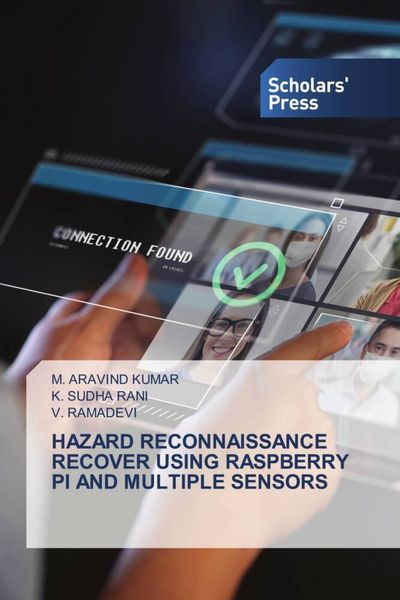
Hazard Reconnaissance Recover Using Raspberry Pi and Multiple Sensors DE
-
- Englisch ausgewählt
Fr. 89.90
inkl. gesetzl. MwSt.,
Beschreibung
Produktdetails
Einband
Taschenbuch
Erscheinungsdatum
30.04.2026
Verlag
Scholars' PressSeitenzahl
92
Maße (L/B/H)
22/15/0.6 cm
Gewicht
155 g
Sprache
Englisch
ISBN
978-620-9-91908-4
The proposed system can be further enhanced by integrating advanced sensors such as CO2, CO, CH , and LPG gas sensors to detect harmful gases, along with radiation and vibration sensors for identifying environmental instability. Additionally, pH and moisture sensors can be used for underground analysis to assess soil conditions. Autonomous navigation can be achieved using ultrasonic sensors for obstacle avoidance, camera-based path detection, and advanced SLAM algorithms for real-time mapping and localization. The system can also incorporate AI-based hazard classification, where machine learning models analyze environmental data to determine danger levels and predict potential risks using historical data. Live video surveillance can be implemented by integrating a Pi Camera, enabling real-time monitoring and streaming through platforms like Blynk. Furthermore, drone integration can extend the system's capabilities by enabling airborne hazard detection in high-risk or inaccessible areas. Finally, cloud data analytics can be used to store and analyze collected data over time, supporting long-term environmental safety assessment and decision-making.
Noch keine Bewertungen vorhanden
Verfassen Sie die erste Bewertung zu diesem Artikel
Helfen Sie anderen Kundinnen und Kunden durch Ihre Meinung.