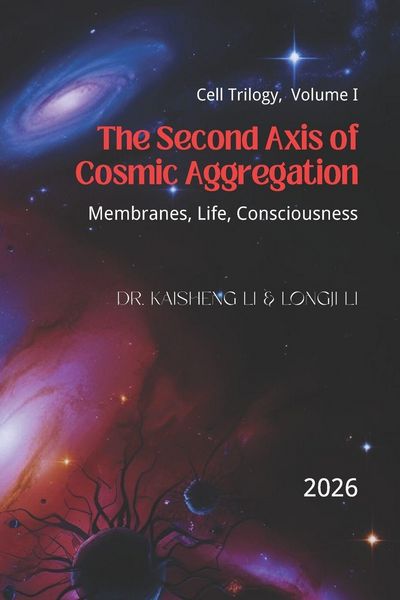
The Second Axis of Cosmic Aggregation Membranes, Life, and Consciousness
-
- Englisch ausgewählt
Fr. 55.90
inkl. gesetzl. MwSt.,
Beschreibung
Produktdetails
Einband
Taschenbuch
Erscheinungsdatum
27.05.2026
Verlag
Independently PublishedSeitenzahl
154
Maße (L/B/H)
22.9/15.2/0.8 cm
Gewicht
216 g
Sprache
Englisch
EAN
9798198815797
This book examines a specific threshold in the history of cosmic complexity: the transition from material and chemical complexity to bounded, life-oriented organization. It begins from the premise that the four fundamental interactions generate the first axis of cosmic aggregation. Through them, particles, nuclei, atoms, molecules, stars, planets, and large-scale cosmic structures become possible. Yet this first axis, however indispensable, does not by itself explain why organic molecules become living systems. Amino acids, nucleotide precursors, fatty acids, mineral surfaces, and energy gradients may all appear in non-living environments, but their presence alone does not produce life.
The central argument of the book is that life requires a second axis of aggregation: enclosure-based aggregation. Lipid membranes and related amphiphilic boundary structures are not treated as a fifth fundamental force. Rather, they are understood as emergent organizational mechanisms grounded in ordinary physical and chemical laws. Their significance lies in their capacity to convert dispersed chemical events into bounded systems. By forming an interior, regulating exchange, preserving gradients, and retaining state differences, membrane-like structures make it possible for molecular complexity to acquire history, direction, and selective relevance.
This framework shifts the question of life's origin from the production of molecules to the organization of molecules. The decisive issue is not simply whether organic compounds can form, but whether they can be held within a system that distinguishes inside from outside, maintains differences across time, and allows those differences to affect later reactions, growth, division, or reorganization. In this sense, information is not first defined as abstract code, metabolism is not first defined as a mature biochemical network, and selection is not assumed to begin only with genes. At the earliest level, information is preserved state difference, metabolism is boundary-organized energy flow, and selection begins when retained differences influence the fate of protocellular systems.
The book therefore positions membranes as threshold mechanisms. They are not life as such, nor are they sufficient to explain consciousness. They are the spatial and functional precondition under which chemistry can begin to behave as a system. From this perspective, the emergence of life is neither a mysterious rupture from physics nor a smooth accumulation of chemical complexity. It is a threshold transition in which material structures become organized interiors, and interiors become capable of retaining, regulating, and comparing states.
The later chapters extend this argument cautiously toward consciousness. The existence of a boundary does not generate subjective experience, and membrane systems should not be confused with minds. Nevertheless, any plausible account of life and consciousness must explain how internal states first became possible. The membrane marks the earliest natural condition under which a system can have a distinguishable interior, preserve state differences, respond to its environment, and develop a history. In this limited but fundamental sense, enclosure-based aggregation provides a bridge between cosmic structure, chemical evolution, biological organization, and the distant preconditions of consciousness.
Kundinnen und Kunden meinen
Verfassen Sie die erste Bewertung zu diesem Artikel
Helfen Sie anderen Kund*innen durch Ihre Meinung