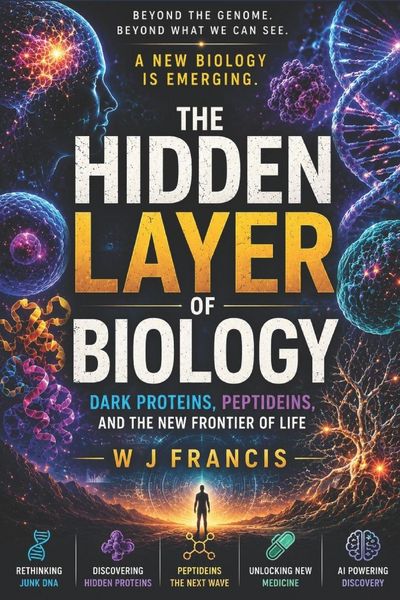
THE HIDDEN LAYER OF BIOLOGY
Dark Proteins, Peptideins, and the New Frontier of Life
For generations, scientists believed they had decoded the blueprint of life.
Then biology began discovering signals where no signals should exist.
Hidden deep within the vast regions once dismissed as
Junk DNA, researchers uncovered an invisible world of
Dark Proteins, mysterious
Microproteins, and unexplained molecular activity operating beyond the boundaries of conventional genetics. What was once considered biological "noise" may in fact contain some of the most important instructions in human life.
In
The Hidden Layer of Biology, a revolutionary new frontier emerges - one that challenges decades of scientific assumptions and reveals the astonishing complexity concealed inside the human genome. At the center of this hidden world lies the
Dark Proteome: a vast network of overlooked proteins, secret cellular signals, and tiny molecular systems that may influence cancer, immunity, brain function, aging, metabolism, and the future of medicine itself.
Among these discoveries are
Peptideins and other hidden proteins - biological molecules so small and elusive that scientists lacked the tools to detect them for decades. Now, powered by breakthroughs in
AI in Biology, machine learning, and next-generation genomics, researchers are beginning to uncover a deeper architecture of life hidden within so-called
Non-Coding DNA.
Blending cutting-edge science with compelling storytelling, this book explores:
- the rise and collapse of the "junk DNA" theory,
- the discovery of hidden proteins inside the genome,
- the rapidly emerging field of Hidden Biology,
- the future of peptide therapeutics and precision medicine,
- and the profound possibility that life is far more layered, adaptive, and mysterious than humanity once imagined.
More than a story about genetics,
The Hidden Layer of Biology is an exploration of scientific blind spots, technological revolutions, and the evolving limits of human knowledge. As science learns to see deeper into living systems, a startling realization begins to emerge:
We may not be approaching the end of biology.
We may only be discovering its hidden foundation.