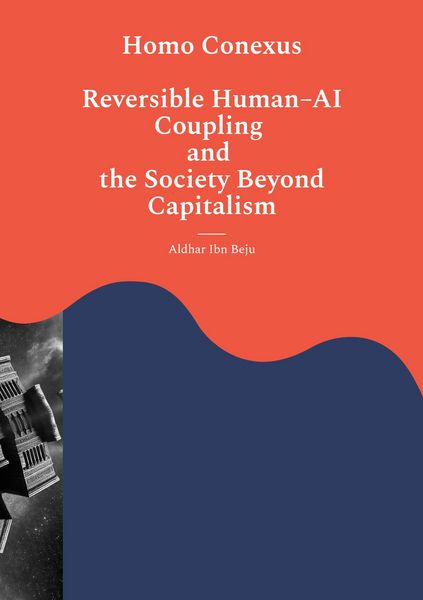
Homo Conexus Reversible Human AI Coupling and the Society Beyond Capitalism
-
- Taschenbuch ausgewählt
- eBook
-
Sprache:Englisch
Fr. 29.90
inkl. gesetzl. MwSt.,
-
Kostenlose Lieferung ab Fr. 30 Einkaufswert
Schweiz & Liechtenstein:
Versandkostenfrei ab Fr. 30.00
Versandkosten bis Fr. 30.00: Fr. 3.50Andere Lieferländer
Fr. 18.00 unabhängig vom Warenwert
Beschreibung
Produktdetails
Einband
Taschenbuch
Erscheinungsdatum
04.06.2026
Verlag
BoD – Books on DemandSeitenzahl
620
Maße (L/B/H)
22/15.5/3.8 cm
Gewicht
972 g
Auflage
1
Sprache
Englisch
ISBN
978-3-696-36788-6
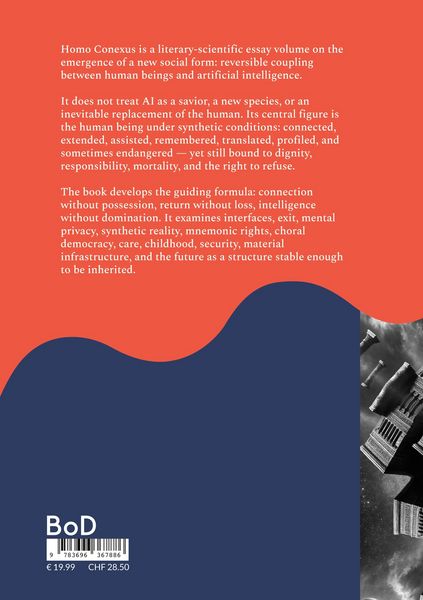
The book develops the guiding formula: connection without possession, return without loss, intelligence without domination. From this center, the essays examine the interface as the first political surface of coupling, the right to exit as the core of freedom, mental privacy and mnemonic rights, synthetic reality and source return, the commons of intelligence, choral democracy, trust without fusion, semantic fairness, threshold hygiene, the right not to continue, children in the synthesis era, security of coupling, care without ownership, and the material weight of artificial intelligence.
The final movement deepens the architecture. Mnemonic Oceans reimagines memory not as storage, but as a dynamic field of traces, currents, drift, attractors, and artificial stabilization. Threshold Beings maps possible development lines of the coupling era, from administrative operationalization to reversible, choral, low-coupling, and care-centered futures. The Future as a Fixpoint asks which future becomes stable enough to be inherited, and why the most humane line will not win unless it becomes coherent, resourced, observable, and reversible.
Between the essays, sung poetry, grotesques, fragments, and the novella The Song of Void open darker and more playful resonance spaces. They do not interrupt the argument; they expose its shadows, absurdities, and mythic pressure points.
The annexes condense the work into a compact apparatus of terms, rights, risk reviews, memory hygiene, development lines, and minimal formalizations. Together, the book is not a manual for AI governance and not a prophecy. It is a large-scale attempt to think the human beyond the old opposition between tool and master, machine and subject, progress and decline.
Its central question is simple and severe: how can human beings enter deep synthetic relations without becoming the property of the systems that help them act?
Noch keine Bewertungen vorhanden
Verfassen Sie die erste Bewertung zu diesem Artikel
Helfen Sie anderen Kundinnen und Kunden durch Ihre Meinung.