Gutscheinbedingungen

*Gültig bis 07.09.2026 auf alle Bücher. Ausgeschlossen sind Zeitschriften, Prozentbücher und Abos | Einlösbar in allen Buchhandlungen von Orell Füssli, Barth Bücher, Buchladen Rapunzel, Schuler Orell Füssli, Stauffacher und ZAP unter Vorweisung des Gutscheins, auf www.orellfüssli.ch durch Eingabe des Gutscheincodes. Beim Service „eBooks verschenken“ und bei eBook-Käufen via eReader nicht einlösbar | Mindesteinkaufswert: Fr. 30.- | Nicht mit anderen Rabatten kumulierbar.

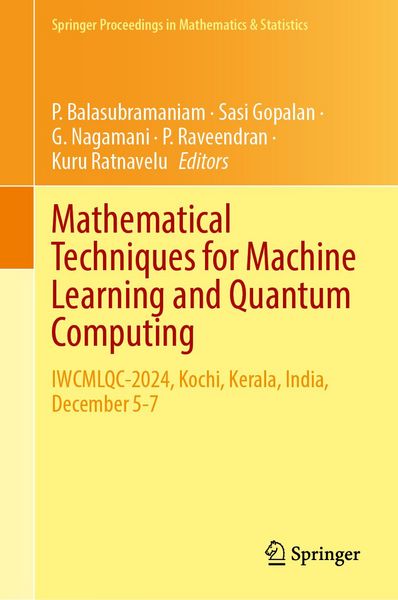
Produktbild: Mathematical Techniques for Machine Learning and Quantum Computing
Band 567 Vorbesteller

Mathematical Techniques for Machine Learning and Quantum Computing IWCMLQC-2024, Kochi, Kerala, India, December 5-7

Fr. 241.00

inkl. gesetzl. MwSt., Versandkostenfrei


Beschreibung

Produktdetails

Einband

Gebundene Ausgabe

Erscheinungsdatum

29.10.2026

Abbildungen

II, 232 p. 57 illus., 40 illus. in color.

Herausgeber

P. Balasubramaniam + weitere

Verlag

Springer Singapore

Seitenzahl

232

Maße (B/H)

15.5/23.5 cm

Sprache

Englisch

ISBN

978-981-9239-11-5

Beschreibung

Portrait

P. Balasubramaniam is a senior professor in the Department of Mathematics, The Gandhigram Rural Institute, Gandhigram, Dindigul, Tamil Nadu, India. He received his Ph.D. degree in mathematics in 1994 in the area of control theory from Bharathiar University, Coimbatore, Tamil Nadu, India, and the D.Sc. degree in the year 2022 from The Gandhigram Rural Institute. His research interest includes stochastic fractional systems, image processing and stability analysis. He received awards including TANSA in 2005, Senior Scientist in 2018, the Mid-Career Award in 2019, and is recognized among the top 2% scientists by Stanford University, USA, in the field of artificial intelligence and image processing, in 2020. He has published over 431 technical papers in journals, conference proceedings, and books, edited books, and special issues in journals.

Sasi Gopalan is a professor in the Department of Mathematics, Cochin University of Science and Technology (CUSAT), Kochi, Kerala, India. He received his MPhil degree in the year 1994 from CUSAT and PhD degree in the year 2010 from M.G. University, Kottayam, Kerala, India, in the area of approximation theory. His area of interest includes optimization, approximation theory, neural network, data mining, and linear algebra. He has published more than 80 international research articles in the area mathematics and computer science.

G. Nagamani is an associate professor in the Department of Mathematics, The Gandhigram Rural Institute, Gandhigram, Dindigul, Tamil Nadu, India. She received her Ph.D. degree in 2011 in the field of mathematical sciences with a specialized area in passivity analysis of neural networks with time-varying delays from the Department of Mathematics in the same university. She received the Tamil Nadu Young Women Scientist Award in 2012 from the Tamil Nadu State Council for Science and Technology for her remarkable research contribution to the field of mathematical sciences. She has published over 83 technical papers in journals, conference proceedings and books, edited books and special issues in journals. Her research interest includes modelling of stochastic differential equations, neural networks, dissipativity and passivity analysis and control theory.

P. Raveendran is an honorary professor in Electrical Engineering at the University of Malaya, Malaysia, where he earlier served as a professor until 2018. He was also a professor at UCSI University’s Institute of Computer Science and Digital Innovation (2019–2021). He earned his bachelor’s and master’s degrees in Electrical Engineering from South Dakota State University, USA, in 1984 and 1985, and briefly worked at Daktronics before joining UM as Lecturer in 1986. In 1994, he received his Doctor of Engineering from the University of Tokushima, Japan, for research in image processing and neural networks. His interests include image/video analysis, EEG signal applications, machine learning, and soft computing, with over 233 publications.

Kurunathan Ratnavelu is a professor at UCSI University, Malaysia, graduated with first-class honors and an M.Sc. in mathematics from the University of Malaya before earning his Ph.D. in atomic physics at Flinders University in 1985 on a research scholarship. He rose from a lecturer in 1989 to a professor in 2001. His pioneering work in atomic collision processes and positron-atom interactions earned him the MOSTE Young Scientist Award (1996) and the Malaysian Toray Science Foundation Award (2004). A Fellow of the Academy of Sciences Malaysia (2005), he also received Flinders University’s Distinguished Alumni Award (2006). His contributions include the optical potential method for positron-hydrogen scattering and co-authoring key work on anti-hydrogen formation. He has held editorial and leadership roles, served as Deputy Dean at UM, and published over 224 papers.

Produktdetails

Einband

Gebundene Ausgabe

Erscheinungsdatum

29.10.2026

Abbildungen

II, 232 p. 57 illus., 40 illus. in color.

Herausgeber

Verlag

Springer Singapore

Seitenzahl

232

Maße (B/H)

15.5/23.5 cm

Sprache

Englisch

ISBN

978-981-9239-11-5

Herstelleradresse

Springer Singapore
No. 12-2F 101 Business Park
47100 Puchong, Selangor D.E.
MY
Email: sdc-bookservice@springer.com
Telephone: +49 6221 3454301
Fax: +49 6221 3454229

Noch keine Bewertungen vorhanden

Verfassen Sie die erste Bewertung zu diesem Artikel

Helfen Sie anderen Kundinnen und Kunden durch Ihre Meinung.

Kundinnen und Kunden meinen

Bewertungen (0)

  • Produktbild: Mathematical Techniques for Machine Learning and Quantum Computing
  • KERNEL METHODS FOR CLASSIFICATION.- Fuzzy Identity Graph of Dihedral Groups.- Natural Language Processing in the Legal Domain: A Comprehensive Survey.- One to Many Party Teleportation Protocol.- Determining the Triple Connected Certified Domination Number for the Mycielskian Graph of Power Graphs.- INTUITIONISTIC LEVEL SUBGROUPS IN THE DIHEDRAL GROUP D5.