KI-Beratung Beta

Produktbild: Revisiting AI Ethics
Vorbesteller Neu

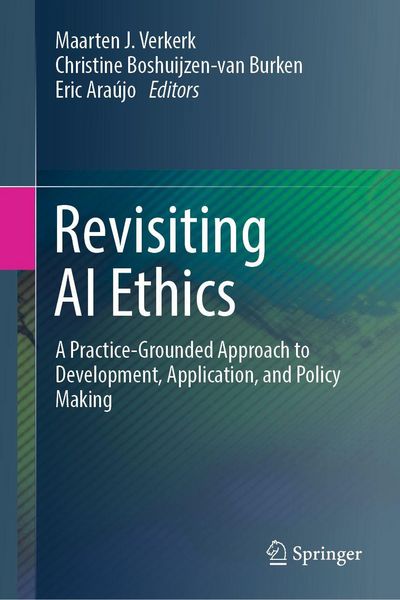
Revisiting AI Ethics A Practice-Grounded Approach to Development, Application, and Policy Making

Fr. 112.00

inkl. gesetzl. MwSt., Versandkostenfrei


Beschreibung

Produktdetails

Einband

Gebundene Ausgabe

Erscheinungsdatum

24.02.2027

Abbildungen

VI, 306 p. 17 illus., 3 illus. in color.

Herausgeber

Maarten J. Verkerk + weitere

Verlag

Springer

Seitenzahl

306

Maße (L/B)

23.5/15.5 cm

Sprache

Englisch

ISBN

978-3-032-41252-2

Beschreibung

Portrait

Maarten J. Verkerk (1953) is a chemist and philosopher whose career has moved between industry, healthcare and the university. He is Professor Emeritus of Reformational Philosophy at Eindhoven University of Technology and at Maastricht University, and served in the Dutch Senate from 2019 to 2023. He spent much of his working life at Philips, then as a director of the Vijverdal psychiatric hospital and of the healthcare innovation network VitaValley, and in 2014 sat on the Schnabel committee advising the Dutch government on end-of-life questions. He has published on philosophy of technology, business ethics and medical ethics, and co-authored Philosophy of Technology (Routledge, 2016), Process Intensification (De Gruyter, 2020) and The Intellectual Legacy of Herman Dooyeweerd (Amsterdam University Press, 2025). His work returns persistently to one question: how abstract philosophical insight becomes a practical decision.

Christine Boshuijzen-van Burken is Associate Professor of Christian Philosophy at Eindhoven University of Technology and a senior researcher at the Faculty of Military Sciences of the Netherlands Defence Academy. She took her doctorate at Eindhoven University of Technology on the role of technology in moral decision-making during military operations, following degrees in human movement engineering, mechanical engineering, and Christian studies of science and society. Her research applies value sensitive design to autonomous systems, particularly in defence, and extends to the ethics of humanitarian logistics for refugees, the sharing economy and normative practices. She has held posts at Delft University of Technology, Queensland University of Technology, Linnaeus University and The University of New South Wales, Canberra. Christine worked as a mechanical engineer in industry, and served as assistant director of the Dutch Research School for Philosophy. She is also a reservist with the Royal Netherlands Army.

Eric Araújo is Associate Professor of Computer Science at Calvin University in Grand Rapids, Michigan. He took his doctorate at the Vrije Universiteit Amsterdam on the computational modelling of social contagion, after degrees in Brazil at UFMG and UFV. His research uses agent-based modelling and complex network analysis to study how behaviours, opinions and sentiments spread through societies, currently focused on the computational modelling of Christian and religious communities and on church polarisation, with continuing threads in crime and urban networks, political polarisation and public health. A parallel strand applies large language models to early Christian texts to recover the roles of women in the early church. He founded the Behavioural Informatics Laboratory (BILbo), and his current work is supported by a Calvin Research Fellowship and a Nagel Institute Fellowship.

Produktdetails

Einband

Gebundene Ausgabe

Erscheinungsdatum

24.02.2027

Abbildungen

VI, 306 p. 17 illus., 3 illus. in color.

Herausgeber

Verlag

Springer

Seitenzahl

306

Maße (L/B)

23.5/15.5 cm

Sprache

Englisch

ISBN

978-3-032-41252-2

Herstelleradresse

Springer-Verlag GmbH
Europaplatz 3
69115 Heidelberg
DE

Email: ProductSafety@springernature.com

Noch keine Bewertungen vorhanden

Verfassen Sie die erste Bewertung zu diesem Artikel

Helfen Sie anderen Kundinnen und Kunden durch Ihre Meinung.

Kundinnen und Kunden meinen

Bewertungen (0)

  • Produktbild: Revisiting AI Ethics
  • .- Introduction.
    .- Exploring the Field.
    .- AI Ethics Frameworks: A Pandemonium.
    .- AI Demystifying the Technology.
    .- Exploring Ethics: A Practice-Grounded Approach.
    .- Five Lenses Model: A Heuristic for AI Ethics.
    .- AI in Action.
    .- AI and the Digital Public Square: The Normative Landscape of Social Media Algorithms.
    .- AI and Sex: Re-thinking Design and Development of Sex Tech to Support Sexual Flourishing.
    .- AI and Healthcare: Trade-offs in Development and Application of AI Technology for Patient Care.
    .- AI and Banking: Blind Spots, Challenges, and Flourishing of Society.
    .- AI and Military Operations: The Case of Lavender.
    .- AI and Court: The Use of Automatic Speaker Comparison in Forensic Practice.
    .- AI and Public Administration: Simply Tech Support?.
    .- AI and Farming: Towards a Sustainable and Equitable Agriculture.
    .- AI and Cybersecurity: Navigating the Ethics of Artificial Intelligence.
    .- AI and Engineering: Design of Wind Turbine Foundations and the Estimation of Project Costs.
    .- AI and Education: A Non-Reductionist Critique of Learning with or without Generative AI.
    .- AI and Research: Voices of Novice Researchers Matter.
    .- AI and Generativity: A Multi-Aspectual Analysis of Affordances, Reductions and Ethical Responses.
    .- Deep Dive.
    .- Thinking About Practices: The Philosophical Basis of the Five Lenses Model.
    .- Learning Lessons from the First Wave of AI for Future AI.
    .- AI and the Human/Machine Distinction: Intelligence and Agency.
    .- AI and Worldview.
    .- Foreign Electoral Interference and the Rule of Law: AI Shield, Responsibility Gap, and State Accountability.
    .- Wisdom of the Spheres: AI, Situational Awareness, and Our World of Personal Relations.
    .- Revisiting AI Ethics.