KI-Beratung Beta

Produktbild: Buddhism in Latin America and the Caribbean
Vorbesteller Neu

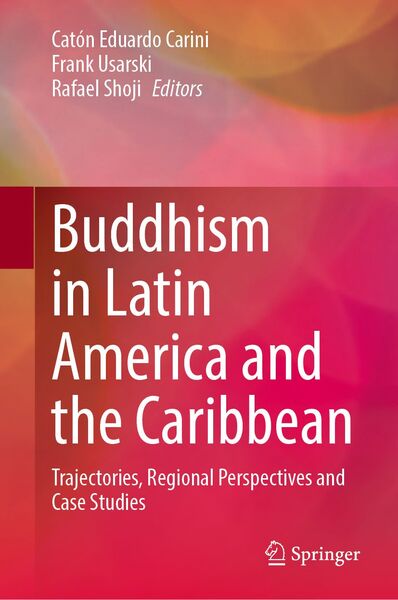
Buddhism in Latin America and the Caribbean Trajectories, Regional Perspectives and Case Studies

Fr. 181.00

inkl. gesetzl. MwSt., Versandkostenfrei


Beschreibung

This book offers a comprehensive examination of the historical development, institutional diversity, and contemporary dynamics of Buddhism across Latin America and the Caribbean. It brings together original chapters and translations of articles originally published in Portuguese and Spanish by a group...

Beschreibung

This book offers a comprehensive examination of the historical development, institutional diversity, and contemporary dynamics of Buddhism across Latin America and the Caribbean. It brings together original chapters and translations of articles originally published in Portuguese and Spanish by a group of scholars whose pioneering work addresses a significant gap in the study of global and transnational Buddhism by focusing on a region that has received comparatively limited attention in the fields of Religious Studies, Sociology of Religion, Anthropology, and Latin American Studies.

Organized into three parts, the book combines a regional overview with country-level analyses and thematic case studies. Chapters explore Buddhist communities and institutions in Brazil, Peru, Argentina, Chile, Venezuela, Mexico, Central America, the Caribbean, and other countries of South America, highlighting the role of Japanese migration, ethnic Buddhist traditions, religious transplantation, conversion, and institutional formation. The volume also analyzes processes of adaptation, glocalization, self-orientalism, religious legitimation, and intercultural exchange, as well as the intersections of Buddhism with literature, philosophy, science, ritual practice, food, and popular religiosity.

Combining fieldwork, archival research, comparative analysis, and sociological perspectives, Buddhism in Latin America and the Caribbean: Trajectories, Regional Perspectives and Case Studies demonstrates how Buddhist traditions have been reinterpreted within diverse Latin American and Caribbean contexts while maintaining connections to wider transnational networks. By bringing together regional surveys and detailed empirical studies, it provides an important resource for understanding the place of Buddhism in contemporary Latin American religious landscapes and contributes to broader discussions on religious mobility, globalization, and cultural transformation.

Some chapters in this book are translations of articles originally published in Portuguese and Spanish. The translation of these articles into English was done with the help of artificial intelligence. A subsequent human revision was done primarily in terms of content.
Portrait

Frank Usarski, PhD in the field of the Study of Religion, is a professor at the Pontifical Catholic University of São Paulo, Brazil. He is the coordinator of the research group CERAL (Centro de Estudos de Religiões Orientais no Brasil) that is investigating the history and contemporary situation of Buddhism and other traditional and “new” Eastern religions in Brazil and Latin America. He is the founder and editor-in-chief both of the periodical "REVER – Revista de Estudos da Religião", the first fulltext online-journal on Religious Studies in Latin America, and of the International Journal of Latin American Religions.

Catón Eduardo Carini is an anthropologist who received his BA from the National University of La Plata (2004), his MA in Social Anthropology from the Latin American Faculty of Social Sciences (FLACSO, 2009), and his PhD in Anthropology in 2012, with a dissertation on Zen Buddhism in Argentina. He is currently Professor at the School of Psychology of the National University of La Plata and an Independent Researcher at the National Council for Scientific and Technical Research (CONICET, Argentina). His research interests focus on the anthropology of religion, particularly the sociological, historical, ritual, and symbolic dimensions of Buddhist centers established in Argentina in recent decades. He has published articles in national and international peer-reviewed journals, as well as book chapters published in Argentina and abroad.

Rafael Shoji holds a Ph.D. in Religious Studies from Leibniz University Hannover (Germany), is a researcher at the Center for the Study of Oriental Religions (CERAL) at Pontifical Catholic University of Sao Paulo and also serves as the managing partner of Eval Digital, specializing in applied cryptography and generative AI. He was a research fellow at the Japan Foundation from 2006 to 2007 and at the Nanzan Institute for Religion and Culture (Nagoya, Japan) from 2010 to 2011. As a scholar in religious studies, he focuses on and has published extensively on Buddhism and Japanese religions in Brazil, as well as on the transformation of religions through technology.

Produktdetails

Einband

Gebundene Ausgabe

Erscheinungsdatum

02.04.2027

Abbildungen

IV, 316 p.

Herausgeber Catón Eduardo Carini + weitere

Produktdetails

Einband

Gebundene Ausgabe

Erscheinungsdatum

02.04.2027

Abbildungen

IV, 316 p.

Herausgeber
Verlag Springer
Seitenzahl

316

Maße (B/H)

15.5/23.5 cm

Sprache

Englisch

ISBN

978-3-032-43733-4

Herstelleradresse

Springer International Publishing AG
Gewerbestr. 11
6330 Cham
Schweiz
Url: www.springer.com

Noch keine Bewertungen vorhanden

Verfassen Sie die erste Bewertung zu diesem Artikel

Helfen Sie anderen Kundinnen und Kunden durch Ihre Meinung.

Kundinnen und Kunden meinen

Bewertungen (0)

  • Produktbild: Buddhism in Latin America and the Caribbean
  • Part I- Overview: Chapter 1: Facets of Institutionalized Buddhism in Latin America and the Caribbean.- Part II: Country Profiles: Chapter 2: The dialectic between Japanese immigration and Japanese-ethnic Buddhism in Brazil.- Chapter 3: Buddhism of Japanese Immigrants within the Scope of Brazilian Buddhism.- Chapter 4: Decline of “Yellow” Buddhism in Brazil.- Chapter 5: Buddhism in Peru – Transplantation and Contemporary Post-Nikkei Dynamics.- Chapter 6: Institutionalized Buddhism in Argentina.- Chapter 7: Buddhism in Chile.- Chapter 8: Institutionalized Buddhism in Venezuela.- Chapter 9: Institutionalized Buddhism in Uruguay, Bolivia, and Paraguay.- Chapter 10: Institutionalized Buddhism in Panama, Colombia, Ecuador, and French Guiana.- Chapter 11: Institutionalized Buddhism in Mexico.- Chapter 12: Buddhism in Central America and the Caribbean: A Sociological Analysis through Glocalization and Self-Orientalism.- Part III: Case Studies: Local Contexts and Transcultural Encounters: Chapter 13: Reinterpretation of Chinese and Korean Buddhism in Brazil.- Chapter 14: Continuum of Japanese-Brazilian Religiosity: The Case of Shingon Karmic Buddhism.- Chapter 15: The Early Reception of Buddhism in Latin American Literature and Philosophy.- Chapter 16: Buddhism, Science, and Modernity: Explorations on Religious Legitimation.- Chapter 17: Cuisine, Ritual, and Community in Argentine Buddhism: Food Practices from an Ethnographic Perspective.- Chapter 18: Brazilian Honji Suijaku: Combinatory Paradigms and Our Lady of Aparecida.