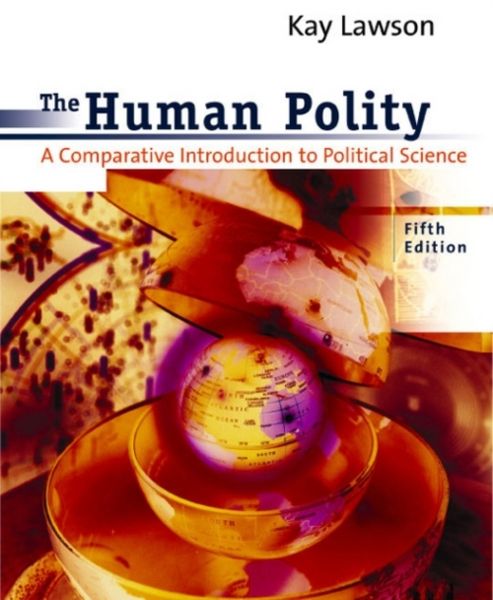
Produktbild: Human Polity 5/e

Human Polity 5/e A Comparative Introduction to Political Science

Fr. 54.90

inkl. gesetzl. MwSt., Versandkostenfrei


Beschreibung

Produktdetails

Einband

Taschenbuch

Erscheinungsdatum

01.12.2002

Verlag

Cengage Learning

Seitenzahl

605

Maße (L/B/H)

23.1/19.3/2.2 cm

Gewicht

940 g

Auflage

5. Auflage

Sprache

Englisch

ISBN

978-0-618-04364-4

Beschreibung

Produktdetails

Einband

Taschenbuch

Erscheinungsdatum

01.12.2002

Verlag

Cengage Learning

Seitenzahl

605

Maße (L/B/H)

23.1/19.3/2.2 cm

Gewicht

940 g

Auflage

5. Auflage

Sprache

Englisch

ISBN

978-0-618-04364-4

Noch keine Bewertungen vorhanden

Verfassen Sie die erste Bewertung zu diesem Artikel

Helfen Sie anderen Kundinnen und Kunden durch Ihre Meinung.

Kundinnen und Kunden meinen

Bewertungen (0)

  • Produktbild: Human Polity 5/e
  • Note: Each chapter ends with a Summary and Conclusion and Questions to Consider.
    I. The Work of Political Science in an Era of Globalization
    1. Political Science in an Era of Globalization
    Political Science and the Human Polity
    The Subjects of Political Science
    The Work of Political Science
    II. Shaping Political Thought
    2. Political Ideologies
    What Is an Ideology?
    Is an Ism Always an Ideology?
    Beyond Ideology
    3. Politics and Culture
    The Political Culture of the Nation-State
    Culture Bases of Subnationalism
    Impact of Cultural Divisiveness on the Nation-state: Yugoslavia and Canada
    Explaining Commitment to a Subnational Group: Identity Theory
    Cultural Dissemination of Political Values: Political Socialization
    III. Acting in Politics
    4. The Individual in Politics
    Individual Motives for Participation in Politics
    Measuring Motives
    Modes of Individual Participation
    Participation by Voting in Elections
    Access: How Welcome Is Individual Participation?
    5. Organizing for Politics: The Group
    Interest Groups
    A Special Problem of Interest Group Behavior: Extraconstitutionalism
    Violent Revolutionary Organizations
    6. Political Parties
    Political Parties as a Unique Form of Political Organization
    The Functions of Political Parties
    The Origins of Political Parties
    Party Organization
    The Members of Parties
    The Selection of Candidates
    Preparing the Campaign
    Executing the Campaign: Parties and the Media
    Parties in Government
    Types of Parties
    Types of Party Systems
    The Role of Parties Today
    7. Acting in International Politics
    Actors Shaping International Politics
    Contemporary Issues International Conflicts
    Actors Resolving International Conflicts
    IV. Governing Nation-States
    8. Making the Laws
    Lawmaking in the Legislature
    The Relationship Between Legislative and Executive Power
    Representation: Legislature and Their Constituents
    Cameras, Committees, and Customs: Other Variations in Legislatures
    Lawmaking by the Executive
    Lawmaking by Judges
    Lawmaking by Political Parties
    9. Making Government Work: Executives and Bureaucrats
    Becoming a Leader
    Leaving Power
    What Chief Executives Do
    The Bureaucracy
    Too Much Government? Or Too Little?
    10. Public Policy
    What Is a Public Policy?
    What Determines What Public Policy Will Be?
    Public Policies Today
    11. Justice Under the Law
    What Is Justice?
    Choosing Credible Judges
    An Independent Judiciary: Theory and Practice
    Guidelines for Adjudication: The Kinds of Kinds of Laws
    Regional Variations in the Rule of Law: Legal Cultures
    Convergence of Legal Systems
    12. Levels of Government within the States
    The Nature of Subnational Government
    Unitary, Federal, and Confederal Political Systems
    Intermediate Level of Governments
    Dilemmas of Subnationalilsm
    V. Governing the World
    13. International and Regional Government
    The History andTypes of International Government
    How International Relations Changed After World War II
    The Contemporary International System
    14. Political and Economic Globalization
    Prospects for Global Democracy
    Kinds of Transitions
    International Agents of Economic Globalization
    Impact of Economic Globalization on National Economies