
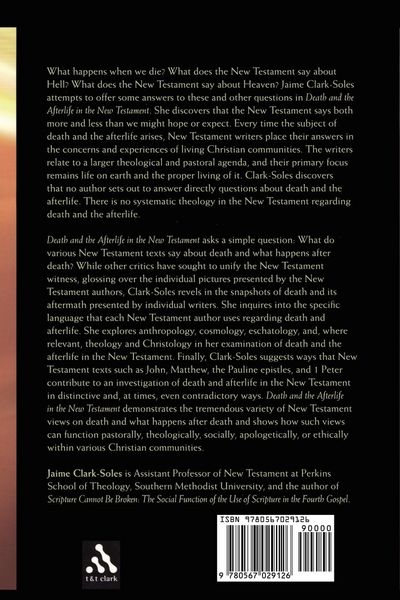
Death and the Afterlife in the New Testament
-
- Taschenbuch ausgewählt
- eBook
-
Sprache:Englisch
Fr. 81.90
inkl. gesetzl. MwSt.,
Beschreibung
Produktdetails
Einband
Taschenbuch
Erscheinungsdatum
15.11.2006
Verlag
Bloomsbury USASeitenzahl
272
Maße (L/B/H)
22.9/15.2/1.5 cm
Gewicht
399 g
Sprache
Englisch
ISBN
978-0-567-02912-6
Clark-Soles began this project in order to answer the question, "What exactly does the New Testament say about death and afterlife?" It turns out that it says both more and less than one might hope or expect. By more, she means that every time the subject of death and what happens after death arises, it is clear that the authors' interests far exceed answering that single question. Their comments emerge from the concerns and experiences of living Christian communities, they relate to a larger theological and pastoral agenda, and their primary focus remains life on earth and the proper living of it.
The texts say less than one may hope because no author sets out to answer my question directly. There is no systematic theology in the New Testament regarding death and aftelife. Certainly resurrection appears throughout, though differently emphasized and interpreted. Beyond that, the fascinating aspects of the question are in the details of the texts. Therefore, the appropriate question, as it turns out, is not: What does the New Testament say about death and afterlife, but what do various New Testament texts say about it? Others have sought to unify the New Testament witness, glossing over the individual pictures presented by the New Testament authors. Clark-Soles revels in the snapshots of the individuals and am less interested in the family photo.
Clark-Soles inquires into the specific language that each author uses regarding death and afterlife. She explores anthropology, cosmology, eschatology, and, where relevant, theology and Christology. Finally, Clark-Soles suggests ways that the stated views function in each situation.
Noch keine Bewertungen vorhanden
Verfassen Sie die erste Bewertung zu diesem Artikel
Helfen Sie anderen Kundinnen und Kunden durch Ihre Meinung.