KI-Beratung Beta

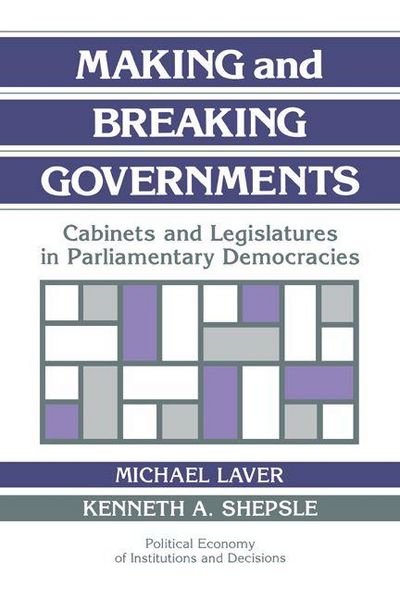
  • Produktbild: Making and Breaking Governments
  • Produktbild: Making and Breaking Governments

Making and Breaking Governments Cabinets and Legislatures in Parliamentary Democracies

Fr. 55.90

inkl. gesetzl. MwSt., Versandkostenfrei


Beschreibung

Making and Breaking Governments offers a theoretical argument about how parliamentary democracy works. The heart of a parliamentary regime is the process by which the elected representatives choose a government, consisting of a cabinet and ministers, to serve as the executive arm of the regime. Strategic...

Beschreibung

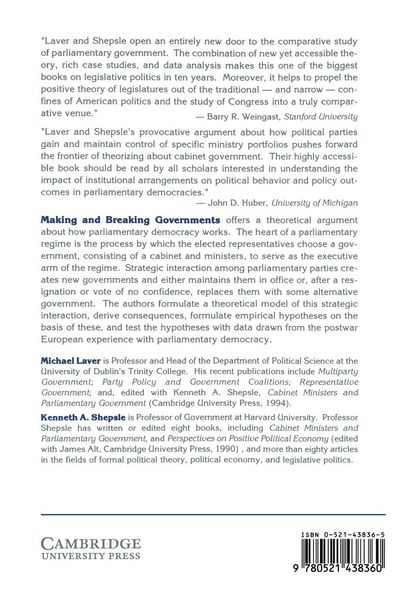
Making and Breaking Governments offers a theoretical argument about how parliamentary democracy works. The heart of a parliamentary regime is the process by which the elected representatives choose a government, consisting of a cabinet and ministers, to serve as the executive arm of the regime. Strategic interaction among parliamentary parties creates new governments and either maintains them in office or, after a resignation or vote of no confidence, replaces them with some alternative government. The authors formulate a theoretical model of this strategic interaction, derive consequences, formulate empirical hypotheses on the basis of these, and test the hypotheses with data drawn from the postwar European experience with parliamentary democracy.

Produktdetails

Einband

Taschenbuch

Erscheinungsdatum

05.01.2004

Herausgeber Laver Michael + weitere
Verlag Cambridge Academic

Produktdetails

Einband

Taschenbuch

Erscheinungsdatum

05.01.2004

Herausgeber
Verlag Cambridge Academic
Seitenzahl

316

Maße (L/B/H)

22.9/15.2/1.9 cm

Gewicht

470 g

Sprache

Englisch

ISBN

978-0-521-43836-0

Noch keine Bewertungen vorhanden

Verfassen Sie die erste Bewertung zu diesem Artikel

Helfen Sie anderen Kundinnen und Kunden durch Ihre Meinung.

Kundinnen und Kunden meinen

Bewertungen (0)

  • Produktbild: Making and Breaking Governments
  • Produktbild: Making and Breaking Governments
  • Series editors' preface; Acknowledgements; Part I. The Context: 1. Theory, institutions, and government formation; 2. The social context of government formation; 3. The government formation process; Part II. The Model: 4. Government equilibrium; 5. Strong parties; Part III. Empirical Investigations: 6. Two cases: Germany, 1987; Ireland, 1992-3; 7. Theoretical implications, data, and operationalization; 8. Exploring the model: a comparative perspective; 9. A multivariate investigation of portfolio allocation; Part IV. Applications, Extensions, and Conclusions: 10. Party systems and cabinet stability; 11. Making the model more realistic; 12. Party politics and administrative reform; 13. Governments and parliaments; Bibliography.