
KI-Beratung Beta

  • Produktbild: Cotton, F: Solutions Manual T/A Basic Inorg Ch
  • Produktbild: Cotton, F: Solutions Manual T/A Basic Inorg Ch

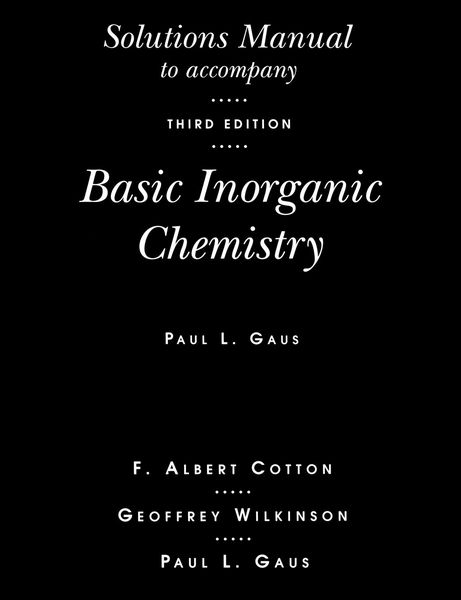
Cotton, F: Solutions Manual T/A Basic Inorg Ch

Fr. 105.00

inkl. gesetzl. MwSt., Versandkostenfrei


Beschreibung

Explains the basics of inorganic chemistry with a primary emphasis on facts; then uses the student s growing factual knowledge as a foundation for discussing the important principles of periodicity in structure, bonding and reactivity. New to this updated edition: improved treatment of atomic orbitals...

Beschreibung

Explains the basics of inorganic chemistry with a primary emphasis on facts; then uses the student s growing factual knowledge as a foundation for discussing the important principles of periodicity in structure, bonding and reactivity. New to this updated edition: improved treatment of atomic orbitals and properties such as electronegativity, novel approaches to the depiction of ionic structures, nomenclature for transition metal compounds, quantitative approaches to acid-base chemistry, Wade s rules for boranes and carboranes, the chemistry of major new classes of substances including fullerenes and silenes plus a chapter on the inorganic solid state.

Produktdetails

Einband

Taschenbuch

Erscheinungsdatum

15.03.1995

Verlag John Wiley & Sons
Seitenzahl

224

Produktdetails

Einband

Taschenbuch

Erscheinungsdatum

15.03.1995

Verlag John Wiley & Sons
Seitenzahl

224

Maße (L/B/H)

24.6/18.9/1.2 cm

Gewicht

443 g

Auflage

3. Auflage

Sprache

Englisch

ISBN

978-0-471-51808-2

Noch keine Bewertungen vorhanden

Verfassen Sie die erste Bewertung zu diesem Artikel

Helfen Sie anderen Kundinnen und Kunden durch Ihre Meinung.

Kundinnen und Kunden meinen

Bewertungen (0)

  • Produktbild: Cotton, F: Solutions Manual T/A Basic Inorg Ch
  • Produktbild: Cotton, F: Solutions Manual T/A Basic Inorg Ch
  • Partial table of contents:

    FIRST PRINCIPLES.

    Some Preliminaries.

    Structure and Bonding in Molecules.

    The Chemistry of Selected Anions.

    Solvents, Solutions, Acids, and Bases.

    THE MAIN GROUP ELEMENTS.

    Hydrogen.

    The Group IIA(2) Elements: Beryllium, Magnesium, Calcium,Strontium, and Barium.

    The Group IIIB(13) Elements: Aluminum, Gallium, Indium, andThallium.

    The Group IVB(14) Elements: Silicon, Germanium, Tin, andLead.

    The Group VB(15) Elements: Phosphorus, Arsenic, Antimony, andBismuth.

    The Group VIB(16) Elements: Sulfur, Selenium, Tellurium, andPolonium.

    The Noble Gases.

    TRANSITION ELEMENTS.

    Introduction to the Transition Elements: Ligand Field Theory.

    The Elements of the Second and Third Transition Series.

    The Actinide Elements.

    SOME SPECIAL TOPICS.

    Organometallic Compounds.

    Bioinorganic Chemistry.

    Appendices.

    Glossary.

    Index.