
Excess Anti-Consumerism in the West
-
- Hardcover
- Taschenbuch ausgewählt
- eBook
-
Sprache:Englisch
Fr. 37.90
inkl. gesetzl. MwSt.,
Beschreibung
Produktdetails
Einband
Taschenbuch
Erscheinungsdatum
01.01.2010
Verlag
WileySeitenzahl
224
Maße (L/B/H)
20.8/13.7/2.3 cm
Gewicht
340 g
Sprache
Englisch
ISBN
978-0-7456-4541-4
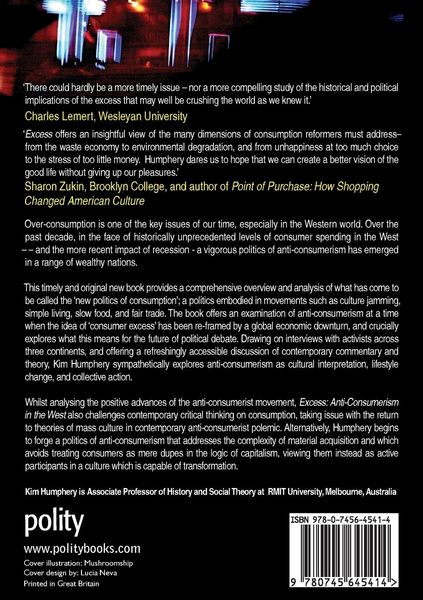
Over-consumption is one of the key issues of our time; especially in the Western world. Over the past decade, in the face of historically unprecedented levels of consumer spending in the West - and the more recent threat of economic recession - a vigorous politics of anti-consumerism has emerged in a range of wealthy nations.
This timely and original new book provides a comprehensive overview and analysis of what has come to be called the 'new politics of consumption'; a politics embodied in movements such as culture jamming, simple living, slow food and fair trade. The book offers an examination of anti-consumerism at a time when the idea of 'consumer excess' is being re-framed by global recession, and crucially explores what this means for the future of the debates. Drawing on interviews with activists across three continents, and offering a refreshingly accessible discussion of contemporary commentary and theory, Kim Humphery sympathetically explores anti-consumerism as cultural interpretation, lifestyle change, and collective action.
While analysing the positive advances of the anti-consumerist movement, Excess: Anti-consumerism in the West also challenges contemporary critical thinking on consumerism. Humphery takes issue with the return to theories of mass culture in the contemporary anti-consumerist polemic and with the tendency for critics to indulge in a high moralism, a pop psychologism, and a self-helpism, all directed more so at the individual as consumer than at the institutions of commercial and political power that drive the systems of consumption. Alternatively, Humphery begins to forge a politics of anti-consumerism that addresses the complexity of material acquisition, which avoids treating consumers as mere dupes in the logic of capitalism, viewing them instead as active participants in a culture which is capable of transformation.
Noch keine Bewertungen vorhanden
Verfassen Sie die erste Bewertung zu diesem Artikel
Helfen Sie anderen Kundinnen und Kunden durch Ihre Meinung.