Zitat
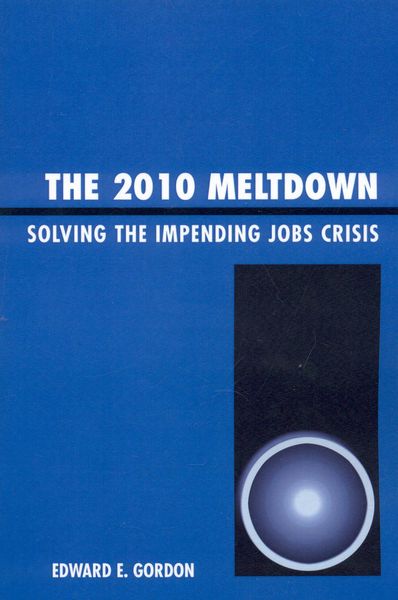
Ed Gordon's latest book, The 2010 Meltdown, builds off his earlier success, Skill Wars, and makes a convincing case that organizations failing to be proactive to help create a skilled labor pool may very well face their own demise in the long term. The City Line The book made me think about how we as Canadians are preparing, or not preparing, for the inevitable...It was one of the best books I have read lately to help explain why the War for Talent is imminent. Canadian Career Information Association, November 2005 Whether you work in a business, service sector, nonprofit organization, governmental agency or school setting, Gordon's book prompts critical thinking about where we are headed and what we need to be both discussing and taking action upon in order to prevent a 2010 meltdown of our workforce and our economy...Read The 2010 Meltdown: Solving the Impending Jobs Crisis...[t]o gather ideas for solving the impending crisis in filling jobs of all kinds. Idaho Press - Tribune, April 2, 2006 In this thought-provoking book, Gordon lays out the critical situation employers will face - do face - in finding and holding employees who have the education and training to get the job done...Recommended for business leaders, educators, human resource professionals, politicians, and enlightened citizens who are dedicated to making a difference for the generations that will follow us. Midwest Book Review You can benefit from reading The 2010 Meltdown...Gordon admonishes U.S. businesses for slashing their training budgets when times are tough. Executive development, sales training, advanced technical training and continuing professional education are still being offered, but only for 25% of the work force. Gordon challenges readers to change what he calls an antiquated American culture that divides most of the work force into two worlds: white-collar managers and professionals who are in the upperand middle classes, and blue-collar manual laborers who mostly remain in the lower class. Despite some of the bleak findings and comments, Gordon's book is hopeful. He calls for action to avoid a major meltdown in our work force and describes model programs involving partnerships between educators, employers and community organizations that pave the way for others who want to work for change.. The Milwaukee Sentinel, January 15, 2006 Gordon, business and education consultant, challenges policy makers to address the anticipated shortage of highly educated and technically trained workers, which he attributes in large part to technology growth, globalization, and baby-boomer retirements. He describes a cultural lag that has led to "techno-peasants" who drop out of high school, have outdated career skills, and seem destined for low-paying jobs, and a business environment that focuses too much on short-term profits, outsourcing, and importing temporary workers. To produce a more educated and technically skilled workforce, he recommends a cultural change in which parents are more involved in their children's education. He also discusses how community involvement in education can be enhanced with the development of NGOs that involve businesses in local community organizations such as chambers of commerce and service clubs to guide students to new careers. A wide variety of schools such as the Fargo Skills and Technology Training Center and corporations such as Hewlett-Packard have aided technical education. The book includes numerous examples of education programs and tables comparing American education to that of other countries. The 2010 Meltdown is especially useful for business professionals, policymakers, and educators. The Choice, March 2006 You can benefit from reading The 2010 Meltdown...Gordon admonishes U.S. businesses for slashing their training budgets when times are tough. Executive development, sales training, advanced technical training and continuing professional education are still being offered, but only for 25% of the work force. Gordon challenges readers to change what he calls an antiquated American culture that divides most of the work force into two worlds: white-collar managers and professionals who are in the upper and middle classes, and blue-collar manual laborers who mostly remain in the lower class. Despite some of the bleak findings and comments, Gordon's book is hopeful. He calls for action to avoid a major meltdown in our work force and describes model programs involving partnerships between educators, employers and community organizations that pave the way for others who want to work for change. The Milwaukee Sentinel, January 15, 2006 Ed Gordon, a business author whose books are filled with examples, illustrations, and explanations that flow from extensive research, has done it again. In this thought-provoking book, Gordon lays out the critical situation employers will face - do face - in finding and holding employees who have the education and training to get the job done...You can open this book to practically any page and be instantly drawn into the story. Before I read the volume cover-to-cover, I flipped through the pages to take a sneak peek at what was there. Reading just a paragraph or looking at organization wasn't enough. I wanted more. I was pulled in to keep reading. Gordon brings this issue to life. Recommended for business leaders, educators, human resource professionals, politicians, and enlightened citizens who are dedicated to making a difference for the generations that will follow us. Midwest Book Review A must-read for community leaders looking to understand this paradigm shift. The author makes a convincing case that those organization failing in the foresight and fight necessary to make the shift will begin to disappear along with low-skilled jobs. -- Michael Metzler, President/CEO, Santa Ana Chamber of Commerce Read it and spread its call. The data is devastating; the problem clear. We simply aren't educating or training for today's world. Unless we wake up and begin to act now, our economy will inevitable slide and, over time, even our democratic system may be threatened. The solution? Ed Gordon tells us that it does not lie with government-national or local-alone, or business alone, or community action alone, or family alone. It requires what he sees as a change of culture; we must mobilize the energies of all these elements to stop and reverse the meltdown. We can. But will we? -- Paul J. Miller, Senior Partner, Sonnenschein Nath & Rosenthal The 2010 Meltdown predicts that a major business culture shift is underway to balance short-term profit taking with long-term human capital development. Gordon suggests how to measure ROI on human capital investments and why employee training, development and education at all levels will be essential for business innovation and, therefore, business survival. -- Peggy Luce, Vice President, Chicagoland Chamber of Commerce The 2010 Meltdown strikes a much needed chord for a cultural change in schools and the way we value young people. Schools must become responsive to the real world. There is time to accomplish change, but is there the political will? -- Joan M. Klaus, chair, Illinois College Access Network Thoroughly researched. Tightly written. This painfully realistic view of tomorrow's global workforce is provocative, instructive, and hopefully stimulating. An urgent must-read for senior executives, human resource professionals, political leaders, and progressive educators. Learn, be challenged, be inspired. It's all here! -- Roger E. Herman, author of Impending Crisis: Too Many Jobs, Too Few People