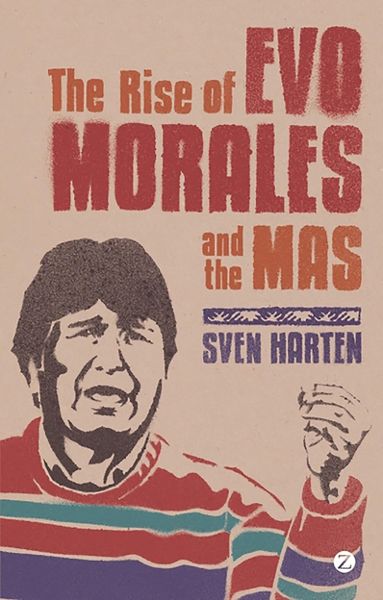
Harten, S: Rise of Evo Morales and the MAS
-
- Hardcover ausgewählt
- Taschenbuch
- eBook
-
Sprache:Englisch
Fr. 156.00
inkl. gesetzl. MwSt.,
Beschreibung
Produktdetails
Einband
Gebundene Ausgabe
Erscheinungsdatum
01.04.2011
Verlag
BloomsburySeitenzahl
272
Maße (L/B/H)
21.8/14.5/2.5 cm
Gewicht
476 g
Sprache
Englisch
ISBN
978-1-84813-523-9
Evo Morales is one of the world's most controversial political leaders. His story is extraordinary: poor shepherd-boy, persecuted coca grower, self-professed admirer of Ché Guevara, hero of the anti-globalization movement, and first indigenous president of modern Latin America.
The story of the social movement turned political party he is a part of -- the Movimiento Al Socialismo (MAS) -- is also exceptional: originally founded as a splinter of an ultra-right party, it was given as a gift for the coca growers after they had been banned several times for spurious reasons to register their own party, and went on to become an irresistible force for indigenous rights in Bolivia.
In this insightful and revealing book, Sven Harten explains the success of the MAS and its wider consequences, showing how Morales has become the symbol for a new political consciousness that has entailed de-stigmatizing indigenous identities. In many ways, the analysis of Morales's political trajectory serves as a mirror for democracy in Bolivia. It reveals the challenge of squaring the rupture with a discredited past with the continuity of democracy and the aim of representing an entire society.
The story of the social movement turned political party he is a part of -- the Movimiento Al Socialismo (MAS) -- is also exceptional: originally founded as a splinter of an ultra-right party, it was given as a gift for the coca growers after they had been banned several times for spurious reasons to register their own party, and went on to become an irresistible force for indigenous rights in Bolivia.
In this insightful and revealing book, Sven Harten explains the success of the MAS and its wider consequences, showing how Morales has become the symbol for a new political consciousness that has entailed de-stigmatizing indigenous identities. In many ways, the analysis of Morales's political trajectory serves as a mirror for democracy in Bolivia. It reveals the challenge of squaring the rupture with a discredited past with the continuity of democracy and the aim of representing an entire society.
Kundinnen und Kunden meinen
Verfassen Sie die erste Bewertung zu diesem Artikel
Helfen Sie anderen Kund*innen durch Ihre Meinung