KI-Beratung Beta

Gutscheinbedingungen

*Gültig bis 06.10.2026 auf alle Bücher. Ausgeschlossen sind Zeitschriften, Prozentbücher und Abos | Einlösbar in allen Buchhandlungen von Orell Füssli (ausser Transa Books), Barth Bücher, Buchladen Rapunzel, Papeterie Köhler, Schuler Orell Füssli, Stauffacher und ZAP unter Vorweisung des Gutscheins, auf www.orellfüssli.ch durch Eingabe des Gutscheincodes. Beim Service „eBooks verschenken“ und bei eBook-Käufen via eReader nicht einlösbar | Mindesteinkaufswert: Fr. 30.- | Nicht mit anderen Rabatten kumulierbar.

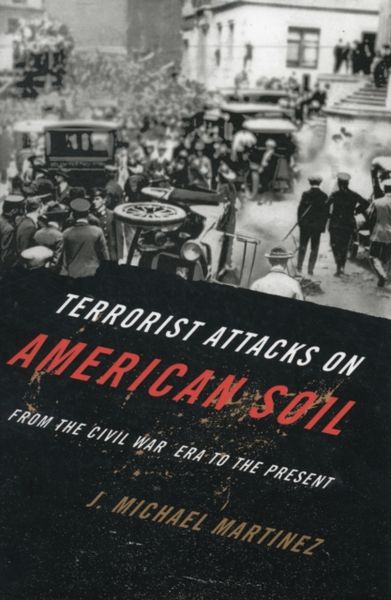
Produktbild: Terrorist Attacks On Amer Soil

Terrorist Attacks On Amer Soil From the Civil War Era to the Present

Fr. 88.90

inkl. gesetzl. MwSt., Versandkostenfrei


Beschreibung

Produktdetails

Einband

Gebundene Ausgabe

Erscheinungsdatum

25.10.2012

Verlag

Rowman & Littlefield Publ Grou

Seitenzahl

488

Maße (L/B/H)

23.4/16.1/4.1 cm

Gewicht

864 g

Sprache

Englisch

ISBN

978-1-4422-0323-5

Beschreibung

Zitat

The United States has suffered a number of violent attacks on its own soil. Martinez (Coming for To Carry Me Home) surveys 12 of them: three in the 19th century (e.g., the 1857 Mountain Meadows Massacre); five in the 'Modern Era' (e.g., the Ku Klux Klan's 16th Street Baptist Church bombing of 1963); and four examples of 'Postmodern Terror' (e.g., the Oklahoma City bombing and 9/11). He examines each attack to determine whether it qualifies as a 'terrorist act.' ... He covers the social circumstances surrounding each attack in order to describe the motivations and origins of the perpetrators. In the cases of individual actors such as Ted Kazinsky, the Unibomber, this is effective... Martinez's conclusion ... is that throughout history disaffected people have resorted to terrorism to spread or emphasize their causes. Library Journal Martinez (Kennesaw State Univ.) has produced a pithy, highly readable analysis of selected terrorist attacks in the US since the Civil War era. The author notes that he does not intend his book to be an exhaustive history of terrorism, but rather a representative sampling of some of the major incidents of the last 150 years. His stated purpose is to examine some of the common characteristics found in these past terrorist attacks in order not only to better understand them, but also to draw useful lessons for modern students of terrorism. Each chapter examines a particular incident and then provides some analysis as to whether or not the incident even qualifies as terrorism, based on selected criteria. While Martinez acknowledges that there is no magic formula to identify terrorism, he does provide a very useful conceptual framework for studying the phenomenon and its impact on US history. Summing Up: Recommended. General readers, lower-division undergraduates, upper-division undergraduates. CHOICE

Produktdetails

Einband

Gebundene Ausgabe

Erscheinungsdatum

25.10.2012

Verlag

Rowman & Littlefield Publ Grou

Seitenzahl

488

Maße (L/B/H)

23.4/16.1/4.1 cm

Gewicht

864 g

Sprache

Englisch

ISBN

978-1-4422-0323-5

Noch keine Bewertungen vorhanden

Verfassen Sie die erste Bewertung zu diesem Artikel

Helfen Sie anderen Kundinnen und Kunden durch Ihre Meinung.

Kundinnen und Kunden meinen

Bewertungen (0)

Die Leseprobe wird geladen.
  • Produktbild: Terrorist Attacks On Amer Soil
  • List of Illustrations Acknowledgments Introduction: Understanding Terrorism PART I: The Nineteenth Century Chapter 1: "A Sight Which Can Never Be Forgotten": The Mountain Meadows Massacre (1857) Chapter 2: "The Gentle, Kindhearted Bioterrorist": Luke Pryor Blackburn and the Yellow Fever Plot (1864-1865) Chapter 3: "We May Suspect That Race was the Cause of the Hostility": The Colfax Massacre (1873) PART II: The Modern Era Chapter 4: "The McNamaras Have Betrayed Labor": The Los Angeles Times Bombing (1910) Chapter 5: "An Explosion Just Like the Sound of a Gatling Gun": The Wall Street Bombing (1920) Chapter 6: "A President Has to Expect These Things": The Truman Assassination Attempt (1950) Chapter 7: "The Klan is Back on the Market": The Sixteenth Street Bombing and the Civil Rights Movement (1963) Chapter 8: "You Don't Need a Weatherman to Know Which Way the Winds Blows": Weatherman and the Counterculture Movement (1960s) PART III: Postmodern Terror Chapter 9: "A Revolution Against the Industrial System": The Unabomber (1970s-1990s) Chapter 10: "How Charged with Punishments the Scroll": The Oklahoma City Bombing (1995) Chapter 11: "There is a Bomb in Centennial Park; You Have 30 Minutes": Eric Robert Rudolph (Late 1990s) Chapter 12: "The System was Blinking Red": The Radical Islamic Movement and the September 11 Attacks PART IV: Conclusion The Lessons of Terrorism Notes References About the Author