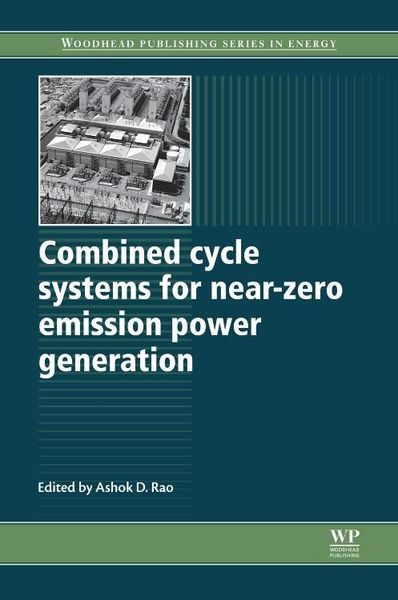
Combined Cycle Systems For Nea
Aus der Reihe
Woodhead Publishing Series in
Fr. 268.00
inkl. gesetzl. MwSt.,
Beschreibung
Produktdetails
Einband
Gebundene Ausgabe
Erscheinungsdatum
01.04.2012
Herausgeber
Ashok D. RaoVerlag
Woodhead PubSeitenzahl
360
Maße (L/B/H)
23.6/16.5/2.5 cm
Gewicht
690 g
Sprache
Englisch
ISBN
978-0-85709-013-3
Combined cycle power plants are one of the most promising ways of improving fossil-fuel and biomass energy production. The combination of a gas and steam turbine working in tandem to produce power makes this type of plant highly efficient and allows for CO2 capture and sequestration before combustion. This book provides a comprehensive review of the design, engineering and operational issues of a range of advanced combined cycle plants.
After introductory chapters on basic combined cycle power plant and advanced gas turbine design, the book reviews the main types of combined cycle system. Chapters discuss the technology, efficiency and emissions performance of natural gas-fired combined cycle (NGCC) and integrated gasification combined cycle (IGCC) as well as novel humid air cycle, oxy-combustion turbine cycle systems. The book also reviews pressurised fluidized bed combustion (PFBC), externally fired combined cycle (EFCC), hybrid fuel cell turbine (FC/GT), combined cycle and integrated solar combined cycle (ISCC) systems. The final chapter reviews techno-economic analysis of combined cycle systems.
With its distinguished editor and international team of contributors, Combined cycle systems for near-zero emission power generation is a standard reference for both industry practitioners and academic researchers seeking to improve the efficiency and environmental impact of power plants.
After introductory chapters on basic combined cycle power plant and advanced gas turbine design, the book reviews the main types of combined cycle system. Chapters discuss the technology, efficiency and emissions performance of natural gas-fired combined cycle (NGCC) and integrated gasification combined cycle (IGCC) as well as novel humid air cycle, oxy-combustion turbine cycle systems. The book also reviews pressurised fluidized bed combustion (PFBC), externally fired combined cycle (EFCC), hybrid fuel cell turbine (FC/GT), combined cycle and integrated solar combined cycle (ISCC) systems. The final chapter reviews techno-economic analysis of combined cycle systems.
With its distinguished editor and international team of contributors, Combined cycle systems for near-zero emission power generation is a standard reference for both industry practitioners and academic researchers seeking to improve the efficiency and environmental impact of power plants.
Noch keine Bewertungen vorhanden
Verfassen Sie die erste Bewertung zu diesem Artikel
Helfen Sie anderen Kundinnen und Kunden durch Ihre Meinung.