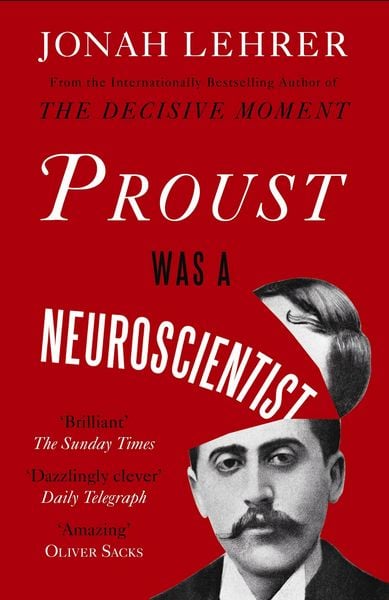
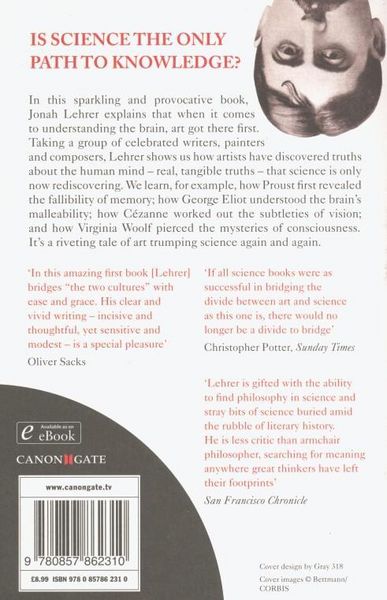
In this sparkling and provocative book, Jonah Lehrer explains that when it comes to understanding the brain, art got there first. Taking a group of celebrated writers, painters and composers, Lehrer shows us how artists have discovered truths about the human mind - real, tangible truths - that science is only now rediscovering. We learn, for example, how Proust first revealed the fallibility of memory; how George Eliot understood the brain's malleability; how the French chef Escoffier intuited umami (the fifth taste); how Cézanne worked out the subtleties of vision; and how Virginia Woolf pierced the mysteries of consciousness. It's a riveting tale of art trumping science again and again.
Kundinnen und Kunden meinen
5.0/5.0
Bewertung
5/5
07.11.2023
Buch (Taschenbuch)
pure exellence
This book particularly inspired me, especially because it made me believe in myself and my intuitions. The book by Jonah Lehrer (who when he wrote was a young neuroscientist with a passion for Proust) leads you to think about how we are slaves to brain mechanisms until someone comes along and forces you to think differently, to see the world with other eyes, to open new synapses that were previously unthinkable.
This book could be read by everyone who has new ideas and new visions but don’t dare to put them into practice for fear of failure. The road to achieving one's visions is always long and arduous, but if one truly believes in oneself, despite the failures, obstacles, and challenges, one always achieves one's goal.
It is a series of stories in which the artist, the writer or the musician "discovered" something about the human mind, BEFORE science got there. For example, Proust with his very famous 'madeleines' managed to understand the mystery of memory by immersing himself in his childhood memories. Proust understood, before science did, that memory is not a space where all the events of our life are archived, but more a process where all that surrounds us triggers those past experiences to pop up.
Or the painter Cezanne exploiting his insights into the physiology of vision. Everyone thought him a madman, a failure, and yet his way of painting, in which he firmly believed and to which he devoted his whole life, misunderstood and mocked, anticipated what science and neuroscience would discover in the 1950s and that is the mechanism of human vision, how vision really happens.
The eyes are not like a camera that immortalizes the real. Reality is not a uniform block but is continually created by the mind, therefore, every time we open our eyes the brain engages in an act of imagination.
An insight that forever changed the way art will be made: After Cezanne Cubism was born, and what about Giacometti who, just like Cezanne, was obsessed with vision and the intricate process of being able to realize in art what you really see?
The part about Stravinsky is what I liked the most. He understood that the ear listens to sound with expectations. And it was precisely the expectations of his audience that he mocked. He created the dissonance, for he sensed that it is from unsatisfied tension that emotion arises, and that the ear, like an instrument, must be tuned and educated.
For hundreds of centuries music had only ever been tonal; almost all the music we hear and know is tonal music. Music has been tonal from 1600 to 1900, for example, the music of Bach, Beethoven, Mozart, Chopin, as well as all opera and operatic repertoire, belong to the category of tonal music. In tonal music, the organization of sounds is hierarchical, meaning that some notes are more important than others at any given moment. The educated public was used to music being a set of consonant chords, (now quiet, then suspense, then tranquility, then suspense again...). But Stravinsky’s music is a total violation of the rules applied up to that time. he realized that they were wrong: beautiful noises are boring. Music is interesting only when it causes us tension, and the source of tension is conflict. He decided that order does not defeat disorder.
His ingenious insight was that the public wanted to hear what it actually refuted.
His Rite of Spring was the first tune that anticipated the audience's predictions and then con-tradicted them all one by one.
In music (as well as in art, in literature) we all have certain expectations, the brain is used to certain resolutions, certain established endings. But in Saga these expectations are of no use because we don't know what note will come next. The tension always remains very high and is never resolved. In one single composition Stravinsky destroyed Mozart, Beethoven, Strauss, Wagner, Chopin...classicism distorted by a cynicism that will eventually become a trend.
What comes into my mind is the sentence that Gertrude Stein said in front of the portrait Pi-casso made of her: “She doesn't look like me at all” (she was still bound by the patterns whereby a painter who makes a portrait must make it resemble the model as closely as possi-ble). Picasso replied: “don't worry Mrs. Stein, you will end up looking like the portrait.”
I'm leaving out the other characters mentioned and analysed in the book, but each of them is a little world of wonder and creativity, of self-denial and sacrifice. They all believed in their ideas, challenged the rules, looked beyond them, and proved that human intuition always an-ticipates what science will one day be able to explain. Our intuitions and visions are already science.
That's why I loved this book. I felt inspired, and I believe that anyone who wants to create something must find a model in the great figures of literature, music, art, and history. These characters had the courage to break the patterns of the mind, that prevent us from grasping novelty and prevent us from moving forward with our ideas.