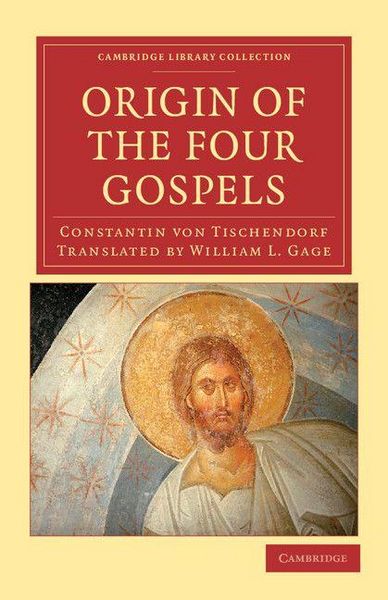
Origin of the Four Gospels
-
- Englisch ausgewählt
-
Verlag:Cambridge Academic
Fr. 47.90
inkl. gesetzl. MwSt.,
Beschreibung
Produktdetails
Einband
Taschenbuch
Erscheinungsdatum
03.01.2012
Verlag
Cambridge AcademicSeitenzahl
292
Maße (L/B/H)
21.6/14/1.7 cm
Gewicht
370 g
Übersetzt von
Gage William L.
Sprache
Englisch
ISBN
978-1-108-04333-5
Constantin von Tischendorf (1815-74) was a pioneering textual scholar of the New Testament, who discovered and transcribed early manuscripts, notably the Codex Sinaiticus, his acquisition of which provoked long-lasting controversies. The original German edition of this book appeared in 1865, and sold 2,000 copies in three weeks; this English translation (1868) was based on the improved and expanded fourth German edition (1866). In it, Tischendorf applies his enormous knowledge of early Christian literature and the oldest Latin, Greek and Syriac gospel manuscripts to the question of the date of the canonical gospel texts, which, he argues, had been established by the end of the first century. Parts of the book are highly polemical, with Tischendorf referring to 'the Tübingen fantasy-builder and the Parisian caricaturist' in his attempt to refute contemporary theories about the person of Jesus. Nevertheless his translator engagingly describes him as a 'great and genial' scholar.
Noch keine Bewertungen vorhanden
Verfassen Sie die erste Bewertung zu diesem Artikel
Helfen Sie anderen Kundinnen und Kunden durch Ihre Meinung.