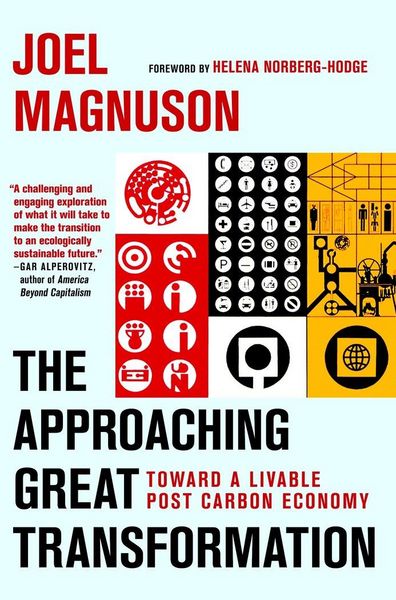
The Approaching Great Transformation Toward a Livable Post Carbon Economy
-
- Taschenbuch ausgewählt
- eBook
-
Sprache:Englisch
-
Verlag:Random House N.Y.
Fr. 26.90
inkl. gesetzl. MwSt.,
-
Kostenlose Lieferung ab Fr. 30 Einkaufswert
Schweiz & Liechtenstein:
Versandkostenfrei ab Fr. 30.00
Versandkosten bis Fr. 30.00: Fr. 3.50Andere Lieferländer
Fr. 18.00 unabhängig vom Warenwert
Beschreibung
Produktdetails
Einband
Taschenbuch
Erscheinungsdatum
16.04.2013
Verlag
Random House N.Y.Seitenzahl
240
Maße (L/B/H)
22.1/14.4/2.2 cm
Gewicht
308 g
Sprache
Englisch
ISBN
978-1-60980-480-0
“A challenging and engaging exploration of what it will take to make the transition to an ecologically sustainable future. Magnuson exposes the false promises of green-wash capitalism—and in the tradition of E.F. Schumacher puts the hopeful shoots of real alternatives squarely on the map for ongoing development.” — Gar Alperovitz, Lionel R. Bauman Professor of Political Economy at the University of Maryland and author of America Beyond Capitalism
"We are literally in the midst of reshaping the world and as a result, this is the time to make the new economy in a way that is redefining, as economist Joel Magnuson writes, “what is good, beautiful, fair, or wholesome, and making sure that our economic system allows us to live according to these beliefs.” —Truthout
"Soon, fossil fuels will run out—or become ridiculously complicated and expensive to extract—and the global economy will be in a real pickle, says Magnuson, an economist "specializing in non-orthodox approaches to political economy." These days, no one is safe from rhetoric about "going green"; Magnusson argues that this is mostly a "marketing ploy," a way for huge corporations to have and eat their cakes—labeling their products "green" while relentlessly pursuing "endless growth" and ignoring the reality of a finite planet with limited resources. While "green" and "sustainable" have become catchwords, material consumption in the last 25 years has increased. A "deeper transformation of our core economic institutions" is necessary, he argues; i.e. capitalism must go. While eloquently argued, the book's central message will be difficult to hear for many, though he effectively skewers the mantras of those who hope to ignore the problem: "at least it won't happen in our life time" and "technology will come through." This is a brave book by a smart person with a masterful command of economic theory; unfortunately, for these reasons its reach is probably limited: most people will balk at its central message: that we will have to get by with much, much less production and consumption." —Publishers Weekly
Noch keine Bewertungen vorhanden
Verfassen Sie die erste Bewertung zu diesem Artikel
Helfen Sie anderen Kundinnen und Kunden durch Ihre Meinung.