KI-Beratung Beta

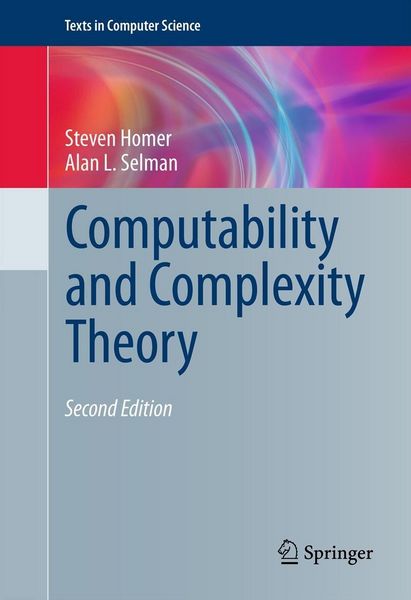
Produktbild: Computability and Complexity Theory

Computability and Complexity Theory

Fr. 106.90

inkl. gesetzl. MwSt.

Beschreibung

This revised and extensively expanded edition of Computability and Complexity Theory comprises essential materials that are core knowledge in the theory of computation. The book is self-contained, with a preliminary chapter describing key mathematical concepts and notations.  Subsequent chapters move...

Beschreibung

This revised and extensively expanded edition of Computability and Complexity Theory comprises essential materials that are core knowledge in the theory of computation. The book is self-contained, with a preliminary chapter describing key mathematical concepts and notations.  Subsequent chapters move from the qualitative aspects of classical computability theory to the quantitative aspects of complexity theory. Dedicated chapters on undecidability, NP-completeness, and relative computability focus on the limitations of computability and the distinctions between feasible and intractable.  Substantial new content in this edition includes:

  • a chapter on nonuniformity studying Boolean circuits, advice classes and the important result of Karp-Lipton.
  • a chapter studying properties of the fundamental probabilistic complexity classes
  • a study of the alternating Turing machine and uniform circuit classes.
  • an introduction of counting classes, proving the famous results of Valiant and Vazirani and of Toda
  • a thorough treatment of the proof that IP is identical to PSPACE

With its accessibility and well-devised organization, this text/reference is an excellent resource and guide for those looking to develop a solid grounding in the theory of computing. Beginning graduates, advanced undergraduates, and professionals involved in theoretical computer science, complexity theory, and computability will find the book an essential andpractical learning tool.


Topics and features:

  • Concise, focused  materials cover the most fundamental concepts and results in the field of modern complexity theory, including the theory of NP-completeness, NP-hardness, the polynomial hierarchy, and complete problems for other complexity classes
  • Contains information that otherwise exists only in research literature and presents it in a unified, simplified manner
  • Provides key mathematical background information, including sections on logic and number theory and algebra
  • Supported by numerous exercises and supplementary problems for reinforcement and self-study purposes

Rezension

From the reviews:

"The difference between this new introductory graduate textbook in theoretical computer science and other texts is that the authors have chosen to concentrate on computability theory and computational complexity theory. They motivate this focus by pointing out that most students have been introduced to the theory of automata and formal languages as undergraduates. The topics are treated in depth and in full formal detail. Explicit homework assignments are tightly integrated into the exposition of the material." --Computing Reviews

"This book is intended for use in a modern graduate course in the theory of computing. … Mainly all old classical complexity results as well as a relatively recent result that space-bounded classes are closed under complements are included into the book. The textbook is self-contained. A list of useful homework problems is appended to each chapter. The book is well written and is recommended to students as well as specialists in theoretical computer science." (Anatoly V. Anisimov, Zentralblatt MATH, Vol. 1033 (8), 2004)

"This book is a solid textbook suited for one- or two-semester graduate courses on the theory of computing. …The authors are two leading researchers in the field of theoretical computer sciences, most notably complexity theory. … This textbook is an excellent resource and guide for those looking to develop a solid grounding in the theory of computing. Beginning graduates, advanced undergraduates and professionals involved in theoretical computer science, complexity theory and computability will find this book an essential and practical learning tool." (André Grosse, The Computer Journal, Vol. 45 (4), 2002)

Produktdetails

Format

PDF

Kopierschutz

Nein

Family Sharing

Nein

Text-to-Speech

Nein

Produktdetails

Format

PDF

Format

eBooks im PDF-Format haben eine festgelegte Seitengröße und eignen sich daher nur bedingt zum Lesen auf einem tolino eReader oder Smartphone. Für den vollen Lesegenuss empfehlen wir Ihnen bei PDF-eBooks die Verwendung eines Tablets oder Computers.

Kopierschutz

Nein

Kopierschutz

Dieses eBook können Sie uneingeschränkt auf allen Geräten der tolino Familie, allen sonstigen eReadern und am PC lesen. Das eBook ist nicht kopiergeschützt und kann ein personalisiertes Wasserzeichen enthalten. Weitere Hinweise zum Lesen von eBooks mit einem personalisierten Wasserzeichen finden Sie unter Hilfe/Downloads.

Family Sharing

Nein

Family Sharing

Mit Family Sharing können Sie eBooks innerhalb Ihrer Familie (max. sechs Mitglieder im gleichen Haushalt) teilen. Sie entscheiden selbst, welches Buch Sie mit welchem Familienmitglied teilen möchten. Auch das parallele Lesen durch verschiedene Familienmitglieder ist durch Family Sharing möglich. Um eBooks zu teilen oder geteilt zu bekommen, muss jedes Familienmitglied ein Konto bei Thalia oder einem anderen tolino-Buchhändler haben. Weitere Informationen finden Sie unter Hilfe/Family-Sharing.

Text-to-Speech

Nein

Text-to-Speech

Bedeutet Ihnen Stimme mehr als Text? Mit der Funktion Text-to-Speech können Sie sich im tolino webReader und in der aktuellen Thalia – Lesen & Hören App das eBook vorlesen lassen. Weitere Informationen finden Sie unter Hilfe/Text-to-Speech.

Erscheinungsdatum

10.12.2011

Verlag Springer New York
Seitenzahl

300 (Printausgabe)

Dateigröße

2821 KB

Auflage

2nd ed. 2011

Sprache

Englisch

EAN

9781461406822

Barrierefreiheit
  • keine Information zur Barrierefreiheit bekannt

Noch keine Bewertungen vorhanden

Verfassen Sie die erste Bewertung zu diesem Artikel

Helfen Sie anderen Kundinnen und Kunden durch Ihre Meinung.

Kundinnen und Kunden meinen

Bewertungen (0)

Weitere Artikel finden Sie in

  • Produktbild: Computability and Complexity Theory