KI-Beratung Beta

Produktbild: Intrinsically Motivated Learning in Natural and Artificial Systems

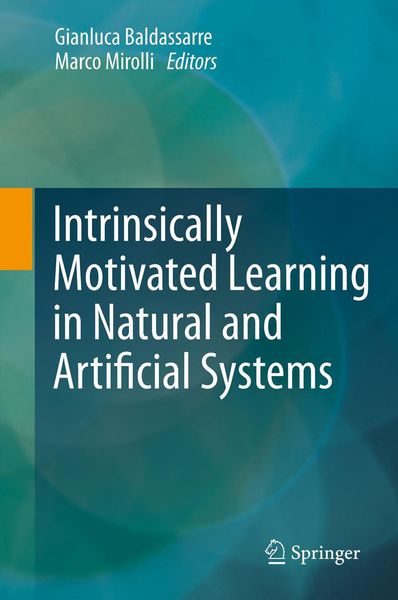
Intrinsically Motivated Learning in Natural and Artificial Systems

Fr. 187.90

inkl. gesetzl. MwSt.

Beschreibung

It has become clear to researchers in robotics and adaptive behaviour that current approaches are yielding systems with limited autonomy and capacity for self-improvement. To learn autonomously and in a cumulative fashion is one of the hallmarks of intelligence, and we know that higher mammals engage...

Beschreibung

It has become clear to researchers in robotics and adaptive behaviour that current approaches are yielding systems with limited autonomy and capacity for self-improvement. To learn autonomously and in a cumulative fashion is one of the hallmarks of intelligence, and we know that higher mammals engage in exploratory activities that are not directed to pursue goals of immediate relevance for survival and reproduction but are instead driven by intrinsic motivations such as curiosity, interest in novel stimuli or surprising events, and inter­est in learning new behaviours. The adaptive value of such intrinsically motivated activities lies in the fact that they allow the cumulative acquisition of knowledge and skills that can be used later to accomplish ¿tness-enhanc­ing goals. Intrinsic motivations continue during adulthood, and in humans they underlie lifelong learning, artistic creativity, and scientific discovery, while they are also the basis for processes that strongly affect human well-being, such as the sense of competence, self-determination, and self-esteem.

This book has two aims: to present the state of the art in research on intrinsically motivated learning, and to identify the related scientific and technological open challenges and most promising research directions. The book introduces the concept of intrinsic motivation in artificial systems, reviews the relevant literature, offers insights from the neural and behavioural sciences, and presents novel tools for research. The book is organized into six parts: the chapters in Part I give general overviews on the concept of intrinsic motivations, their function, and possible mechanisms for implementing them; Parts II, III, and IV focus on three classes of intrinsic motivation mechanisms, those based on predictors, on novelty, and on competence; Part V discusses mechanisms that are complementary to intrinsic motivations; and Part VI introduces tools and experimentalframeworks for investigating intrinsic motivations.

The contributing authors are among the pioneers carrying out fundamental work on this topic, drawn from related disciplines such as artificial intelligence, robotics, artificial life, evolution, machine learning, developmental psychology, cognitive science, and neuroscience. The book will be of value to graduate students and academic researchers in these domains, and to engineers engaged with the design of autonomous, adaptive robots.
The contributing authors are among the pioneers carrying out fundamental work on this topic, drawn from related disciplines such as artificial intelligence, robotics, artificial life, evolution, machine learning, developmental psychology, cognitive science, and neuroscience. The book will be of value to graduate students and academic researchers in these domains, and to engineers engaged with the design of autonomous, adaptive robots.

Portrait

Dr. Gianluca Baldassarre is a Researcher at the Institute of Cognitive Sciences and Technologies (ISTC) of the Italian National Research Council (CNR) where he is a member of the Laboratory of Computational Embodied Neuroscience; his research interests include computational embodied neuroscience, psychology, neuroscience, developmental robotics, artificial life, and machine learning.Dr. Marco Mirolli is a Researcher at the Institute of Cognitive Sciences and Technologies (ISTC) of the Italian National Research Council (CNR) where he is a member of the Laboratory of Computational Embodied Neuroscience Laboratory; his research interests lie in the study of behavior through computer simulations, in particular the evolution of communication and language, the role of language as a cognitive tool, the biological bases of motivations and emotions, and the role of intrinsic motivations in cumulative learning.

Produktdetails

Format

PDF

Kopierschutz

Nein

Family Sharing

Nein

Text-to-Speech

Nein

Produktdetails

Format

PDF

Format

eBooks im PDF-Format haben eine festgelegte Seitengröße und eignen sich daher nur bedingt zum Lesen auf einem tolino eReader oder Smartphone. Für den vollen Lesegenuss empfehlen wir Ihnen bei PDF-eBooks die Verwendung eines Tablets oder Computers.

Kopierschutz

Nein

Kopierschutz

Dieses eBook können Sie uneingeschränkt auf allen Geräten der tolino Familie, allen sonstigen eReadern und am PC lesen. Das eBook ist nicht kopiergeschützt und kann ein personalisiertes Wasserzeichen enthalten. Weitere Hinweise zum Lesen von eBooks mit einem personalisierten Wasserzeichen finden Sie unter Hilfe/Downloads.

Family Sharing

Nein

Family Sharing

Mit Family Sharing können Sie eBooks innerhalb Ihrer Familie (max. sechs Mitglieder im gleichen Haushalt) teilen. Sie entscheiden selbst, welches Buch Sie mit welchem Familienmitglied teilen möchten. Auch das parallele Lesen durch verschiedene Familienmitglieder ist durch Family Sharing möglich. Um eBooks zu teilen oder geteilt zu bekommen, muss jedes Familienmitglied ein Konto bei Thalia oder einem anderen tolino-Buchhändler haben. Weitere Informationen finden Sie unter Hilfe/Family-Sharing.

Text-to-Speech

Nein

Text-to-Speech

Bedeutet Ihnen Stimme mehr als Text? Mit der Funktion Text-to-Speech können Sie sich im tolino webReader und in der aktuellen Thalia – Lesen & Hören App das eBook vorlesen lassen. Weitere Informationen finden Sie unter Hilfe/Text-to-Speech.

Erscheinungsdatum

29.03.2013

Herausgeber
Verlag Springer
Seitenzahl

458 (Printausgabe)

Dateigröße

7006 KB

Sprache

Englisch

EAN

9783642323751

Barrierefreiheit
  • keine Information zur Barrierefreiheit bekannt

Noch keine Bewertungen vorhanden

Verfassen Sie die erste Bewertung zu diesem Artikel

Helfen Sie anderen Kundinnen und Kunden durch Ihre Meinung.

Kundinnen und Kunden meinen

Bewertungen (0)

Weitere Artikel finden Sie in

  • Produktbild: Intrinsically Motivated Learning in Natural and Artificial Systems
  • Chap. 1 - Intrinsically Motivated Learning Systems: An Overview.- Chap. 2 - Intrinsic Motivation and Reinforcement Learning.- Chap. 3 - Functions and Mechanisms of Intrinsic Motivations.- Chap. 4 - Exploration from Generalization Mediated by Multiple Controllers.- Chap. 5 - Maximizing Fun by Creating Data with Easily Reducible Subjective Complexity.- Chap. 6 - The Role of the Basal Ganglia in Discovering Novel Actions.- Chap. 7 - Action Discovery and Intrinsic Motivation: A Biologically Constrained Formalisation.- Chap 8 - Novelty Detection as an Intrinsic Motivation for Cumulative Learning Robots.- Chap. 9 - Novelty and Beyond: Towards Combined Motivation Models and Integrated Learning Architectures.- Chap. 10 - The Hippocampal-VTA Loop: The Role of Novelty and Motivation in Controlling the Entry of Information into Long-Term Memory.- Chap. 11 - Deciding Which Skill to Learn When: Temporal-Di¿erence Competence-Based Intrinsic Motivation (TD-CB-IM).- Chap. 12 - Intrinsically Motivated Affordance Discovery and Modeling.- Chap. 13 - Intrinsically Motivated Learning of Real-World Sensorimotor Skills with Developmental Constraints.- Chap. 14 - Investigating the Origins of Intrinsic Motivation in Human Infants.- Chap. 15 - A Novel Behavioural Task for Researching Intrinsic Motivations.- Chap. 16 - The "Mechatronic Board": A Tool to Study Intrinsic Motivations in Humans, Monkeys, and Humanoid Robots.- Chap. 17 - The iCub Platform: A Tool for Studying Intrinsically Motivated Learning.