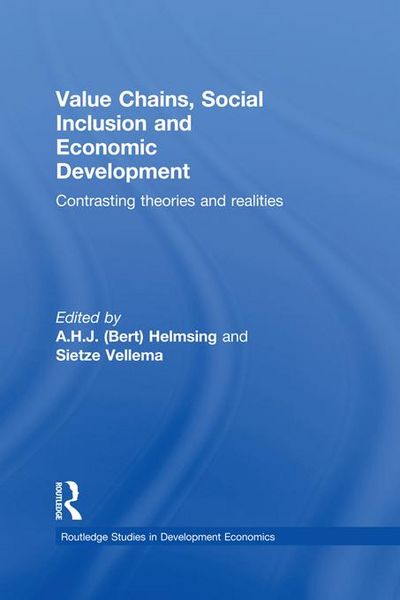
Value Chains, Social Inclusion and Economic Development Contrasting Theories and Realities
-
- Hardcover
- Taschenbuch
- eBook ausgewählt
-
Form:Einzelkauf Download
-
Sprache:Englisch
Fr. 85.90
inkl. gesetzl. MwSt.Beschreibung
Produktdetails
Format
ePUB
Kopierschutz
Ja
Family Sharing
Nein
Text-to-Speech
Ja
Erscheinungsdatum
23.05.2012
Herausgeber
A. H. J. Helmsing + weitereVerlag
Taylor & Francis eBooksSeitenzahl
320 (Printausgabe)
Dateigröße
3401 KB
Sprache
Englisch
EAN
9781136724718
Lead firms, development organisations, donors and governments view value chains and voluntary standards as vital instruments for achieving millennium development goals through trade and market-related interventions. The precise foundations for these development strategies, which suggest positive development outcomes from integration of poor actors into value chains, are as yet underdeveloped. The interdisciplinary work in this volume shows how trade is managed and asks theory-driven questions about how value chains relate to locally-rooted development processes.
Policy makers and development practitioners are increasingly using value chain analysis to frame pro-poor development interventions. This book offers multiple conceptualizations of development outcomes of inclusion of small producers, firms and workers in value chains. Processes of inclusion at different scales are unpacked in order to identify the terms of participation of small producers, firms and workers. As value chains are embedded, the book further argues that inclusion can be conceptualized as the degree of alignment between value chain logics and the institutions and capacities in the local business system. The combination of inclusive governance and endogenous development informs a grounded debate on roles of development-oriented partnerships.
Chapters in this volume draw on multiple strands of economics, sociology, political science, geography and management studies; and for empirical grounding engage in comparative analysis of cases from Latin America, SubSaharan Africa and East and South East Asia. These are combined with processes taking place at a global level, such as the proliferation of standards and the growth of roundtables and multi-stakeholder partnerships. The contributions explore contrasts - between contexts, between industries or commodities/products, and between conceptual frameworks; and the context dependency of development impact necessitates cross-case investigations. This collection will be of interest to scholars in development studies, economics, business studies, as well as to development policy makers.
Noch keine Bewertungen vorhanden
Verfassen Sie die erste Bewertung zu diesem Artikel
Helfen Sie anderen Kundinnen und Kunden durch Ihre Meinung.