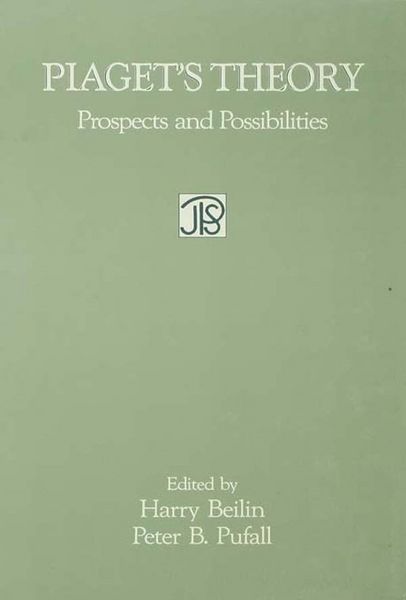
Piaget's Theory Prospects and Possibilities
-
- Taschenbuch
- eBook ausgewählt
-
Form:Einzelkauf Download
-
Sprache:Englisch
-
eBook Format:ePUB 3
- ePUB 3 Fr. 185.90 ausgewählt
- PDF Fr. 185.90
Fr. 185.90
inkl. gesetzl. MwSt.Beschreibung
Produktdetails
Format
ePUB 3
Kopierschutz
Ja
Family Sharing
Nein
Text-to-Speech
Ja
Erscheinungsdatum
15.04.2013
Herausgeber
Harry Beilin + weitereVerlag
Taylor & Francis eBooksSeitenzahl
360 (Printausgabe)
Dateigröße
1591 KB
Sprache
Englisch
EAN
9781134994281
This volume marks the 20th Anniversary Symposium of the Jean Piaget Society. Some of the American contributors were among the first to introduce Piaget to developmental and educational psychology in the United States, while some of the international contributors worked with Piaget to develop his program of genetic epistemology and continue to make significant contributions to it.
Within this volume the possibility of Piaget's paradigm is reviewed not only as the stuff of normal science, yielding fascinating empirical questions that linger within it, but also, and more importantly, as the stuff of revolutionary science, with continuing potential to comprehensively structure our thinking about developmental theory.
The constructive contribution Piaget's theory has for developmental theory emerges as four central themes in the volume:
- understanding the intentional or semantic aspect of mental life without abandoning the Piagetian assumption that is rational and committed to truth testing;
- examining mental life and its development as a dialectical relation of function and structure--a relation Piaget introduced in his study of the developmental relation between procedural and operational knowledge;
- exploring new and interdisciplinary perspectives on equilibration as the driving force of constructive adaptive processes;
- understanding social and historical forces in individual and cultural development--not necessarily as forces antithetical to Piaget's perspective but as forces that take on new meaning within his framework which avoids erroneous dichotomies such as the distinction between subjective and objective knowledge.
Noch keine Bewertungen vorhanden
Verfassen Sie die erste Bewertung zu diesem Artikel
Helfen Sie anderen Kundinnen und Kunden durch Ihre Meinung.