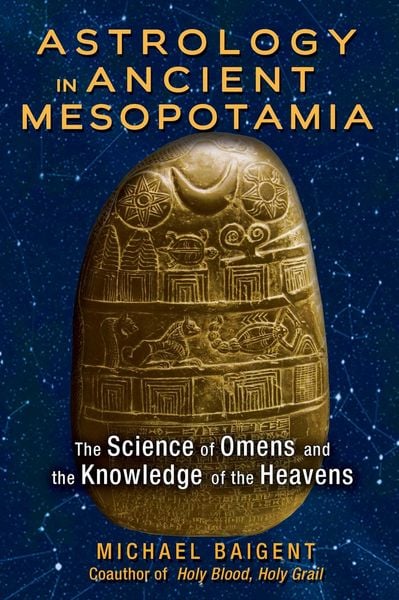
Astrology in Ancient Mesopotamia The Science of Omens and the Knowledge of the Heavens
-
- Taschenbuch ausgewählt
- eBook
-
Sprache:Englisch
Fr. 27.90
inkl. gesetzl. MwSt.,
-
Kostenlose Lieferung ab Fr. 30 Einkaufswert
Schweiz & Liechtenstein:
Versandkostenfrei ab Fr. 30.00
Versandkosten bis Fr. 30.00: Fr. 3.50Andere Lieferländer
Fr. 18.00 unabhängig vom Warenwert
Beschreibung
Produktdetails
Einband
Taschenbuch
Erscheinungsdatum
20.07.2015
Verlag
Inner Traditions/Bear & CompanySeitenzahl
256
Maße (L/B/H)
22.8/15.1/2 cm
Gewicht
423 g
Auflage
2nd edition
Sprache
Englisch
ISBN
978-1-59143-221-0
Among the many significant discoveries excavated from Assyrian king Ashurbanipal's royal library in Nineveh were tablets documenting the development of Mesopotamian astrology, now recognized as the earliest astrological science.
Drawing upon translations of the Nineveh library tablets as well as many other ancient sources, Michael Baigent reveals the roots of modern astrology in the Babylonian science of omens. He explains how astrology in the Babylonian and Assyrian empires was concerned not with individuals but with the king and the state. He shows that by the first dynasty of Babylon, around 1900 to 1600 BC, astrology had become a systematic discipline, the preserve of highly trained specialists intent upon interpreting omens from the movements of planets and stars. He explores Mesopotamian mythology as it relates to the planets and to astrology as well as to Mesopotamian religion, magic, and politics--for the mythology of Babylon and Assyria served the state and thus changed as the state changed. He shows how this ancient form of astrology uniquely represents both Sun and Moon as masculine entities and Saturn (Ninurta) as the principle of order imposed on chaos. He examines the connections between ancient astrology and the symbolism of Western religions, such as how the "Greek" or "Templar" cross may symbolize the Babylonian god Nabu, now known as Mercury.
Baigent reveals how the religious and magical aspects of early Babylonian cosmological speculation played a significant role in the Renaissance, influencing prominent figures such as Cosimo de Medici, Marsilio Ficino, and Botticelli.
Noch keine Bewertungen vorhanden
Verfassen Sie die erste Bewertung zu diesem Artikel
Helfen Sie anderen Kundinnen und Kunden durch Ihre Meinung.