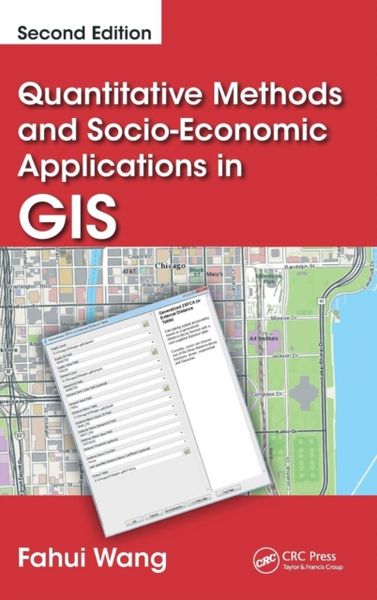
Wang, F: Quantitative Methods and Socio-Economic Application Editio
-
- Hardcover ausgewählt
- Taschenbuch
-
Sprache:Englisch
Fr. 216.00
inkl. gesetzl. MwSt.,
Beschreibung
Produktdetails
Einband
Gebundene Ausgabe
Erscheinungsdatum
01.12.2014
Verlag
Taylor & Francis Ltd (Sales)Seitenzahl
334
Maße (L/B/H)
23.9/16.1/2.5 cm
Gewicht
610 g
Auflage
2nd edition
Sprache
Englisch
ISBN
978-1-4665-8472-3
The second edition of a bestseller, Quantitative Methods and Socio-Economic Applications in GIS (previously titled Quantitative Methods and Applications in GIS) details applications of quantitative methods in social science, planning, and public policy with a focus on spatial perspectives. The book integrates GIS and quantitative (computational) methods and demonstrates them in various policy-relevant socio-economic applications with step-by-step instructions and datasets. The book demonstrates the diversity of issues where GIS can be used to enhance the studies related to socio-economic issues and public policy.
See What’s New in the Second Edition:
- All project instructions are in ArcGIS 10.2 using geodatabase datasets
- New chapters on regionalization methods and Monte Carlo simulation
- Popular tasks automated as a convenient toolkit: Huff Model, 2SFCA accessibility measure, regionalization, Garin-Lowry model, and Monte Carlo based spatial simulation
- Advanced tasks now implemented in user-friendly programs or ArcGIS: centrality indices, wasteful commuting measure, p-median problem, and traffic simulation
Each chapter has one subject theme and introduces the method (or a group of related methods) most relevant to the theme. While each method is illustrated in a special case of application, it can also be used to analyze different issues. For example, spatial regression is used to examine the relationship between job access and homicide patterns; systems of linear equations are analyzed to predict urban land use patterns; linear programming is introduced to solve the problem of wasteful commuting and allocate healthcare facilities; and Monte Carlo technique is illustrated in simulating urban traffic.
The book illustrates the range of computational methods and covers common tasks and major issues encountered in a spatial environment. It provides a platform for learning technical skills and quantitative methods in the context of addressing real-world problems, giving you instant access to the tools to resolve major socio-economic issues.
Noch keine Bewertungen vorhanden
Verfassen Sie die erste Bewertung zu diesem Artikel
Helfen Sie anderen Kundinnen und Kunden durch Ihre Meinung.