KI-Beratung Beta

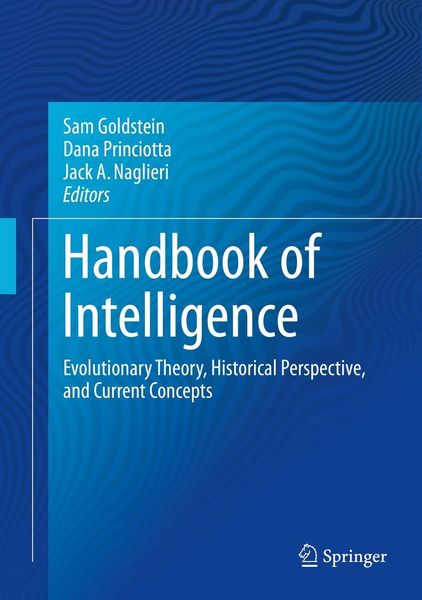
Produktbild: Handbook of Intelligence

Handbook of Intelligence Evolutionary Theory, Historical Perspective, and Current Concepts

Fr. 206.90

inkl. gesetzl. MwSt.

Beschreibung

Numerous functions, cognitive skills, and behaviors are associated with intelligence, yet decades of research has yielded little consensus on its definition. Emerging from often conflicting studies is the provocative idea that intelligence evolved as an adaptation humans needed to keep up with - and...

Beschreibung

Numerous functions, cognitive skills, and behaviors are associated with intelligence, yet decades of research has yielded little consensus on its definition. Emerging from often conflicting studies is the provocative idea that intelligence evolved as an adaptation humans needed to keep up with - and survive in - challenging new environments. The Handbook of Intelligence addresses a broad range of issues relating to our cognitive and linguistic past. It is the first full-length volume to place intelligence in an evolutionary/cultural framework, tracing the development of the human mind, exploring differences between humans and other primates, and addressing human thinking and reasoning about its own intelligence and its uses. The works of pioneering thinkers - from Plato to Darwin, Binet to Piaget, Luria to Weachsler - are referenced to illustrate major events in the evolution of theories of intelligence, leading to the current era of multiple intelligences and special education programs. In addition, it examines evolutionary concepts in areas as diverse as creativity, culture, neurocognition, emotional intelligence, and assessment. Featured topics include:
  • The evolution of the human brain from matter to mind
  • Social competition and the evolution of fluid intelligence
  • Multiple intelligences in the new age of thinking
  • Intelligence as a malleable construct
  • From traditional IQ to second-generation intelligence tests
  • The evolution of intelligence, including implications for educational programming and policy.
The Handbook of Intelligence is an essential resource for researchers, graduate students, clinicians, and professionals in developmental psychology; assessment, testing and evaluation; language philosophy; personality and social psychology; sociology; and developmental biology.

Rezension

“I applaud the present volume for its use of evolutionary theory not simply to represent and exemplify a subfield of psychology but rather to provide a foundational meta-theoretical framework that integrates the entire field of psychology in the same way it has for the field of biology. … an essential textbook and/or resource not only for undergraduate and graduate students and researchers in all subfields of psychology but also for professionals engaged in intelligence assessment and evaluation.” (Jack Demick, PsycCRITIQUES, Vol. 60 (21), May, 2015)

Produktdetails

Format

PDF

Kopierschutz

Nein

Family Sharing

Nein

Text-to-Speech

Nein

Produktdetails

Format

PDF

Format

eBooks im PDF-Format haben eine festgelegte Seitengröße und eignen sich daher nur bedingt zum Lesen auf einem tolino eReader oder Smartphone. Für den vollen Lesegenuss empfehlen wir Ihnen bei PDF-eBooks die Verwendung eines Tablets oder Computers.

Kopierschutz

Nein

Kopierschutz

Dieses eBook können Sie uneingeschränkt auf allen Geräten der tolino Familie, allen sonstigen eReadern und am PC lesen. Das eBook ist nicht kopiergeschützt und kann ein personalisiertes Wasserzeichen enthalten. Weitere Hinweise zum Lesen von eBooks mit einem personalisierten Wasserzeichen finden Sie unter Hilfe/Downloads.

Family Sharing

Nein

Family Sharing

Mit Family Sharing können Sie eBooks innerhalb Ihrer Familie (max. sechs Mitglieder im gleichen Haushalt) teilen. Sie entscheiden selbst, welches Buch Sie mit welchem Familienmitglied teilen möchten. Auch das parallele Lesen durch verschiedene Familienmitglieder ist durch Family Sharing möglich. Um eBooks zu teilen oder geteilt zu bekommen, muss jedes Familienmitglied ein Konto bei Thalia oder einem anderen tolino-Buchhändler haben. Weitere Informationen finden Sie unter Hilfe/Family-Sharing.

Text-to-Speech

Nein

Text-to-Speech

Bedeutet Ihnen Stimme mehr als Text? Mit der Funktion Text-to-Speech können Sie sich im tolino webReader und in der aktuellen Thalia – Lesen & Hören App das eBook vorlesen lassen. Weitere Informationen finden Sie unter Hilfe/Text-to-Speech.

Erscheinungsdatum

08.12.2014

Herausgeber
Verlag Springer New York
Seitenzahl

498 (Printausgabe)

Dateigröße

7166 KB

Sprache

Englisch

EAN

9781493915620

Barrierefreiheit
  • keine Information zur Barrierefreiheit bekannt

Noch keine Bewertungen vorhanden

Verfassen Sie die erste Bewertung zu diesem Artikel

Helfen Sie anderen Kundinnen und Kunden durch Ihre Meinung.

Kundinnen und Kunden meinen

Bewertungen (0)

Weitere Artikel finden Sie in

  • Produktbild: Handbook of Intelligence
  • Preface.- SECTION 1. BACKGROUND.- The Roots of Human Intelligence: What Were We Before We Were Intelligent?.- Intelligence in Non primates.- Intelligence in Primates.- The Evolution of Language.- Intelligence in Humans.- The Origins of Intelligence as a Conceptual Construct:  Plato, Pascal and Philosophy.- Modern Foundation:  Darwin, Charcot and Dalton.- SECTION 2. THEORIES OF INTELLIGENCE.- Intelligence Defined:  James, Wundt, Cattell, Thorndike and Yerkes.- Alfred Binet and the Children of Paris.- David Wechsler and the Soldiers of America.- Alan Kaufman and Intelligence Redefined as Cognitive Processing.- A.R. Luria and Intelligence Redefined as a Neuropsychological Construct.- Daniel Sternberg and Multiple Intelligences in the New Age of Thinking.- Daniel Goleman and Emotional Intelligence and Behavior.- Carol Dweck and Intelligence as a Malleable Construct.- SECTION  3. ASSESSMENT OF INTELLIGENCE.- The Connection Between Intelligence Tests and Theory of Intelligence.- Assessing Intellectual Knowledge.- Assessing Intellectual Ability.¿