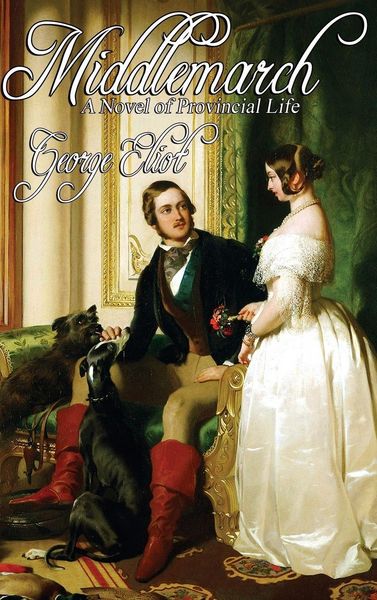
Middlemarch A Study in Provincial Life (Complete One-Volume Edition)
2-
- Hardcover ausgewählt
- Taschenbuch
- eBook
- Hörbuch
-
Sprache:Englisch
- Deutsch Fr. 55.90
- Englisch Fr. 69.90 ausgewählt
-
Verlag:Wildside Press
- Legare Street Press Fr. 46.90
- Quarto Publishing Fr. 36.90
- Random House N.Y. Fr. 46.90
- KNV Besorgung Fr. 26.90
- Union Square & Co. Fr. 49.90
- Vintage Books UK Fr. 36.90
- Vermilion Fr. 29.90
- Arcturus Publishing Limited Fr. 46.90
- Ingram Publishers Services Fr. 55.90
- Arcturus Publishing Ltd Fr. 38.90
- Penguin US Fr. 29.90
- British Library, Historical Print Editions Fr. 52.90
- Macmillan Publishers International Fr. 23.90
- Creative Media Partners, LLC Fr. 46.90
- Simon & Brown Fr. 61.90
- Wildside Press Fr. 69.90 ausgewählt
- Penguin Books Ltd Fr. 29.90
Fr. 69.90
inkl. gesetzl. MwSt.,
Beschreibung
Produktdetails
Einband
Gebundene Ausgabe
Erscheinungsdatum
13.05.2026
Verlag
Wildside PressSeitenzahl
622
Maße (L/B/H)
23.5/15.7/4.1 cm
Gewicht
1147 g
Sprache
Englisch
ISBN
978-1-4794-0510-7
Middlemarch: A Study of Provincial Life is a 1874 novel by English author George Eliot, the pen name of Mary Anne Evans. It is her seventh novel, begun in 1869 and then put aside during the final illness of Thornton Lewes, the son of her companion George Henry Lewes. During the following year Eliot resumed work, fusing together several separate stories into a coherent whole, and during 1871-72 the novel was serialized. A one-volume edition was published in 1874 and sold well.
Subtitled "A Study of Provincial Life", the novel is set in the fictitious Midlands town of Middlemarch, which is thought to be based on Coventry, during the period 1830-32. It has multiple plots with a large cast of characters and distinct, though interlocking narratives. The main themes, include the status of women, the nature of marriage, idealism, self-interest, religion, hypocrisy, political reform, and education. The pace is leisurely, the tone is mildly didactic (with occasional authorial comment).
Although Middlemarch has some comical elements, it is a work of realism. Through the voices and opinions of different characters we become aware of various issues of the day: the Great Reform Bill, the beginnings of the railways, the death of King George IV, and the succession of his brother, the Duke of Clarence (who became King William IV). The novel also provides insight into the state of contemporary medical science and the deeply reactionary mindset found within a settled community facing the prospect unwelcome change.