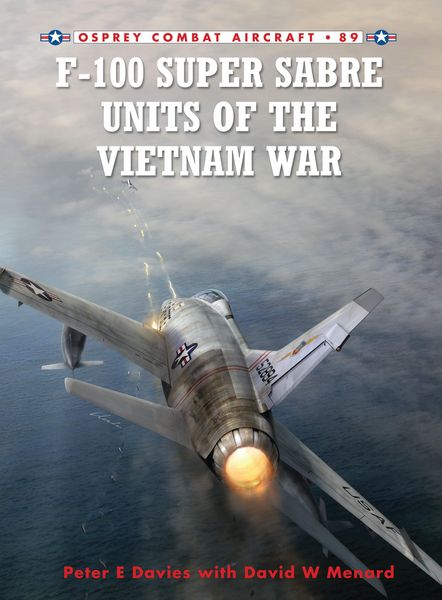
Produktbild: F-100 Super Sabre Units of the Vietnam War

F-100 Super Sabre Units of the Vietnam War

Fr. 18.90

inkl. gesetzl. MwSt.

Beschreibung

Produktdetails

Format

ePUB

Kopierschutz

Ja

Family Sharing

Nein

Text-to-Speech

Ja

Erscheinungsdatum

20.11.2012

Illustriert von

Rolando Ugolini

Verlag

Bloomsbury eBooks UK

Seitenzahl

96 (Printausgabe)

Auflage

1. Auflage

Sprache

Englisch

EAN

9781782006992

Beschreibung

Produktdetails

Format

ePUB

eBooks im ePUB-Format erlauben eine dynamische Anpassung des Inhalts an die jeweilige Display-Größe des Lesegeräts. Das Format eignet sich daher besonders für das Lesen auf mobilen Geräten, wie z.B. Ihrem tolino, Tablets oder Smartphones.

Kopierschutz

Ja

Zum Lesen dieses eBooks auf Geräten der tolino Familie sowie auf sonstigen eReadern und am PC benötigen Sie eine Adobe ID. Weitere Hinweise zum Lesen von kopiergeschützten eBooks finden Sie unter Hilfe/Downloads.

Family Sharing

Nein

Mit Family Sharing können Sie eBooks innerhalb Ihrer Familie (max. sechs Mitglieder im gleichen Haushalt) teilen. Sie entscheiden selbst, welches Buch Sie mit welchem Familienmitglied teilen möchten. Auch das parallele Lesen durch verschiedene Familienmitglieder ist durch Family Sharing möglich. Um eBooks zu teilen oder geteilt zu bekommen, muss jedes Familienmitglied ein Konto bei Thalia oder einem anderen tolino-Buchhändler haben. Weitere Informationen finden Sie unter Hilfe/Family-Sharing.

Text-to-Speech

Ja

Bedeutet Ihnen Stimme mehr als Text? Mit der Funktion Text-to-Speech können Sie sich im tolino webReader und in der aktuellen Thalia – Lesen & Hören App das eBook vorlesen lassen. Weitere Informationen finden Sie unter Hilfe/Text-to-Speech.

Barrierefreiheit

  • keine Information zur Barrierefreiheit bekannt

Erscheinungsdatum

20.11.2012

Illustriert von

Rolando Ugolini

Verlag

Bloomsbury eBooks UK

Seitenzahl

96 (Printausgabe)

Auflage

1. Auflage

Sprache

Englisch

EAN

9781782006992

Noch keine Bewertungen vorhanden

Verfassen Sie die erste Bewertung zu diesem Artikel

Helfen Sie anderen Kundinnen und Kunden durch Ihre Meinung.

Kundinnen und Kunden meinen

Bewertungen (0)

Weitere Artikel finden Sie in

Die Leseprobe wird geladen.
  • Produktbild: F-100 Super Sabre Units of the Vietnam War
  • Chapter 1 A very brief account of the design philosophy and development of the aircraft from the F-100A day fighter driven by Korean War needs, through the F-100C which provided Tactical Air Command's contribution to the nuclear deterrent, to the improved F-100D, the workhorse for Tactical Air Command world-wide and its war-horse in South Vietnam. Early deployments to Don Muang Airport, Thailand, in April 1961 in response to Pathet Lao incursion are followed by squadron-size deployments to Takhli RTAFB in 1962 and the first combat missions from Da Nang, South Vietnam, in June 1964. Chapter 2 In response to the Gulf of Tonkin incident, more F-100Ds fly escort missions from Da Nang for reconnaissance flights over Laos and South Vietnam. Combat air patrols over the Gulf of Tonkin bring many near-engagements with MiGs, while the first loss on an attack mission in Laos occurs in August 1964. Super Sabres begin Operation Barrel Roll missions, including hazardous attacks on anti-aircraft sites, and fly fighter cover and flak suppression for F-105 strikes in Operation Flaming Dart. In November 1965 Operation Rolling Thunder involves three squadrons of F-100s as MiGCAP and flak suppression elements. F-100D pilot Lt Hayden Lockhart becomes the first USAF prisoner of war in Hanoi. Attacks on the Than Hoa and Ham Rong Bridges involve five flights of F-100s and a probable MiG kill for Capt Kilgus. F-4C Phantom IIs arrive and replace F-100s in the MiGCAP role. Chapter 3 Four airbases are built or expanded in South Vietnam to house three tactical fighter wings equipped with F-100s for the 'in-country' war, leaving only five F-100 squadrons in the USA. Intensive close-support missions are flown, including challenging night missions over the Ho Chi Minh trails. Pilots pride themselves on their accuracy and the frequency of their missions. The chapter will discuss the F-100's flying and fighting characteristics and the conditions and support networks at the relevant airbases. Chapter 4 The conversion of F-100F airframes provided the USAF with its first Wild Weasels, pioneering SEAD techniques that are still in use and developing the equipment to defeat enemy radars and radar-guided missiles and guns. Training is carried out in great secrecy and four modified F-100Fs begin to operate from Korat RTAFB with F-105 bombers, destroying heavily defended SAM sites close to Hanoi. Missions continue until July 1966. Chapter 5 'Misty' FAC The Commando Sabre detachment at Phu Cat AB provides high-speed FAC for air strikes from 1967 to May 1970, flying some of the most dangerous missions of the war and suffering heavy losses. They also fly combat air patrols for rescue missions searching for aircrew shot down in hostile territory. Once again the F-100 and its crews develop and introduce new battle techniques that are still part of today's aerial warfare tactics. Appendices: F-100 deployments to Southeast Asia: units, dates and bases, with commanding officers listed. F-100 specifications, performance and armament details F-100 combat losses.