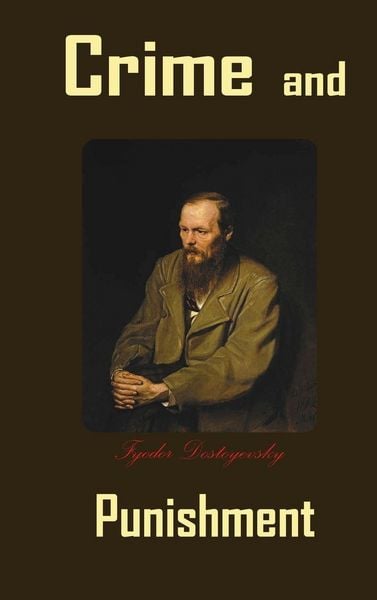
Crime and Punishment
7-
- Hardcover ausgewählt
- Taschenbuch
- Besondere Ausgabe
- eBook
- Hörbuch
- Sonstiges
-
Sprache:Englisch
- Deutsch Fr. 16.90
- Englisch Fr. 44.90 ausgewählt
-
Verlag:Ancient Wisdom Publications
- Hachette Book Group USA Fr. 35.90
- Random House N.Y. Fr. 28.90
- Quarto Publishing Group Fr. 29.90
- Carlton Publishing Fr. 25.90
- Ingram Publishers Services Fr. 43.90
- Chiltern Publishing Fr. 38.90
- Chelsea House Fr. 31.90
- Infinity Spectrum Books Fr. 39.90
- Everyman's Library Hardback Fr. 29.90
- Insel Fr. 24.90
- Weldon Owen Fr. 24.90
- Arcturus Press Fr. 37.90
- Oxford University Press Fr. 29.90
- Macmillan Publishers International Fr. 23.90
- Ancient Wisdom Publications Fr. 44.90 ausgewählt
- Quarto Publishing Plc IWUK Fr. 19.90
- Prakash Books India Private Limited Fr. 31.90
- Benediction Classics Fr. 43.90
- Simon & Brown Fr. 39.90
- Gröls Verlag Fr. 39.90
Fr. 44.90
inkl. gesetzl. MwSt.,
Beschreibung
Produktdetails
Einband
Gebundene Ausgabe
Erscheinungsdatum
12.05.2015
Verlag
Ancient Wisdom PublicationsSeitenzahl
464
Maße (L/B/H)
23.5/15.7/2.9 cm
Gewicht
817 g
Sprache
Englisch
ISBN
978-1-940849-34-8
Crime and Punishment focuses on the mental anguish and moral dilemmas of Rodion Raskolnikov, an impoverished ex-student in St. Petersburg who formulates and executes a plan to kill an unscrupulous pawnbroker for her cash. Raskolnikov argues that with the pawnbroker's money he can perform good deeds to counterbalance the crime, while ridding the world of a worthless vermin. He also commits this murder to test his own hypothesis that some people are naturally capable of such things, and even have the right to do them. Several times throughout the novel, Raskolnikov justifies his actions by comparing himself with Napoleon Bonaparte, believing that murder is permissible in pursuit of a higher purpose. Dostoyevsky conceived the idea of Crime and Punishment in the summer of 1865, having gambled away much of his fortune, unable to pay his bills or afford proper meals. At the time the author owed large sums of money to creditors, and was trying to help the family of his brother Mikhail, who had died in early 1864. Projected under the title The Drunkards, it was to deal "with the present question of drunkness ... [in] all its ramifications, especially the picture of a family and the bringing up of children in these circumstance, etc., etc." Once Dostoyevsky conceived Raskolnikov and his crime, now inspired by the case of Pierre François Lacenaire, this theme became ancillary, centering on the story of the Marmeladov family.