Band 8989
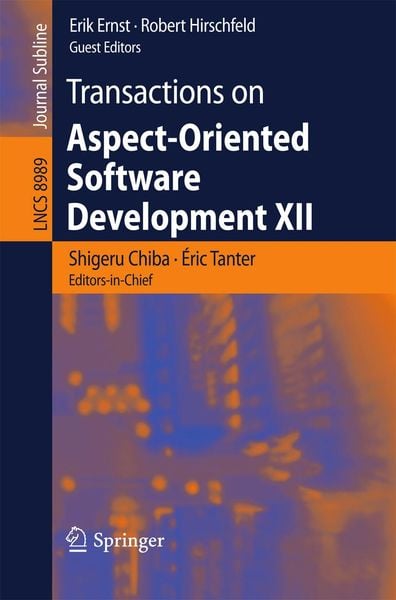
Transactions on Aspect-Oriented Software Development XII
Aus der Reihe
Lecture Notes in Computer Science
-
- Taschenbuch
- eBook ausgewählt
-
Form:Einzelkauf Download
-
Sprache:Englisch
Fr. 62.90
inkl. gesetzl. MwSt.Beschreibung
Produktdetails
Format
ePUB
Kopierschutz
Nein
Family Sharing
Nein
Text-to-Speech
Ja
Erscheinungsdatum
19.03.2015
Herausgeber
Shigeru Chiba + weitereVerlag
SpringerSeitenzahl
221 (Printausgabe)
Dateigröße
23104 KB
Auflage
2015
Sprache
Englisch
EAN
9783662467343
The LNCS journal Transactions on Aspect-Oriented Software Development is devoted to all facets of aspect-oriented software development (AOSD) techniques in the context of all phases of the software life cycle, from requirements and design to implementation, maintenance and evolution. The focus of the journal is on approaches for systematic identification, modularization, representation, and composition of crosscutting concerns, i.e., the aspects and evaluation of such approaches and their impact on improving quality attributes of software systems.
This volume, the 12th in the Transactions on Aspect-Oriented Software Development series, contains one regular paper, on modular reasoning in aspect-oriented languages from a substitution perspective, and four extended, improved papers selected from those presented at Modularity 2014. Topics covered include novel dynamic semantics through delegation proxies, modularity potential detection based on co-change clusters, improvements in reusability for components of semantic specifications of programming languages, and probabilistic model checking applied to dynamically generated members of a product line.
This volume, the 12th in the Transactions on Aspect-Oriented Software Development series, contains one regular paper, on modular reasoning in aspect-oriented languages from a substitution perspective, and four extended, improved papers selected from those presented at Modularity 2014. Topics covered include novel dynamic semantics through delegation proxies, modularity potential detection based on co-change clusters, improvements in reusability for components of semantic specifications of programming languages, and probabilistic model checking applied to dynamically generated members of a product line.
Noch keine Bewertungen vorhanden
Verfassen Sie die erste Bewertung zu diesem Artikel
Helfen Sie anderen Kundinnen und Kunden durch Ihre Meinung.